


The harsh reality of Britain’s spiralling inflation hit home in the frosty days before Christmas when I ran out of oil to heat my family home.
I live in a small village in West Sussex in the south of England, where most of the homes have an oil tank outside that has to be filled up by delivery.
As new owners, we were unaware that the gauge was faulty — telling us the tank was half-full when it was empty. It meant ordering emergency oil — double the cost of a regular fill up, which was already expensive as oil prices hit seven year highs.
Retreating into my study, I calculated exactly how the flow of money into the household account was being spent every month, but there was a bigger purpose to this exercise: I needed to prepare our finances for a difficult year ahead.
Headlines such as “cost-of-living catastrophe”, “energy crisis”, “higher bills” and “inflation set for a 30-year-high” are hard to ignore when you write them on a daily basis.
As Myron Jobson, senior personal finance analyst at interactive investor, pointed out: “No one is immune to the cost-of-living squeeze, but it will feel like a stranglehold for the poorest households who already struggle to make ends meet.”
While annual inflation rose to 5.4 per cent in December, a three-decade high according to the Office for National Statistics, the Bank of England expects the figure to hit 7.25 per cent in April, and average close to 6 per cent across the whole of 2022 — the fastest price growth since 1991 and well above the central bank’s 2 per cent target.
Analysts at Capital Economics expect a higher figure of 7.5 per cent, once last week's double blow of higher energy prices and higher interest rates hit households in April.
On Thursday, the UK energy regulator Ofgem raised the price cap — the maximum suppliers are allowed to charge in a year — by £693, while the Bank of England increased interest rates to 0.5 per cent from 0.25 per cent as it expects prices to rise faster than pay.
Throw in tax rises after the government decided to push ahead with its rise in National Insurance contributions from April — with workers set to pay an extra 1.25 per cent a year — and the cumulative effect will see households £1,200 a year worse off from April, according to the UK think tank, the Resolution Foundation.
After a winter of discontent, “April is set to be the cruellest month in decades for household finances”, said Mr Jobson.
“Creeping inflation, a national insurance hike and a new bumper energy price cap have conspired to create a perfect storm — and a financial headache for many. Even those not scraping by with skin-of-the-teeth survival will now be on red alert as interest rates creep up.”
Food inflation is worse than consumers realise
An easy example of the trouble ahead can be found in supermarket bills. Look closely at the typical trolley and the price of margarine rose 27.3 per cent in December on the year before, while roasting beef was up 28.6 per cent and oils and fats rose 13.1 per cent.
Any shopper trawling the aisles already knows that food inflation on some products is even higher because not everything makes it into the basket of goods the ONS uses to measure inflation.
The statistics body is now widening the number of products it tracks to give a more accurate picture following criticism from food blogger and campaigner Jack Monroe who said poorer consumers were being hit harder because rises in the prices of essentials was much greater than food prices at large.
I’m tackling the food price rises head on by using a scanner on my local supermarket’s app to track my weekly spending — putting any expensive luxuries back if they tip me over my budget.
It sounds extreme, but I’m one of the lucky ones. Even considering putting the children's favourite brand of ice cream into the trolley is not an option for some in these constrained times.
I have noticed far more scanners around the supermarket aisles in recent weeks as others adopt a similar defensive strategy to buffer their finances against the inevitable blows to come.

Bank of England governor Andrew Bailey said last week that the rising cost of living would not ease until 2023, with many people facing a “difficult period” ahead with “a reduction in real income".
“We're going to start coming out of it in 2023, and two years from now, we expect inflation back to a more stable position,” he said.
The Bank expects post-tax incomes to fall by 2 per cent this year, as a result of the rising cost of living — the biggest fall in living standards since records began in 1990 — and a hit to incomes five times worse than in the aftermath of the financial crisis.
While some analysts said the Bank’s rate rise decision indicated the lender was now in a hawkish mood and finally taking inflation seriously, “many will ask what took so long,” said Laith Khalaf, head of investment Analysis at AJ Bell.
Higher energy prices are fuelling inflation
There is no doubt that energy prices are the main driver of this crisis, with the 54 per cent increase on the price cap taking bills to a maximum £1,971 a year from April for millions who pay a default tariff for gas and electricity.
The increase in energy bills was swiftly followed by Chancellor of the Exchequer Rishi Sunak’s speech detailing how the government would help cushion the blow through a £9 billion package that will allow all customers to get a £200 discount on bills from October.

However, that will be financed by loans underwritten by the government and repaid by households in annual £40 instalments over five years — with expectations that one in six UK households will not be able to afford consistent heat and electricity when the price rise comes into force.
The cause of this problem is the global leap in the price of natural gas, which has almost quadrupled in the past year, reaching a record in December.
The cap level is determined by wholesale prices over the previous six months, creating a time lag between when the energy is bought by suppliers and sold to consumers. That can cause “large, hard-to-avoid losses for suppliers, which can ultimately lead to higher prices for consumers”, Ofgem said.
While the Band of England is adamant the current cost-of-living crisis is temporary, driven largely by the pandemic-induced energy crisis and supply chain bottlenecks that become a dominant feature of last year, some analysts are less convinced.
“Four members [of the Monetary Policy Committee} voted to raise rates by 50 basis points,” said James Lynch, fixed income investment manager at Aegon Asset Management.
“It sounds like those four are bit more worried.”
How long will the cost-of-living crisis last?
How long the household squeeze lasts depends on how the inflationary forces driving Consumer Price Inflation higher evolve, said Stuart Cole, chief macroeconomist at brokerage Equiti Capital.
“At the moment we are largely seeing cost-push pressures. This is not really inflation per se, but rather an increase in some prices. If CPI could measure every single product and service available for sale in the UK I doubt the headline rate would be as high as it is,” he said.
While he agrees that the rising cost of energy is the biggest factor to consider, the higher prices will eventually drop out of the annual calculation, causing inflation to fall even if the Bank had not taken any action.
“The concern, however, is if high CPI translates into high wages growth. This is what the BoE is worried about.”

Workers are currently receiving pay rises of just below 5 per cent on average, according to a Bank survey, and Mr Bailey has urged employees not to ask for too big a pay rise this year as this will only exacerbate the problem.
Restraint on pay would prevent the inflationary spike from becoming embedded in the economy, Mr Bailey said.
How will this impact economic growth?
While Britain’s economy surpassed pre-pandemic levels for the first time in November after growing by a stronger-than-expected 0.9 per cent — making it 0.7 per cent larger than in February 2020 before the first lockdown was imposed in the UK — analysts expect a lower rate of growth in future.
December’s gross domestic product figures, due later this week, are predicted by Capital Economics to show the economy contracted by 0.5 per cent in December, partly owing to restrictions imposed during the Omicron wave of the coronavirus, according to Capital Economic.
“Going forward, I think we have two main battles in play: the dampening impact of a simultaneous tightening in both fiscal and monetary policy against the stimulatory impacts of a stronger than expected labour market recovery and the ability households have to draw down on the excess stock of savings built up over the pandemic to maintain current consumption levels,” said Mr Cole.
Interest rates are expected to rise further this year, to 1.25 per cent by the end of 2022, and perhaps rise even higher in 2023, according to Capital Economics, with a high chance those increases come sooner than expected as the MPC looks to quash inflation.
Mr Cole is upbeat, however, supporting Mr Bailey’s position that the high and volatile inflation rates will drop off as energy prices reduce later in the year.
“The excess stock of household savings is sufficient to offset at least partially this impact while much of the extra tax take — the NI increase — will be a redistribution of spending rather than a removal of spending power per se,” said Mr Cole. He said growth would slow, dropping about 0.5 per cent from pre-pandemic annual rates of 2 to 2.5 per cent.
Mr Bailey said the fast growth seen over the past year stemmed from the huge downturn in 2020, when annual output dropped 9.9 per cent.
“We're going back to a period of much slower growth. We would be going back anyway, because we can't sustain the recovery level that we've had,” he said.
Can inflation go even higher than expected?
One thing that could tip inflation into even higher territory, however, is the risk of war with Ukraine, something Mr Bailey is already acutely aware of, as rising energy and transport costs have already been such a big driver behind inflation so far.
“If we were to get conflict in the Ukraine, because of its strategic significance in the supply of gas from Russia to Europe, that I'm afraid would probably push the prices up,” he said.
-

Russian and Belarus troops held joint combat training at firing ranges in Belarus as tensions remain high under the looming threat of war with Ukraine. AP Photo -

A soldier drives an armoured vehicle at Brestsky firing range, Belarus. AP Photo -
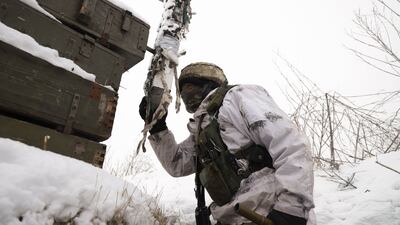
A Ukrainian serviceman carries out checks not far from the pro-Russian militant-controlled city of Donetsk, Ukraine. EPA -

A Russian military vehicle drives off a railway platform after arriving in Belarus. AP Photo -

A soldier takes aim during a Russian and Belarusian military drill at Brestsky firing range. AP Photo -

A Ukrainian serviceman repairs a shelter near Donetsk, Ukraine. EPA -

Aircraft are lined up on 'USS Harry S Truman' in the Adriatic Sea. The Truman strike group is operating under Nato command and control along with several other Nato allies for co-ordinated maritime manoeuvres, anti-submarine warfare training and long-range training. Reuters -

Russian soldiers attend the Yurginsky training ground in the Kemerovo region, Russia. AP Photo -

A Ukrainian serviceman lays flowers where one of his friends was killed in 2017 near Avdiivka. Anatolii Stepanov / AFP -

A Ukrainian serviceman stands guard in a dugout on the frontline with the Russia-backed separatists near Avdiivka. AFP -

This satellite image shows troops gathered at a training ground in Pogonovo, Russia. AP Photo


If hostilities in Ukraine fail to materialise, Mr Cole expects a much brighter future with inflation set to ease once it passes the April peak.
For some, however, the pain has already started, with the 850,000 UK mortgage holders on a variable rate deal already feeling the heat of higher payments because theirs is linked to the Bank of England’s base rate.
Personal finance expert Mr Jobson advises those on a fixed rate to secure new deals now as mortgage offers can remain valid for a number of months.
His other tip is for everyone preparing for the April hit to evaluate their expenditure and look for ways to reduce spending.
“Even simple things such as opting to purchase a store brand equivalent of traditional larder products can help to cut down the cost of groceries,” he said.
The chairman of Tesco, John Allan, has waded in on the cost-of-living debate, urging consumers to ignore sell-by dates on food and keep their bread in the fridge to ensure it lasts longer.
I’ve been doing that one for years, Mr Allan, even going one step further and keeping it in the freezer — a habit adopted during my days living in the UAE where food could spoil more quickly due to the heat.
So far, my 2022 household budget is working out, but it is only the start of month two and the biggest hits are yet to come.
Budgeting was another tactic I employed during my days living in the Emirates. Then it was a way to ensure we hit our savings goals, now it is essential to make sure we live within our means.
My husband has taken my stern warning on our financial future too far, however. As somebody who does not feel the cold, he switches the heating off the moment I remove one of the many layers of clothing I wear these days to ward off the freezing temperatures.
When I call him “the heating tsar”, he retorts with “it’s eating or heating” and in this cost-of-living squeeze, he certainly has a point.

