

Live updates: Follow the latest on Israel-Gaza
Israeli Prime Minister Benjamin Netanyahu on Tuesday said the military would “finish the job” of destroying Hamas in the southern Gaza city of Rafah while allowing civilians to leave, as US leaders warn against such a move.
“We will finish the job in Rafah while enabling the civilian population to get out of harm’s way,” Mr Netanyahu told lobby group the American Israel Public Affairs Committee by video link.
He said the Israeli military has “taken measures to minimise civilian casualties that no other army has taken in history”, although he did not say how.
US President Joe Biden has warned Israel not to attack the southern Gaza city of Rafah without a clear plan to protect civilians, calling it a “red line” for continued support by Washington.
More than a million Palestinians have been forcibly displaced from other northern parts of the Gaza Strip to Rafah, which borders Egypt.
The White House on Monday said Israel has not presented a “credible and implementable” plan for a Rafah operation.
Mr Netanyahu claims that the southern city is one of the last spots for forces to defeat Hamas, the group behind the deadly attack on Israeli soil in October last year, which Israel says resulted in the killings of about least 1,200 people.
-

More than one million displaced Palestinians are living in makeshift camps in Rafah, only metres from the border fence with Egypt. Reuters -

The border looms large in the everyday lives of Palestinians in Rafah. AFP -
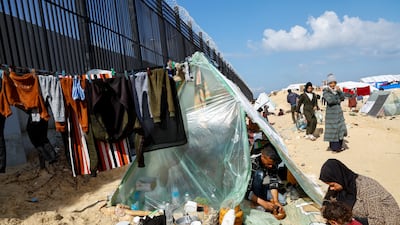
Conditions on the border are dire as Palestinians living in tents not only face starvation, but also lack fuel and electricity. Reuters -
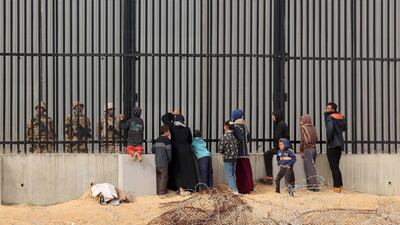
Egyptian authorities fear that an Israeli assault on the border city could force increasingly desperate Palestinians to seek safety by entering Egypt. AFP -
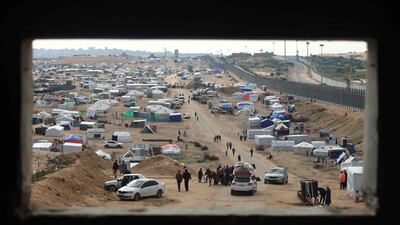
More than half of Gaza's population of 2.3 million people is already pushed up against the border. AFP -

Rafah is the main entry point for aid into Gaza, as the enclave's only border crossing that does not involve travel to or from Israel. Reuters -
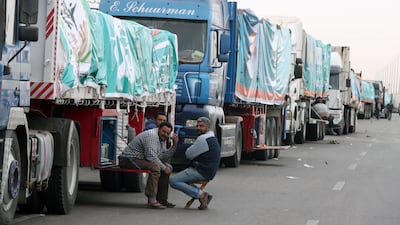
Large convoys of lorries carrying aid are frequently stuck at Rafah as a result of Israeli restrictions on how much aid can enter Gaza since the outbreak of the war in October. EPA -

Egyptian authorities have ordered the construction of a logistics zone they say is to receive aid in Rafah. Reuters -
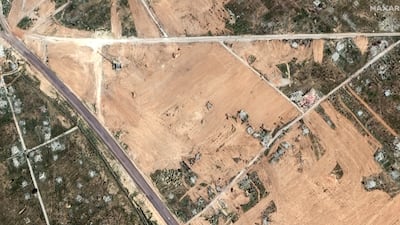
Satellite images show construction on the Egyptian side of the border. Maxar Technologies via Reuters -

Sources say authorities are constructing a walled area on the Egyptian side of the border to prepare for a potential influx of Palestinians. Reuters -
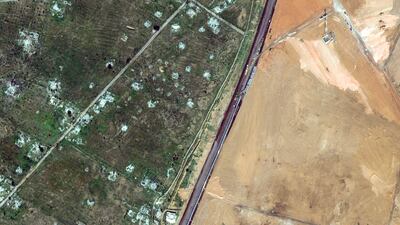
A satellite image shows the construction of a new wall along the Egypt-Gaza border. Maxar Technologies via Reuters -

Egyptian President Abdel Fattah El Sisi has repeatedly said that Egypt will not readily accept the displacement of Palestinians into Egypt. Reuters


Israel has conducted retaliatory actions in the months since, with damage forcing Palestinians out of their homes, and at least 31,100 people killed, according to the Gaza health authorities.
“For Israel, every civilian death is a tragedy," Mr Netanyahu said. "For Hamas, every civilian death is a strategy.
"So it is wrong and immoral to hold Israel to a standard for avoiding civilian casualties that no other country on Earth is held to.
“My friends, I want to assure you, none of these pressures will stop us.”
Some Senate Democrats are calling for the President to follow through on his “red line” comment.
If Israeli action takes place in Rafah, US officials told Politico that Mr Biden would consider limiting military aid.
Axios quoted US officials as saying the Biden administration is considering restrictions on US military aid to Israel or amending American support for ceasefire resolutions at the UN if the “red line” is crossed.
Senator Chris Van Hollen told Politico that Congressional action to halt military aid is “certainly something that’s on the table”.

