


The administration of US President Joe Biden has ratcheted up its rhetoric towards Israel in recent months, culminating in its description of the killing of a 19-year-old Palestinian by an Israeli settler as a “terror attack”.
Washington has historically reserved the word “terror” to describe the actions of Palestinians towards Israelis, and the reversal this week marks a significant moment in US-Israel relations.
“I think this was a very deliberate decision on the part of the administration to show its deepening concern over where the policies of this coalition government are headed, not only internally, domestically, in terms of the rule of law but also in terms of the decisions that they're taking and encouraging in terms of the occupied territories,” said Edward Djerejian, a former US ambassador to Israel during the Bill Clinton administration.
The far-right government of Israeli Prime Minister Benjamin Netanyahu – which includes high-profile cabinet ministers that openly express the desire to annex the West Bank – has strained the US-Israel relationship and frustrated the Biden administration, as it puts the hope of a future two-state solution even farther out of reach.
The White House has yet to officially extend an invitation for a visit to Mr Netanyahu, though the two leaders are expected to meet later this year, though a date and location have not been announced.
“The fact that Biden has not invited the recently elected prime minister of Israel to Washington goes beyond all precedent,” Mr Djerejian told The National.
Israel’s controversial judicial reforms, which would remove certain review powers from the Supreme Court and increase the strength of politicians, has deeply troubled Mr Biden.
Israelis protest against judicial overhaul – in pictures
-
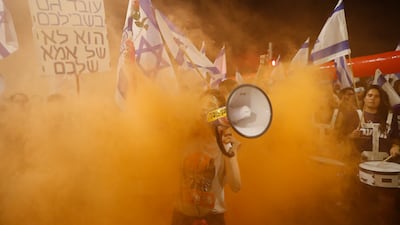
Mass protests continue across Israel against the government's justice system reform plan. EPA -

Anti-government protesters march towards the Israeli Knesset in Jerusalem. EPA -
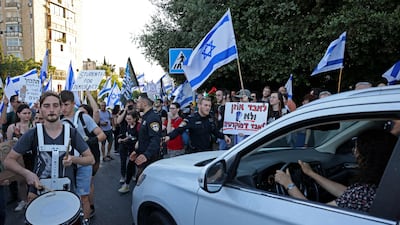
Protesters blocked roads across Israel, hours after parliament adopted a key clause of the government's judicial overhaul package, which opponents say threatens democracy. AFP -
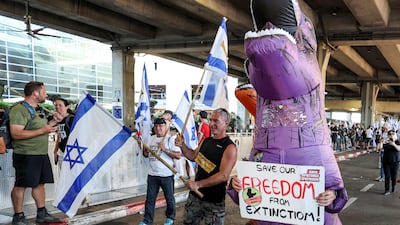
A demonstrator in a dinosaur suit marches at Ben Gurion Airport near Lod. AFP -
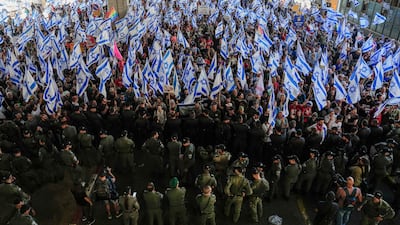
Israelis wave flags during a protest against plans by Prime Minister Benjamin Netanyahu's government to overhaul the judicial system. AP -
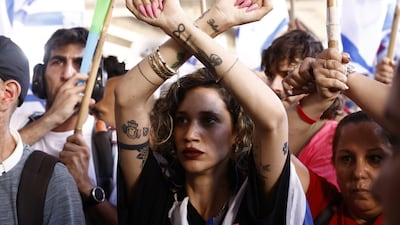
Israelis have taken to the streets en masse to protest against the government’s plans to weaken the power of judges. Bloomberg -

Mass protests continue across the country against the government's justice system reform plan. EPA -
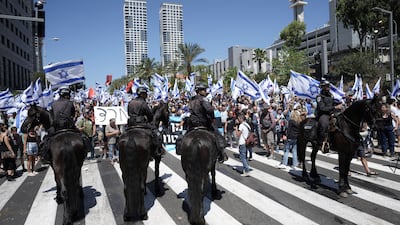
Mounted police in Tel Aviv, Israel, control protesters demonstrating against plans to overhaul the judicial system. AP -
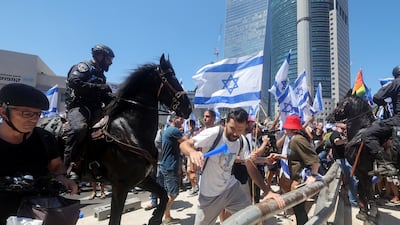
Police and protesters clash on the 'Day of Disruption' opposing the judicial overhaul, in Tel Aviv. Reuters -
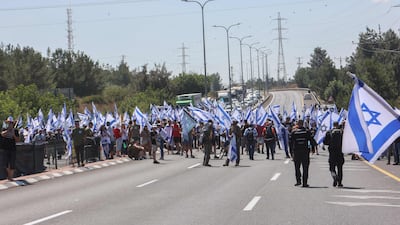
Israeli demonstrators wave flags as they block Highway 443 between Jerusalem and Tel Aviv, near Modiin. AFP -
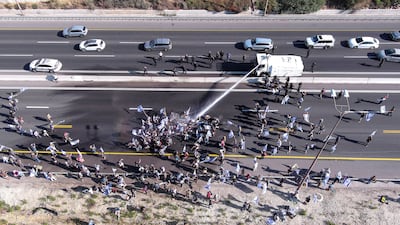
Israeli police use a water cannon against demonstrators at the Ein Hemed junction towards Jerusalem. Reuters -
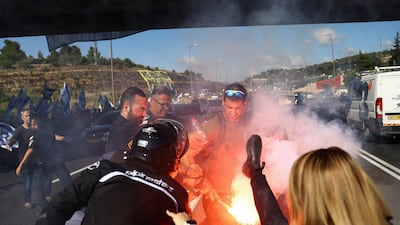
Protesters set off a flare near Jerusalem as they oppose a bill to curb the Israeli Supreme Court's power to void government decisions. Reuters -
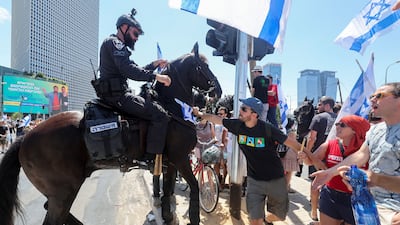
A confrontation in Tel Aviv, Israel, during protests against the move by Prime Minister Benjamin Netanyahu's coalition. Reuters -
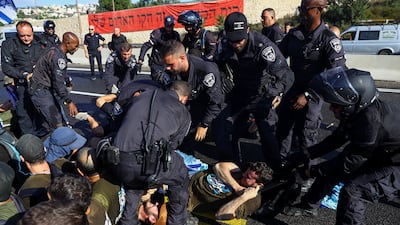
Members of the Israeli security forces remove demonstrators blocking a highway to Jerusalem. Reuters -
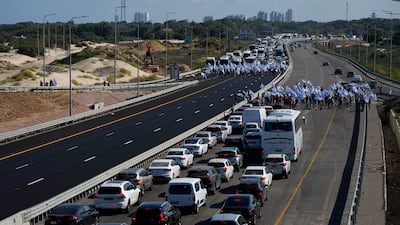
Israeli protesters block the Tel Aviv to Haifa highway near Beit Yanai, Israel. AP -
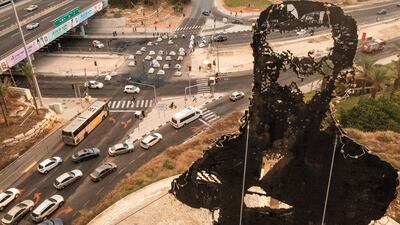
Demonstrators block a road with tents at the entrance to Herzliya, north of Tel Aviv, Israel. Reuters -
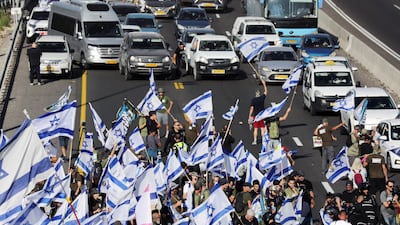
Israeli anti-government protesters block the entrance to Jerusalem, where some demonstrators entered the Knesset building. EPA


He has repeatedly urged Mr Netanyahu to change course and said that he was “very concerned” by the reforms.
Mr Netanyahu delayed the reforms but has ultimately decided to go through with them, much to the chagrin of Washington.
Since Mr Netanyahu returned to power in December 2022, violence between Israeli settlers and Palestinians in the occupied West Bank has intensified.
In the first six months of this year, the UN recorded 591 settler-related incidents against Palestinians, a nearly 40 per cent increase per month from the previous year and the highest number since the UN started tracking settler violence in 2006.
Earlier this year, the Israeli military launched its largest military operation in the West bank in more than two decades, storming the city of Jenin in an effort to root out armed Palestinians following several shooting incidents.
Twelve Palestinians were killed in the raid, including four children. One Israeli soldier was also killed.
The surge in violence from both sides has alarmed observers and while Washington remains quick to support Israel's right to defend itself, officials have been increasingly vocal in condemning settler violence.
“I think you can interpret it that we are gravely concerned about that attack,” said State Department spokesman Matthew Miller.
He said that the tweet sent out by the Department’s Bureau of Near Eastern Affairs “made clear our position on terrorist attacks and made clear our position on extremist settler violence”.
Analysts say that US rhetoric towards Israel has been trending in this direction for some time.
“I was not surprised,” said Ghaith Al Omari, a senior fellow at the Washington Institute for Near Eastern Affairs.
“We've been seeing the administration expressing concern about settler violence for a while now.”
The decision to describe the attack near the village of Burqa as “terror” is important and one the administration is unlikely to have made lightly.
“Words do matter,” said Mr Djerejian.
“Administrations are usually very cautious about what they say in these matters, especially vis-a-vis Israel, but we've seen the hardening of the public rhetoric on a part of the administration.”

