


Long-time foreign policy giant Senator Ben Cardin, once dubbed Washington's “Diplomat-in-Chief”, announced last week that he will not be seeking re-election.
One of the Democratic Party's most ardent advocates of the US-Israel relationship, he departs as the tide slowly turns regarding Congress's and the American public's attitudes towards Israel.
With roots in his home city of Baltimore's thriving Jewish community, the 79-year-old's career spanned 36 years and touched on a wide variety of issues both foreign and domestic. But his leadership on the US-Israel relationship is one many have highlighted as a standout.
“His efforts will continue to shape US foreign policy long after his retirement. He will be greatly missed in the halls of Congress,” Senate foreign relations committee chairman Bob Menendez told The National.
Hadar Susskind, president and chief executive of Jewish-American group Americans for Peace Now, told The National that Mr Cardin's legacy is “to a tee” the “traditional US definition of what it means to be pro-Israel”.
That traditional view is one that sees “no daylight” between the US and Israel and their special relationship, and considers Israel as the closest ally in the Middle East, Mr Susskind said.
That position has historically been a solidly bipartisan one in Washington, and it at times compelled Mr Cardin to cross party lines.
However, recent events have shown that even the close US-Israeli ties aren't necessarily guaranteed.
Mr Cardin criticised the effort by Israeli Prime Minister Benjamin Netanyahu’s far-right government to radically overhaul the judiciary. The proposal triggered days of street protests across Israel.
“Out of love for the people of Israel and our shared values, I am fearful for the future of democracy in Israel as the right-wing Netanyahu government threatens to undermine the essential checks and balances that make democracies work,” Mr Cardin wrote in February.
The overhaul, now on pause, seeks to weaken the Supreme Court and increase the government's role in selecting its judges.
This chaotic moment for Israeli democracy has “clearly been uncomfortable” for Mr Cardin, argues Mr Susskind, and for Americans like him who have been “deeply uncomfortable” criticising Israel over the years.
Attitudes towards Israel and Palestine are undergoing a sea change in the US, where a reckoning in Washington is under way over democratic threats in Israel and more Americans come to terms with its rights abuses against Palestinians.
In 2001, Gallup polling showed that only 16 per cent of Americans sympathised more with Palestinians, while 51 per cent sympathised more with Israelis.
Polling this year shows sympathy towards Palestinians has almost doubled to a new high of 31 per cent.
There was a larger surge among Democrats, who polled at 49 per cent more sympathetic towards the Palestinian people.
And Mr Cardin's retirement comes at moment of change for Congress, as more and more representatives and senators are speaking out for Palestinians.
“Those people who share [Mr Cardin's] views on that special relationship, and 'no daylight' and all that, that opinion is not increasing,” Mr Susskind said.
“The Senate is changing, and I think it was going to change whether [Mr Cardin] was in it or not. But certainly this generational change becomes part of that story.”
Ben Cardin's work on MENA issues
-
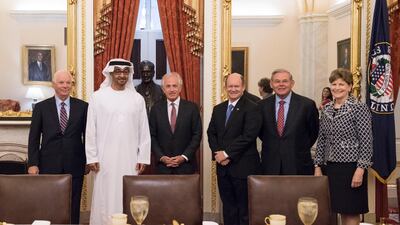
US Senator Ben Cardin, far left, with UAE President Sheikh Mohamed, then Crown Prince of Abu Dhabi, before a Capitol Hill lunch with other senators. Rashed Al Mansoori / Crown Prince Court Abu Dhabi -
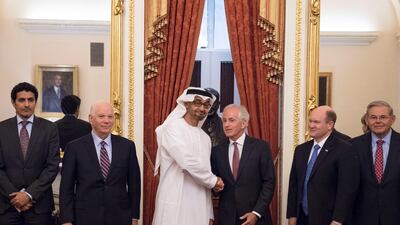
Leading senators have called Mr Cardin, pictured with Sheikh Mohamed, 'a tireless proponent for peace in the Middle East'. Rashed Al Mansoori / Crown Prince Court Abu Dhabi -
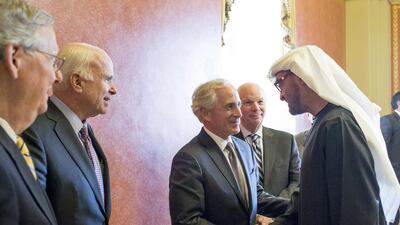
Sheikh Mohamed greets US senators Bob Corker, Mitch McConnell, John McCain and Mr Cardin. Ryan Carter / Crown Prince Court Abu Dhabi -
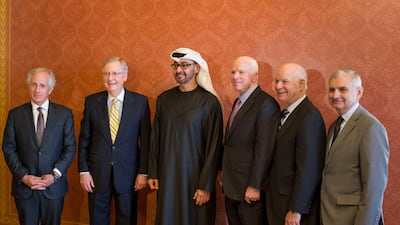
Mr Cardin joins a bipartisan group of top US senators for a meeting with Sheikh Mohamed. Ryan Carter / Crown Prince Court Abu Dhabi -
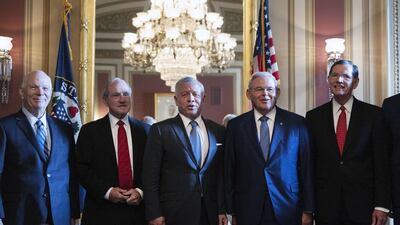
Mr Cardin, far left, joins King Abdullah II of Jordan and other Senate foreign policy leaders for a breakfast meeting at the US Capitol in 2021. -

King Abdullah with US Senator Bob Menendez, second right, and Mr Cardin at the Capitol in Washington in May 2022. AFP -
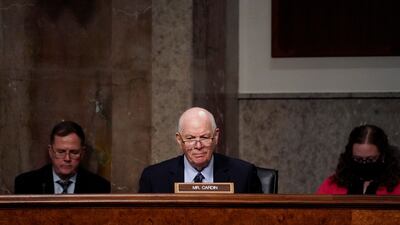
Mr Cardin listens to testimony during a Senate foreign relations committee hearing about US policy on Turkey in July 2021. Reuters -
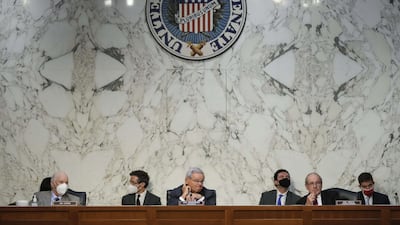
Mr Cardin, foreign relations committee chairman Mr Menendez and ranking member Senator James Risch on Capitol Hill in August 2021 for a hearing on repealing authorisation for military activity in Iraq. Getty / AFP -
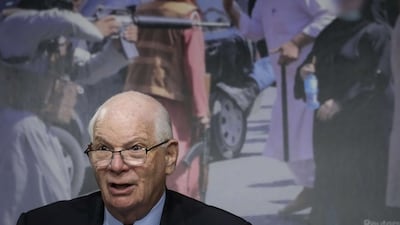
Mr Cardin questions Secretary of State Antony Blinken during a committee hearing in September 2021 in about the Biden administration's handling of the US withdrawal from Afghanistan. Getty / AFP -
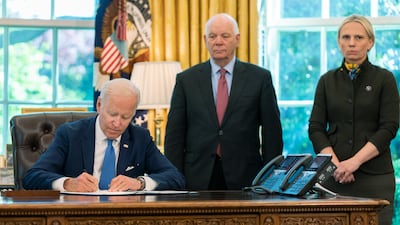
US President Joe Biden signs the Ukraine Democracy Defence Lend-Lease Act in the Oval Office of the White House in May 2022, with Mr Cardin and Ukraine-born House member Victoria Spartz. AP -
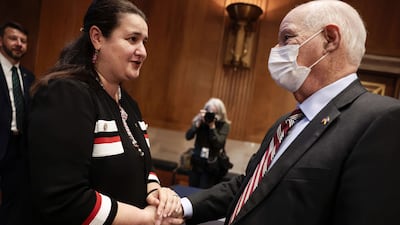
Ukraine's ambassador to the US, Oksana Markarova, greets Mr Cardin before a hearing with the Helsinki Commission in March 2022 in Washington. Getty / AFP


Senate foreign relations committee ranking member Jim Risch told The National that Mr Cardin “has worked to fight corruption and promote human rights … and is a tireless proponent for peace in the Middle East. His leadership will be missed”.
Among one of his most noted moments, Mr Cardin became a rare Democratic senator to break party lines and vote against former president Barack Obama's landmark Iran nuclear deal — the Joint Comprehensive Plan of Action — in 2015.
Once former president Donald Trump took office and pulled Washington out of the deal, Mr Cardin ultimately spoke out against withdrawal.
He wrote in 2018 that “President Trump has breathed air into Tehran’s inevitable argument to the international community: We kept our end of the deal, but America is not good for its word and cannot be trusted.”
Sean Bartlett served as Mr Cardin's communications director and spokesman during that hectic moment in foreign policy. He said that Mr Cardin ultimately became “one of the most adamant and clear voices that the JCPOA was working”, he told The National.
“I was proud that despite his ultimate opposition to the JCPOA, he found a way to set any personal or political feelings aside, understand the policy was working, and become an ardent defender of what was in the best interest of the US,” Mr Bartlett added.
In 2017, Mr Cardin co-sponsored the Israel Anti-Boycott Act, which would have cracked down on the Boycott, Divest, Sanction Palestinian rights movement, aimed at boycotting illegal Israeli settlements in the West Bank.
The bill never passed, amid Democratic concern about its threat to free speech rights.
The veteran senator had been associated with the stalwartly pro-Israel American Israeli Public Affairs Committee, but stirred some discussion when in 2018 he spoke at the group's more progressive Jewish-American rival, J Street.

