


Mexican drug cartels are not only recruiting their own countrymen for their ranks — they are also drawing in Americans, including current and former members of the military.
A report released by Mexican news agency Milenio last week revealed that, since 2020 alone, the US has detained about 700 people linked to various cartels and criminal groups operating in the country, among them American citizens and soldiers.
Jonathan Zarazua, Emmanuel Oppongagyare and Ralph Gregory Saint-Joie — all active-duty members of the US military — were convicted in 2021 on drug and human trafficking charges.
Oppongagyare, a National Guardsman, and Saint-Joie, of the US Army, were discovered trafficking two migrants in the boot of a car, having been directed by a third party to carry out the crime while in uniform to deflect suspicion.
Zarazua, a National Guardsman, was caught trying to cross the border from the Mexican city of Matamoros to Brownsville, Texas, with several kilos of cocaine, something he had done up to 30 times before, according to the US Attorney's Office of the Southern District of Texas. He also claimed that he had been recruited to traffic cocaine specifically due to his military background.
Last year, Angel Dominguez Ramirez Jr, a former marine who holds both American and Mexican citizenship, was sentenced to 16 years in jail after pleading guilty to running a money laundering and drug trafficking ring that was allied to groups including the Sinaloa Cartel and the Jalisco New Generation Cartel — an entity that, along with Lebanon's Hezbollah, has been listed as one of the top transnational organised crime threats to the US.
At its height, the organisation smuggled about 10 tonnes of cocaine per month into the US and sent at least $10 million in monthly drug proceeds back to Mexico, CBS reported.
These were only the most recent incidents.
In 2015, former military servicemen Kevin Corley and Samuel Walker were arrested in a sting operation. Corley was convicted of conspiracy and Walker of committing murder-for-hire on behalf of DEA agents they believed were members of the cartel Los Zetas.
Violence breaks out in Mexico cartel stronghold as ‘Chapo’ son arrested - in pictures
-
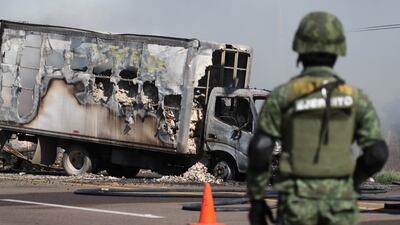
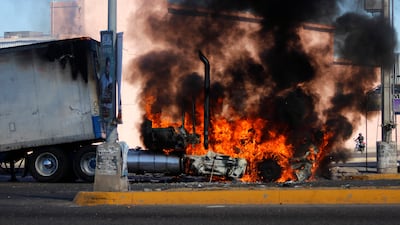
The wreckage of a vehicle set on fire by drug gang members after the arrest of Ovidio Guzman, a son of Joaquin 'El Chapo' Guzman, in Mazatlan, Mexico. Reuters -
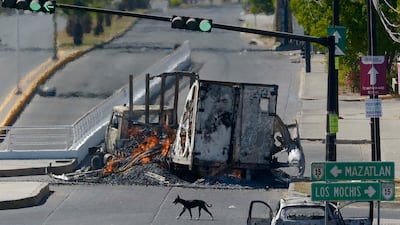
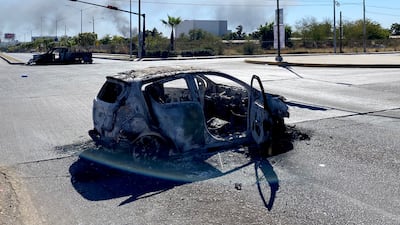
Burnt-out vehicles after clashes between federal forces and armed groups following Ovidio Guzman's capture. EPA -
Under tight security, Guzman was transferred to the same prison from which his father once escaped. EPA -
Guzman's arrest is a high-profile win in the fight against the powerful Sinaloa drug cartel days before US President Joe Biden visits. AFP -

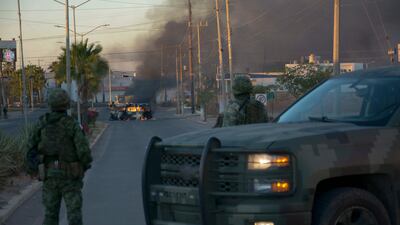
The pre-dawn operation on Thursday led to gunfights and roadblocks in Culiacan, the western state’s capital. AP -
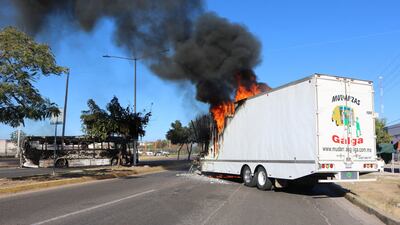
Vehicles across the city were set on fire by members of the drug gangs. Reuters -
Ovidio Guzman, an alleged drug trafficker, is wanted by the United States. AP Photo -
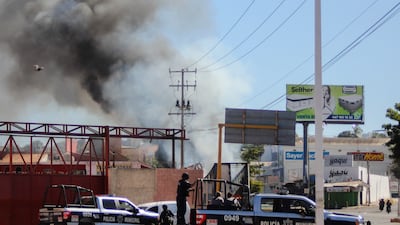
Police arrive after a shop was looted in Culiacan on Thursday. AP Photo -
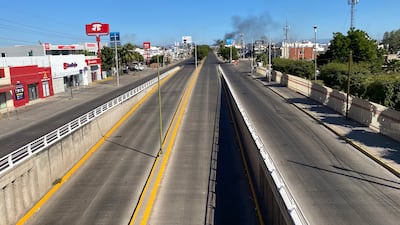
A deserted street in Culiacan after clashes between federal forces and gang members. EPA -
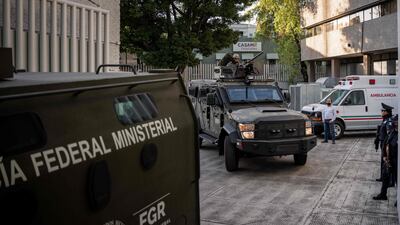
Armoured vehicles at the Attorney General's Office for Special Investigations on Organised Crime in Mexico City, after Guzman's arrest. AFP -
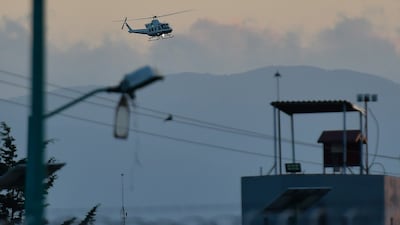
A helicopter, part of a security convoy used to transport Ovidio Guzman, arrives at the Altiplano prison in Toluca, Mexico. EPA


And in 2009, Army Pvt Michael Apodaca was convicted of killing an informant living in the US on behalf of the Juarez Cartel.
But this may only scratch the surface of the involvement of US citizens, including current and former soldiers, in Mexico's ever-growing drug and human trafficking trade.
One witness told Telemundo in 2019 that within the hitman — or sicario — training camps run by the CJNG, there were a number of deserters from both the Mexican and the US armed forces.
“The high command bought marines from an elite group,” the witness, known only as Francisco, said, claiming there were former “navys”, or Navy Seals, as well as ex-members of Delta Force at the camps.
Former US soldiers are reportedly highly desirable recruits due to their special set of skills, including the abilities and knowledge required to carry out contract killings and other special missions.
A 2011 FBI intelligence bulletin indicated that at least one criminal group, Los Zetas, has focused recruitment on people with prior specialised training, such as ex-military and ex-law enforcement officers, and not on US-based gangs, to “maintain a highly disciplined and structured hierarchy”.
Ordinary US citizens have become another group cartels are increasingly using for cross-border business.
“What drug traffickers want is to minimise as much as possible the risks of being detected to successfully smuggle drugs on the other side of the border,” Javier Osorio, an assistant professor at the University of Arizona's School of Government and Public Policy who specialises in political and criminal violence in Latin America, told The National.
“One of the strategies to do that is to engage with people who will not raise any suspicions. That is in line with cartels trying to minimise the risk of losing their merchandise or cargo.”
During the Covid-19 pandemic in particular, cartels reportedly ramped up recruitment of US citizens after the border was closed to slow the spread of the disease.
One smuggler told Vice News that cartels were relying “100 per cent on US citizens” to move smaller quantities of drugs over the border due to pandemic restrictions. Those looking to cash in on the region's multimillion-dollar illicit substance trade spiked due to higher unemployment in the US at the time.
The ways in which Americans are being recruited includes social media. In May 2021, members of the House of Representatives Homeland Security Committee wrote a letter to TikTok executives urging them to address the app's use by cartels for recruitment purposes.
Both WhatsApp and Facebook have also been used by criminal groups involved in human trafficking to engage drivers for newly arrived migrants. These drivers have included teenagers, according to Fox News.
Dr Osorio added that, in addition to offering large sums of cash, cartels also recruit through coercion.
“So they might say, hey, there's some money here. But if you don't agree to the deal, we might hurt you or hurt your family,” he said.
“I've seen cases where CBP [Customs and Border Protection] agents have relatives in Mexico. Eventually, cartels find that out and they threaten the family in Mexico to coerce CBP agents to do this.”

