

Before the 2003 US invasion of Iraq, Heather Yamour never questioned whether she belonged in America.
Growing up in rural Ohio as the daughter of an Iraqi father and an American mother, she felt safe and secure in her country of birth — a citizen like any other.
But that year, Ms Yamour’s world crumbled when the US invaded and subsequently occupied Iraq, where she still had many relatives.
“[The war] pierced this sort of bubble, the sort of security that I had growing up,” said Ms Yamour, who was a university student at the time.
She felt “a sudden fear” for her family, not only in Iraq but also in America, where many local Arab and Iraqi-American communities were suddenly regarded with suspicion.
“When the US invaded Iraq, everything changed. It wasn't just that you're American, you're Iraqi American,” said Ms Yamour, explaining that she felt the emphasis on her Iraqi heritage lessened her sense of belonging in the US.
Twenty years later, the scars the invasion left on many Iraqi Americans have proved hard to heal, as the consequences of the war severely affected their lives and perspectives.
“I remember the look on my father's face every time he'd watch the news. He was silent,” Ms Yamour said. “We were all worried about the same thing: Is our family safe? Are they alive?”
The US occupation and the ensuing civil war would result in hundreds of thousands of civilian casualties — according to the most conservative estimates — as well as untold suffering.

While millions demonstrated against the war around the world, including in the US, the occupation of oil-rich Iraq was backed by strong American public opinion and had bipartisan support in Congress.
Ms Yamour also worried if it was safe for her and her family to go to the mosque or even talk on the phone with family in Iraq because of concerns over wiretapping by US law enforcement agencies.
“I never got that sense of safety or security back,” she said.
“And over the years since the US invasion, every Iraqi American I've talked to has been touched by the war. Their family in Iraq has been touched by the war in some way. They had either relatives that had died or friends and neighbours who were killed.”
Hassan Hussain, an Iraqi-American university lecturer who left Iraq at the age of seven with his family in the early 1980s, said he felt “heart-broken” by the severe impact the sanctions, invasion and occupation had on his country of origin.
Before 2003, Iraqis had endured years of deprivation following the Gulf War in the early 1990s. The country was hit with strong sanctions and the entire population was effectively punished for the decision of Saddam Hussein to invade neighbouring Kuwait.
“We were the second richest economy in the Middle East after Saudi Arabia. We didn't have beggars on the streets in the seventies and eighties,” said Mr Hussain, who teaches Middle East history, Arabic and Farsi at the University of North Georgia.
Iraq War protests around the world in 2003 — in pictures
-
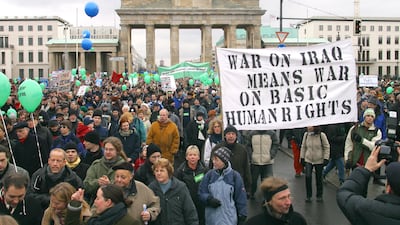
Protesters at the Brandenburg Gate in Berlin, demonstrating against war in Iraq, on February 15, 2003 - the day that saw peace demonstrations around the world. All photos: Getty Images -

Thousands of protesters gather in New York. -
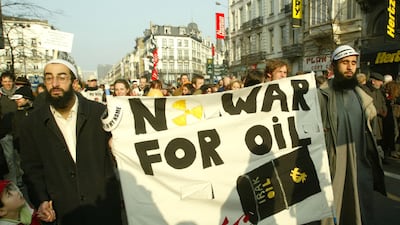
Demonstrators rally in Brussels, Belgium. -
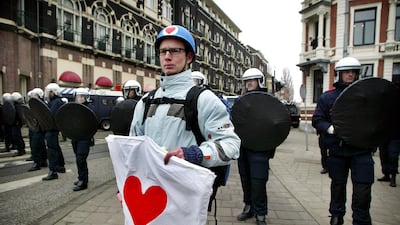
A protester holds a heart flag near riot police in Amsterdam. -

A huge rally for peace in Paris. -

Protesters make their way up Queen Street in Auckland, New Zealand. -
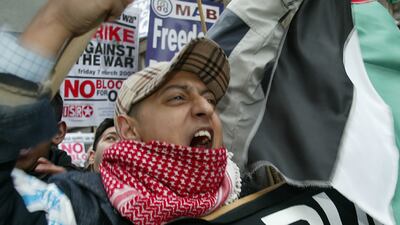
Anti-war demonstrators in London. -

Activists attend a rally in Dublin. -
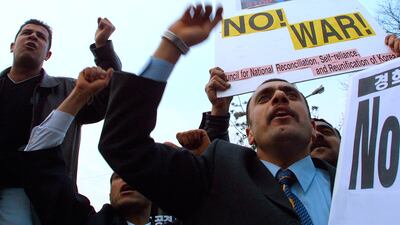
Muslim protesters at an anti-war rally in Seoul. -

Protesters with an inflatable globe at demonstrations in New York. -
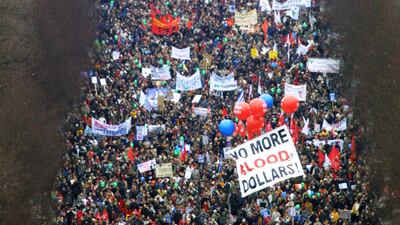
An estimated 500,000 protesters gathered in Berlin.


To him, the “heartbreak” was already there from the effects of 13 years of sanctions and an embargo that had destroyed Iraqi society and thrown millions into poverty.
Thousands of Iraqi children also died senselessly due to malnutrition and a lack of medicine because of the sanctions.
“This was clearly degrading a country, pushing it backward. It was watching what was a developed country become an undeveloped one,” said Mr Hussain. “And it was clearly by policy design, not by circumstance.”
For Mr Hussain, the 2003 military invasion of Iraq was painful and “surreal” to comprehend.
“It started with the bombing. Just constant bombing, which was devastating to watch because the objective was literally to bomb Iraq back to the Stone Age,” he said.
He points to the international reaction to Russia's invasion of Ukraine, describing it as heaping salt on a wound that has yet to heal.
Iraqis didn’t get the international support and military aid that Ukrainians are receiving today, he said.
“It was clearly understood [in 2003] that America bypassed the United Nations, didn't care about any norms of international law, and was too big to be held accountable. Whereas now, we are demanding that the whole world holds Russia accountable,” Mr Hussain said.
The occupation of Iraq proved to be a strategic blunder that plunged the country into a spiral of instability and sectarian division, and ended up hurting US interests in the region.
“No single event had enabled Iranian influence more than America's intervention in 2003, which handed Iraq to Iran,” said Fanar Haddad, a former adviser to former Iraqi prime minister Mustafa Al Kadhimi.
Divisions between Sunnis and Shiites grew to an “unthinkable” level, according to Mr Haddad, author of Sectarianism in Iraq and Understanding 'Sectarianism'.
“What Iraqis were put through over the course of 20 years is unforgivable … The human cost has been absolutely staggering,” he said.
Abdulrazzaq Al Saiedi, a technical expert on Iraq who works with Physicians for Human Rights, a US-based NGO that investigates and documents human rights abuses, said that Iraqis paid a hefty price following the US invasion and the ousting of Saddam Hussein.
“I think the US had an excellent plan to get rid of Saddam … But the postwar plan was very, very poorly planned,” he said during the online event organised by Washington think tank New America.
“So, we paid a lot. We might have gained our freedom from Saddam, but we lost our national identity.”
Ms Yamour has never set foot in Iraq, but she grew up listening to her father speak fondly of his birthplace.
“He would always describe Iraq as this place where you wanted to go because it felt so welcoming. It's such a good place, such a safe place with good values,” she said.
But after the US invasion and the instability it created, her father’s dream to one day go back to Iraq faded.
“My father is 85 now. We can't go back. He'll never go back. My family has told us not to come,” she said.
“And I can't foresee a time in the future when I will visit Iraq, because the Iraq that was described to me doesn't exist [any more].”


