


When George W Bush gave his State of the Union address to the US Congress 20 years ago, he warned of “decisive days” ahead.
Less than two months later, America led an invasion of Iraq that defined the beginning of the 21st century. The repercussions continue to reverberate.
Each year, Americans turn on their televisions to watch the State of the Union speech. President Joe Biden is delivering his third on Tuesday.
The annual remarks, in which US leaders outline legislative goals and give an assessment of America’s direction, often amount to a laundry list of unmemorable talking points.
But Mr Bush’s speeches in 2002 and 2003 were different. Historians will remember them for the way in which the president presented his blueprints for a war that was justified by faulty intelligence.
“In today’s parlance, we would call it The Big Lie,” said Dr Ray Smock, who was the first official historian for the House of Representatives, from 1983 to 1995.
Mr Bush opened his 2003 speech with talk about domestic issues such as education, the economy and even hydrogen-powered cars.
He then turned to Iraq, detailing how Saddam Hussein was amassing stockpiles of chemical and biological weapons, with the aim of using them to “to dominate, intimidate or attack".
“Our intelligence officials estimate that Saddam Hussein had the materials to produce as much as 500 tonnes of sarin, mustard and VX nerve agent,” Mr Bush said.
“The British government has learnt that Saddam Hussein recently sought significant quantities of uranium from Africa.”
Those and other claims he made turned out to be wrong, based on faulty intelligence that politicians from the “Coalition of the willing” — mainly the US and UK — who were eager to invade Iraq were all too ready to believe.
Documents alleged that Saddam was seeking to acquire yellowcake uranium from Niger. Those documents were forged.
“As it turns out, the whole war was predicated on a falsehood that Saddam Hussein had weapons of mass destruction,” Dr Smock, director of the Robert C Byrd Centre for Congressional History and Education, told The National.
2003 invasion of Iraq — in pictures
-
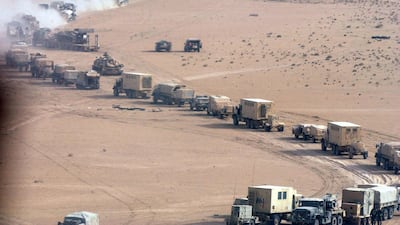
A long US military convoy moving inside an unspecified area of southern Iraq on March 21, 2003. US and British forces were poised to capture the city of Basra on day two of the war to topple President Saddam Hussein. AFP -
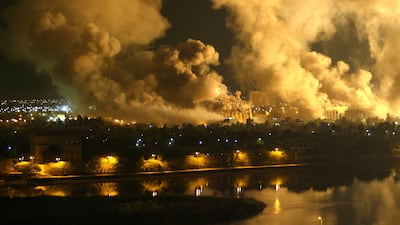
Smoke covers the presidential palace compound in Baghdad on March 21, 2003 during a massive US-led air raid on the Iraqi capital. Smoke billowed from a number of sites, including one of President Saddam Hussein's palaces, an AFP correspondent said. AFP -

Members of Britain's 16 Air Assault Brigade on patrol during a sandstorm in the deserts around the oil fields of Rumaila in southern Iraq on March 25, 2003. AFP -
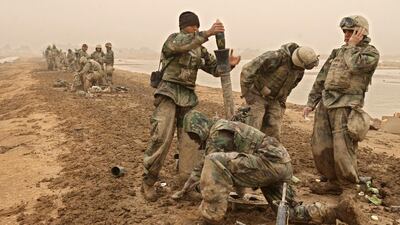
US Marines from the 2nd Batallion 8th Regiment load mortar shells into launchers in Nasiriyah, about 360 kilometres south-east of Baghdad, as they pound Iraqi positions early on March 26, 2003. AFP -
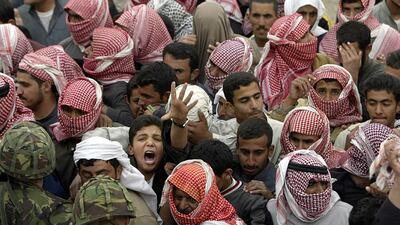
An Iraqi boy struggles amid a crowd to reach for giveaways thrown from a lorry in the southern city of Safwan on March 26, 2003. AFP -

Residents flee the burning town of Basra in southern Iraq on March 28, 2003. British soldiers said the fleeing refugees had described a city still in the grip of an Iraqi military that had hidden large amounts of artillery tanks in civilian and commercial areas. AFP -

Iraqi Republican guards cheer as they pass a wrecked US army Abrams tank, south of Baghdad, on April 6, 2003. AFP -
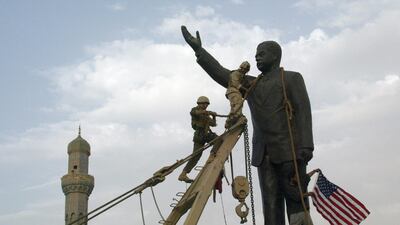
US Marines chain the head of a statue of Saddam Hussein before pulling it down in Baghdad's Firdous Square on April 9, 2003, while an Iraqi waves the US flag. US troops moved into the heart of the Iraqi capital meeting little resistance. AFP -
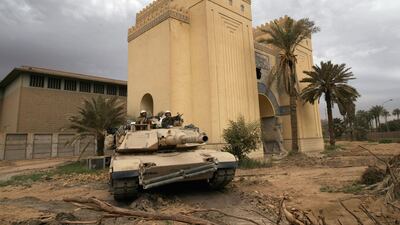
A US tank takes up position outside the plundered Iraqi National Museum in Baghdad on April 16, 2003. Getty Images -
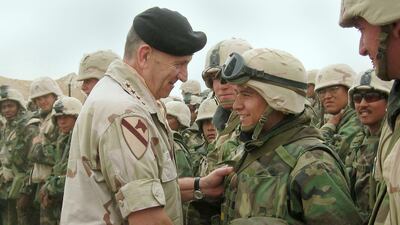
Gen Tommy Franks shakes hands with US Marines of the 1st Marine Expeditionary Force in the Iraqi city of Numaniyah, about 140 kilometres south-east of Baghdad, on April 7, 2003. Getty Images -
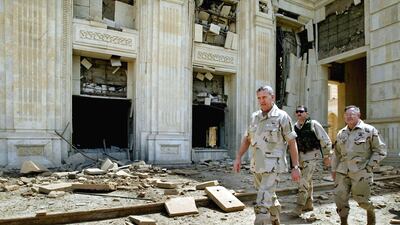
Gen Tommy Franks (c) visits a palace of Saddam Hussein in Baghdad on April 16, 2003. Getty Images -

US Secretary of Defence Donald Rumsfeld (c) is saluted by US Army Lt Gen William Wallace as he arrives at Baghdad International Airport on April 30, 2003. Getty Images -
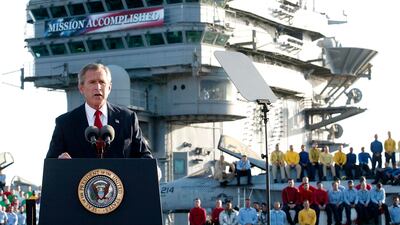
US President George W Bush addresses the nation aboard the nuclear aircraft carrier USS Abraham Lincoln on May 1, 2003. Mr Bush declared that major fighting was over in Iraq, calling it "one victory in a war on terror". AFP


America in 2003 was still reeling from the September 11, 2001, Al Qaeda attacks that killed about 3,000 people.
A US-led invasion of Afghanistan that year quickly led to the overthrow of the Taliban government, but the Bush administration soon lost interest in the day-to-day running of the country and shifted its focus to opening a second front in the so-called war on terror.
Mr Bush was surrounded by a coterie of ultra-hawkish advisers, including his vice president Dick Cheney, secretary of defence Donald Rumsfeld and Mr Rumsfeld's deputy, Paul Wolfowitz.
Within hours of the Al Qaeda attacks in New York and at the Pentagon, the men were looking for reasons to blame the horror on Saddam, even though the Iraqi dictator was not involved.
Memos from Mr Rumsfeld that were declassified in 2013 show that by November 2001, he was asking staff about “how [to] start” a war with Iraq.

Mr Bush’s 2002 State of the Union address reflected this quest for conflict.
He famously referred to Iran, Iraq and North Korea as an “axis of evil”, using language that harked back to the Nazi-allied Axis powers of the Second World War.
“States like these, and their terrorist allies, constitute an axis of evil, arming to threaten the peace of the world,” Mr Bush said in 2002.
“By seeking weapons of mass destruction, these regimes pose a grave and growing danger.”
When he returned to Congress for his 2003 speech, war planning was well under way and the invasion was all but inevitable.
Even as he spoke to the packed chamber, tens of thousands of US troops were massing in or near the Middle East.
“We seek peace. We strive for peace,” Mr Bush claimed.
But “if war is forced upon us, we will fight in a just cause and by just means, sparing, in every way we can, the innocent".
According to Brown University’s Watson Institute for International and Public Affairs, between 275,000 and 306,000 civilians died from war-related violence attributed to the US, its allies, the Iraqi military and police, and opposition forces.
The war also killed more than 4,400 US troops and maimed tens of thousands more. Mr Bush’s second term in office expired in 2008 with his approval rating at a record low of 25 per cent, according to Gallup.
In the years since, his approval rating has improved as the chaos of the Iraq invasion slips from people's memories and the former president is seen to be ageing gracefully.
But Thomas Balcerski, a presidential historian and visiting professor at Occidental College in Los Angeles, California, said Mr Bush’s legacy would forever be tarnished by the Iraq invasion.
“The aspect of the Bush presidency that continues to be problematic … the one in which historians remain critical, is precisely this moment where he led the nation to a war,” Prof Balcerski told The National.
It has been "and continues to be a source of criticism from both Democrats as well as so many of us Americans who felt then and now that it was an unjust war".
The rise and fall of Saddam Hussein - in pictures
-
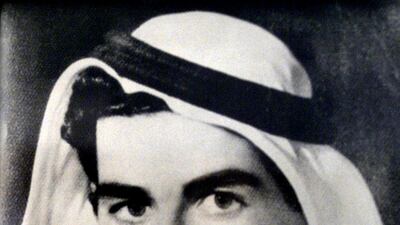
A picture taken in 1960 shows Saddam Hussein as a young member of the Baath Party. AFP -
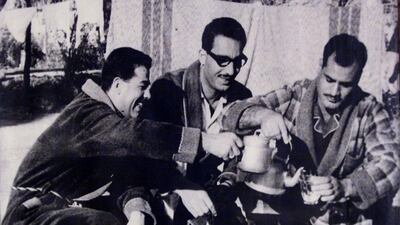
Saddam Hussein, left, in his housecoat, is seen preparing a hot drink with unidentified others in this photo taken in the 1960s, as his influence in the Ba'ath Party was growing. AFP -
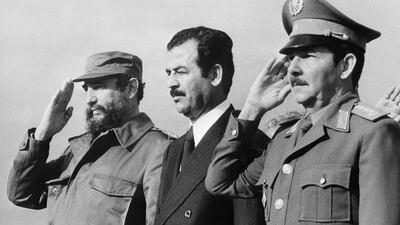
Saddam Hussein, then Iraq's vice president, stands with Cuban leader Fidel Castro, left, and defense minister Raul Castro, January 30, 1979 in Havana. AFP -
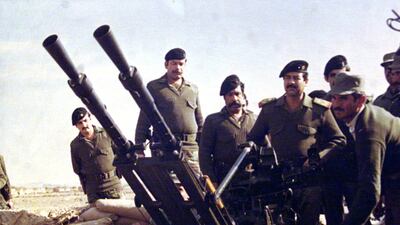
Saddam Hussein, now Iraq's president, during the 1980-1988 Iraq-Iran war. AFP -
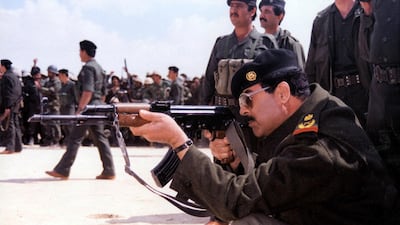
Saddam Hussein points a Kalashnikov at an unspecified location in Iraq, 1987. AFP -
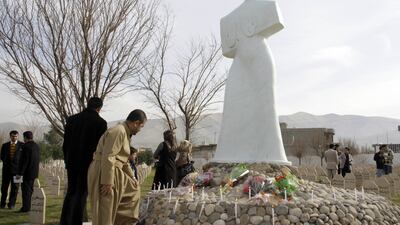
Iraqi Kurds light candles and lay flowers in the cemetery for the victims of the Halabja chemical attack carried out by Saddam Hussein in 1988. AFP -
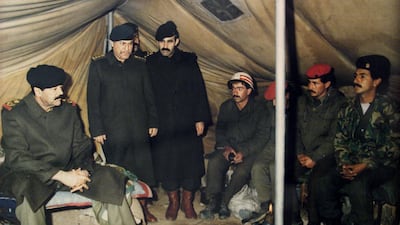
Saddam Hussein visits Iraqi troops at a military camp in occupied Kuwait after the 1990 invasion of the Gulf state. AFP -

Two elderly Israeli women look at damage caused when an Iraqi Scud missile slammed into their house January 18, 1991. Reuters -
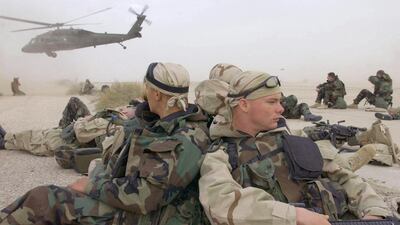
American troops take control of an unspecified area in southern Iraq during the 2003 US invasion of the country. AFP -

Saddam Hussein at an unknown location in Iraq following his capture by US troops on December 13, 2003. AFP -
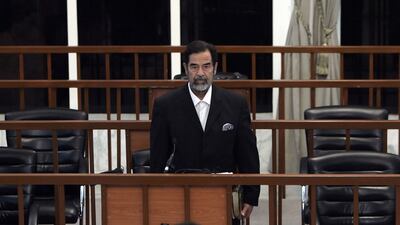
Saddam Hussein listens as he receives his verdict during a trial held amid tight security in Baghdad's heavily fortified Green Zone, November 5, 2006. AFP -
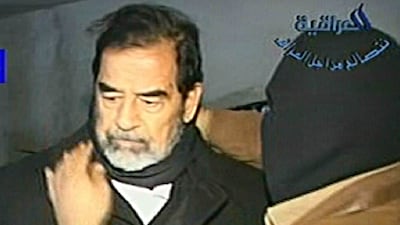
A video grab taken from Al Iraqiya TV shows Saddam Hussein moments before being hanged in Baghdad on December 30, 2006. AFP



