

US President Joe Biden on Sunday honoured Dr Martin Luther King Jr's civil rights legacy with a sermon at the leader's Ebenezer Baptist Church.
From that historic pulpit, Mr Biden said the fight for voting rights and racial equity in America endured.
“Are we a people who would choose democracy over autocracy?” he asked the congregation.
“We have to choose a community over chaos. Are we, the people, going to choose love over hate?
"These are the vital questions of our time. I believe Dr King's life and legacy show us the way and we should pay attention."
The US marks Martin Luther King Jr Day on Monday.
Among the civil rights milestones credited to Dr King's leadership before his 1968 assassination is the 1965 Voting Rights Act.
The landmark legislation included laws that eliminated barriers to voting for African Americans, who in some areas had been almost completely disenfranchised.
Mr Biden made reference to Dr King's famous "I Have a Dream" speech in his sermon.
"We all deserve liberty and justice. And it's still the task of our time to make that dream a reality because it's not there yet," he said.
-

Martin Luther King Jr among the leaders behind former US President Lyndon B Johnson at the August 1965 signing of the Voting Rights Act. Photo: US National Archives -
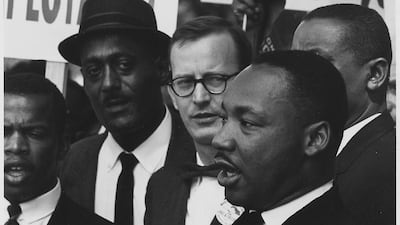
King, president of the Southern Christian Leadership Conference, and Mathew Ahmann, executive director of the National Catholic Conference for Interrracial Justice, in a crowd at the Civil Rights March on Washington in 1963. Photo: US National Archives -

King with organisers of the Civil Rights March on Washington in front of the Lincoln Memorial. Photo: US National Archives -
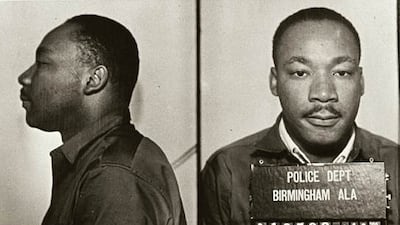
King's 1963 mugshot after his arrest for protesting over the treatment of black Americans in Birmingham, Alabama. -

King, right, accompanied by the Rev Ralph D Abernathy, centre, is booked by city police Lt D H Lackey in Montgomery, Alabama, for his part in the bus boycott protests, on February 23, 1956. AP -
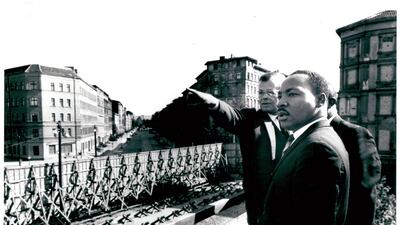
King visits the Soviet Sector border of the Berlin Wall in Bernauer Strasse. Photo: US Information Service Bonn -
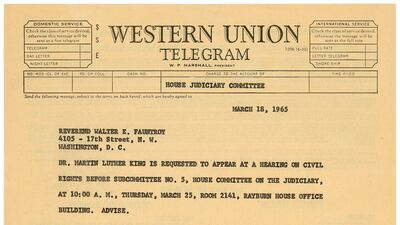
A 1965 telegram note requesting King's appearance before the House subcommittee on voting rights. -
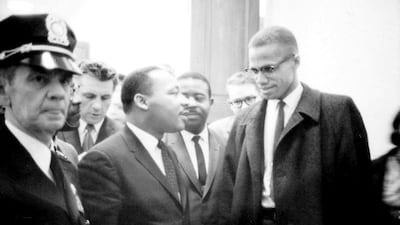
King with Muslim minister and human rights activist Malcolm X in March 1964. Photo: Library of Congress -
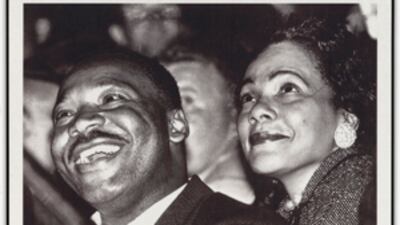
King and his wife Coretta Scott King enjoying a Sammy Davis Jr performance. Picture: US National Archives


Rights watchers have warned that in many parts of the US, the right to vote is being threatened.
“State laws violate the right to vote and misinformation about the 2020 elections is eroding public faith in elections and democratic institutions,” Human Rights Watch wrote before last year's midterm elections.
Mr Biden's Democratic party failed to pass a voting rights bill that included provisions to make election day a national holiday.
It would have ensured access to early voting and mail-in ballots, and enabled the Justice Department to intervene in states with a history of voter interference.
With a new Republican majority in the House, the Democrats face a steeper challenge to ensure that protection in the new year.
In September, Mr Biden gave a prime-time speech warning Americans that far-right groups “promote authoritarian leaders and they fan the flames of political violence that are a threat to our personal rights, to the pursuit of justice, to the rule of law, to the very soul of this country”.
Georgia's newly elected Democratic Senator Raphael Warnock spoke before the president on Sunday, telling of America's democratic promise and its history of marginalisation.
Mr Warnock referred to the famous white monuments in the nation's capital — to founders George Washington and Thomas Jefferson, and “the Great Emancipator” Abraham Lincoln.
He quoted Mr Jefferson's famous words in the US Declaration of Independence, that “all men are created equal".
“But on the other side of the Tidal Basin, a Black man stands there with his arms folded, as if to say to Thomas Jefferson. 'Did you mean what you said?'” he said.
A memorial to Dr King sits across from the Jefferson memorial.
Mr Biden is the first sitting president to stand at Dr King's Georgia pulpit to deliver a Sunday sermon, wearing the same Catholic rosary on his wrist that his late son Beau wore on his death bed, he said.

