


When Yalda Royan arrived at Dulles International Airport, just outside Washington, she knew nothing about the country she was in.
Ms Royan, a women’s rights activist who had worked for US organisations during the war in Afghanistan, had just escaped Kabul with her two daughters after the chaotic US military withdrawal and Taliban takeover.
While they were relieved to be in America, it was the beginning of a painful new journey with an uncertain ending.
“I still have nightmares," Ms Royan told The National. "When I dream, it's the Taliban. Either they are following me or trying to kill me."
She had become worried over the summer of 2021, watching the Taliban quickly take over provinces across Afghanistan, but didn’t believe the capital would fall, at least for a long time.
Like so many others, including top officials in the US government, Ms Royan was wrong.
“I went to the bank to withdraw some money because things were looking abnormal," she said. “I was in the middle of the city when shooting started and people started running.”
The Taliban had entered Kabul.
Ms Royan went home to learn from one of her daughters that former president Ashraf Ghani had fled.
“That wasn’t good news, I knew what the consequences would be," she said.
As an ethnic Hazara, a Shiite Muslim and a single mother who had worked for international institutions and the fallen Afghan government, Ms Royan and her family were at particular risk.
The US non-profit for which she worked was able to arrange tickets for an evacuation flight from Kabul airport to America.
With one backpack, Ms Royan fought through crowds of people desperate to escape the city while bullets fell around her.
She took several flights on military planes through a number of countries before landing in the US state of Virginia, after an evacuation she described as undignified and painful.
-
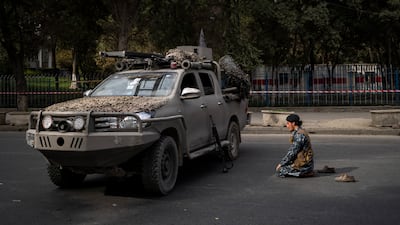
A Taliban fighter prays next to a demonstration organised by the Afghan Society of Muslim Youth, demanding the release of frozen international money in Kabul, Afghanistan. AP Photo -
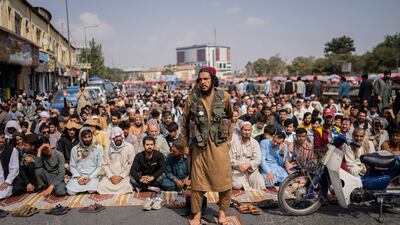
A Taliban fighter and a group of Afghan men attend Friday prayers in Kabul. AP Photo -
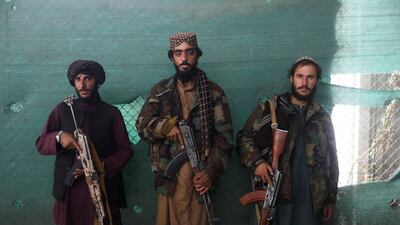
Taliban soldiers in Bagram Air Base in Parwan. Reuters -
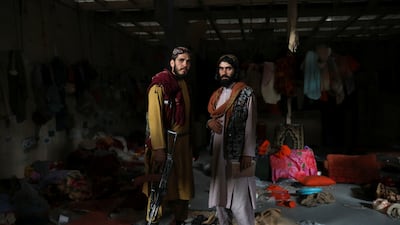
Taliban soldiers Seifatollah and Vasighollah stand in a prison in Bagram Air Base. Reuters -
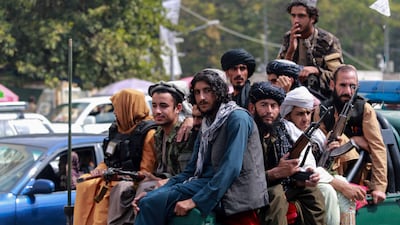
Taliban patrol Kabul. EPA -
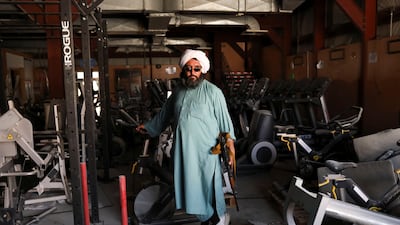
Vahdat, a Taliban soldier and former prisoner, stands next to exercise equipment in Bagram Air Base. Reuters -
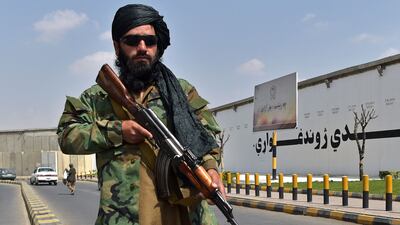
A Taliban fighter stands guard near Zanbaq Square in Kabul. AFP -
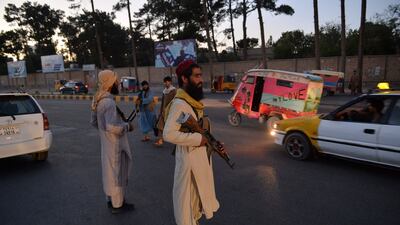
Taliban fighters police a road in Herat. AFP


Ms Royan’s story is a familiar one.
Tens of thousands of Afghans were taken to the US as part of operation Allies Welcome, the official name of the US government’s Afghan assistance programme and the most significant resettlement effort since the Vietnam War.
But changing to life in the US under such circumstances came with complications.
Case pending
As she passed immigration at the airport, Ms Royan’s passport was stamped with the word "parole", something she didn’t understand at the time.
The US Citizenship and Immigration Services (USCIS) says parole, also known as Humanitarian Parole, allows a person to be in the US for a temporary period of time for urgent humanitarian reasons.
For the Afghans who escaped last summer, that period is two years.
“Coming into the US with parole doesn’t give them legal status”, said Parastoo Zahedi, an immigration lawyer working in Virginia.
“They’ve got to turn it into some kind of a Green Card application or apply for what’s known as asylum protection, if they can meet that burden.”
Without this, evacuated Afghans could eventually wind up being deported.
As an outspoken critic of the Taliban, Ms Royan, who addressed the UN this year about the plight of women in her country, is convinced she and her children will be killed if they are ever forced to return home.

With the help of a lawyer working pro bono, she applied for asylum, an arduous process that forced her to revisit many difficulties in her past life, including threats and domestic violence.
Her asylum interview lasted for eight hours, Ms Royan said, in which she was interrogated by an immigration official non-stop.
“Going through that was another trauma for me”, she said.
It has been almost a year since the interview and Ms Royan’s case is still pending.
Under usual circumstances, she should have received a decision from the agency's asylum office within 150 days.
Lindsay Harris, director of the Immigration and Human Rights Clinic at the University of the District of Columbia, took on Ms Royan's case last year and said she followed up regularly.
"There's not much we can do other than sit and wait," Ms Harris told The National.
She said that while Ms Royan's asylum case was being processed, she could not be removed from the country.

The USCIS and the US Department of Homeland Security did not immediately respond to requests for comment.
For the 76,000 evacuees in the US, a similar state of legal limbo hangs over them, many without the help of overstretched lawyers, translators or charitable organisations.
They often lack official documents needed for applications and interviews owing to their rushed exit from Afghanistan.
"Asylum is a pretty stringent legal standard," said Ms Harris. "Not everybody who was paroled is going to meet that definition.
"What are we going to do? Send the people that we airlifted back to Afghanistan?"
The immigration system has left Ms Royan and others like her in a position of serious uncertainty.
“I was put on one of those military planes because I was a person at risk”, she said.
“All these people, if they are sent back to Afghanistan, what will happen to them? If I go back, I’m sure I will not survive.”
‘The only hope'
On a bitterly cold afternoon outside the US Capitol building in Washington, a group of Afghans gathered for the latest round of their months-long protest.
“It’s freezing here, I feel like my nose and my fingers are cut,” said Sarina Faizy, a former local politician who at the age of 17 became the youngest woman elected to Kandahar Provincial Council.
"But the reason we are here is to make the Afghan Adjustment Act possible," she told The National.
Ms Faizy, who was in the US during the Taliban takeover of Afghanistan, is one of the many people demanding politicians pass a bill to give Afghans moved from the country a pathway to citizenship.
“They have to do something," she said.

The Afghan Adjustment Act, which was introduced in both chambers of Congress days before the first anniversary of the US troop withdrawal, would allow evacuees to apply for permanent legal status if they submit to other background checks.
Otherwise, those Afghans could only gain residency in the US by asylum or Special Immigrant Visas, programmes beset by major backlogs and high procedural burdens.
Afghans and US veterans have been staging demonstrations outside the DC landmark, where politicians arrive and depart from their workplaces, in support of the bill.
They, as well as a bipartisan group of senators and even some US businesses, have thrown their support behind it, but it remains stalled in Congress and probably faces resistance from anti-immigration Republicans.
“The US government has completely forgotten about Afghanistan”, said Anees Khalil, another protester.
Mr Khalil worked with Nato forces in Afghanistan during the war and helped to evacuate nationals in 2021.
-
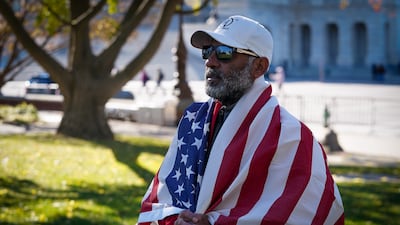
Anees Khalil, who was detained by the Taliban while helping to evacuate Afghans during the US withdrawal, believes the US has forgotten about Afghanistan -
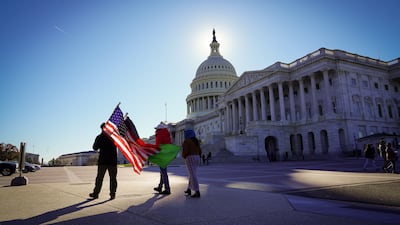
Protesters walk in front of the US Capitol flying Afghan and US flags -
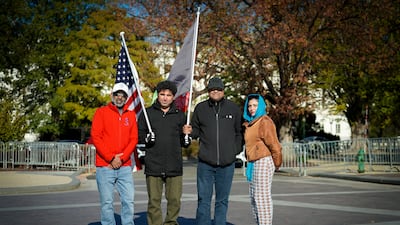
A protest group known as the Capitol Fire Watch has been gathering outside Congress for months


He and his brother were captured by the Taliban and held for more than 100 days before being returned to the US.
"They are lost, they are in limbo, they are going through depression, their families are divided, they are hopeless," he said. “The only hope they have is if this bill passes.”
Ms Royan, along with many of the proponents of the Afghan Adjustment Act, hope it happens before Republicans take control of the US House in January next year.
“The US has lost in Afghanistan," she told The National, “both on the battlefield and morally.”
“The only thing [they] could now do is pass this bill.”

