


With Turkish President Recep Tayyip Erdogan this week indicating a possible ground operation into Syria, attention has turned to Russia and the US to restrain Ankara from such an escalation.
Mr Erdogan, speaking after he returned from the World Cup opening in Qatar on Sunday, made it clear that Turkey’s response to the November 13 bombing in Istanbul and rocket attacks on its territory, will not be limited to aerial bombardment, which the Turkish military carried out in Northern Syria at the weekend.
"This is not limited to just an air operation," he said, adding that he would be consulting with his military and national security advisers on further steps.
“If someone disturbs our country and lands, we will make them pay the price."
While this is not the first time this year Mr Erdogan has threatened a ground invasion into Syria, experts say a shift in circumstances and an election campaign in Turkey could tip the balance in favour of an incursion for the first time since 2019.
Aaron Stein, a Turkey policy expert and author, said it would be prudent to take the Turkish president at his word.
“I tend to just listen to Erdogan and not make this too complicated. So yes, a ground invasion is possible,” Mr Stein told The National.
Key to Turkey’s thinking would be Russia’s reaction, he said.
Moscow controls the airspace and has observers in that region of Syria, but has been preoccupied with its own invasion of Ukraine.

“The first evidence we have is that Turkish jets did not cross into Syria [over the weekend], which would suggest Russia has not signed off on any invasion,” said Mr Stein, author of The US War Against ISIS.
“Turkey can always choose to ignore Russia, but they have not done so thus far.”
Aron Lund, a fellow at Century International and a Syria scholar, saw some ambiguity in Mr Erdogan’s remarks.
“Erdogan has been talking about a ground operation to seize terrain in northern Syria since May," Mr Lund said.
"Over the summer, his plan seemed to get stuck in negotiations with Russia.
"Now when the air strikes came, that seemed almost de-escalatory in the sense that Ankara had not opted to exploit the Istanbul bombing to justify a full-scale offensive.
“But now with Erdogan signalling that ground troops might be used, all bets are off."
Increasing the volatility of the situation were rocket attacks against southern Turkey on Monday in response to the Turkish bombardment.
Mr Lund, author of two books on Syria, said Russia’s position may end up deciding the fate of such invasion.
He said the key questions were: “Will Moscow oppose an attack, or what would it demand in return for facilitating one? Will the Russians yield if Erdogan goes ahead anyway?”
The personal rapport between Russian President Vladimir Putin and Mr Erdogan will also play a role, Mr Lund said.
“They do not see eye to eye on lots of things, Syria among them, but they do have a solid, well-tested relationship and have successfully negotiated difficult deals before,” Mr Lund said.
As for a US role, Mr Stein and Mr Lund expressed opposing views on its influence and willingness to interfere.
“The US isn’t really engaged [in northern Syria] and won’t be," said Mr Stein. "Ankara can basically do what it wants. The US has moved on."
At the Manama Dialogue on Saturday, White House Co-ordinator for the Middle East and North Africa Brett McGurk repeated the US position "to make sure that nothing is done to further destabilise that very difficult situation in north-east Syria".
Mr McGurk said Washington wanted “the border with Turkey is secure".
But Mr Lund saw an essential behind-the-scenes role for the US administration of President Joe Biden, “both in and of itself and as a potential reinforcement of a Russian ‘nyet'" [no].
-
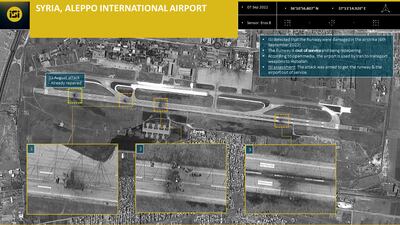
A satellite image shows damage at Aleppo airport in northern Syria following reported Israeli strikes on September 6. AFP -

More damage at Aleppo airport after Israeli strikes on August 31. -
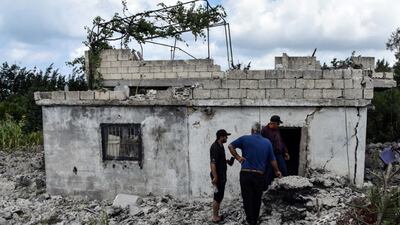
A building damaged by a reported Israeli air strike in the western Syrian coastal city of Tartus. AFP -
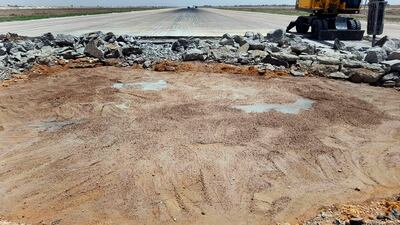
The damaged runway of the Damascus International Airport, when it was hit by an Israeli air strike on June 10. AP -
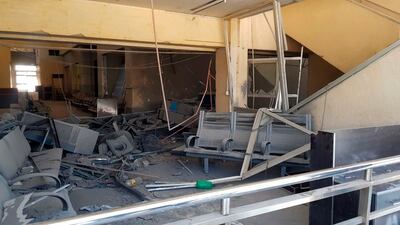
Syria said the June 10 strike caused "significant" damage to infrastructure and knocked out the main runway. AP -

Damage reported by the Syrian state media in Damascus in March. Reuters -

Fire burns after a reported Israeli missile attack on a container storage area in the port of Latakia in December 2021. Reuters -

Firefighters called in to tackle the Latakia blaze. Reuters -

An Israeli pilot in an F-35 fighter jet at Nevatim air base. Reuters -

An Israeli Air Force F-35 fighter jet performs an aerial demonstration at the Hatzerim air base. Reuters -

An Israeli F-15 fighter jet at the Blue Flag 2017 exercise at Israel's Ovda military air base. Reuters -
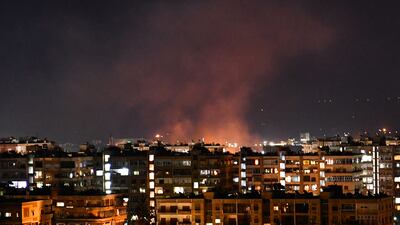
Smoke billows following an Israeli airstrike targeting Syrian capital Damascus in July 2020. AFP


Last summer, Mr Lund said Washington and Moscow “flashed a red light and that ended up dissuading Erdogan” from a ground invasion.
But with US-Turkey relations strained over arms and trade deals with Moscow and Congressional sanctions against Ankara, Mr Lund said Mr Erdogan, who is facing elections in June, “would not mind brushing US objections aside, which could play well into his re-election campaign".
But the aerial attacks in Syria are already infuriating members of Congress.
Congressman Frank Pallone tweeted on Sunday that Ankara’s bombardment “is yet another reason why I am working to block the sale of F-16 fighter jets to Turkey".
The US state Department repeated its position, urging Ankara to “halt offensive operations in north-east Syria”, a US official told The National.
Turkish President Recep Tayyip Erdogan visits Saudi Arabia - in pictures
-

Saudi King Salman walks with Turkish President Recep Tayyip Erdogan at Al Salam Palace in Jeddah, Saudi Arabia. All photos: SPA -
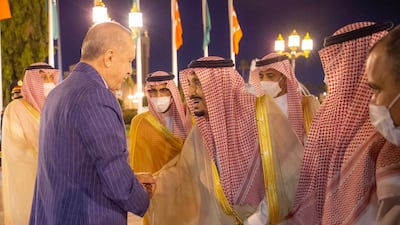
King Salman welcomes Mr Erdogan to Al Salam Palace. -
King Salman welcomed Mr Erdogan and a high-level delegation to the palace in Jeddah. -
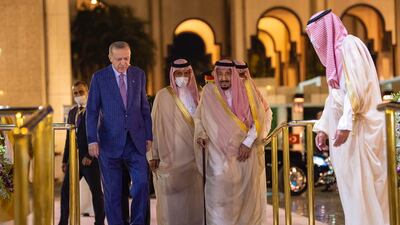
King Salman held a welcome ceremony and iftar for Mr Erdogan and his delegation. -
King Salman and Mr Erdogan at Al Salam Palace. -
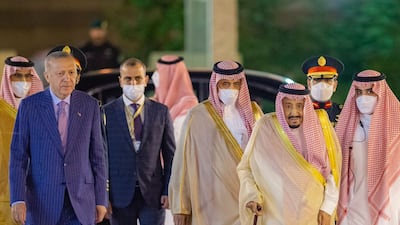
Mr Erdogan thanked King Salman for his welcome as he looked to strengthen ties between his country and the kingdom. -
King Salman welcomes Mr Erdogan to Jeddah on the start of his two-day visit. -
King Salman and Mr Erdogan share coffee as they speak at Al Salam Palace. -
King Salman in discussion with Mr Erdogan. -
Mr Erdogan expressed his happiness to visit Saudi Arabia and to meet King Salman and Crown Prince Mohammed bin Salman. -
Saudi Crown Prince Mohammed bin Salman at Al Salam Palace. -
Crown Prince Mohammed bin Salman welcomes Mr Erdogan at the Jeddah palace. -
Dignitaries at the reception for Mr Erdogan included leading members of the Saudi royal family.



