



The wave of protests sweeping Iran is complicating the Biden administration’s calculus as it pushes to revive a nuclear deal with the country right as its leaders are being accused of oppressing and brutalising their own people.
Washington is facing a dilemma as it monitors the widespread demonstrations that have continued gaining momentum in the biggest show of popular unrest in Iran since 2009, when hundreds of thousands took to the streets to protest against what they said was the rigged election of Mahmoud Ahmadinejad.
If President Joe Biden's administration continues to push for a deal aimed at constraining Iran's nuclear programme, critics will say the White House is failing the protesters and potentially freeing up billions of dollars in sanctions relief for the very regime repressing them.
But if it abandons the nuclear talks, Tehran could do the same and be months from building a nuclear bomb.
Now in their third week, the current protests erupted over the death of a young Iranian-Kurdish woman, Mahsa Amini, in police custody.
US National Security Adviser Jake Sullivan insisted Washington could both revive the nuclear deal and back the protests.
-
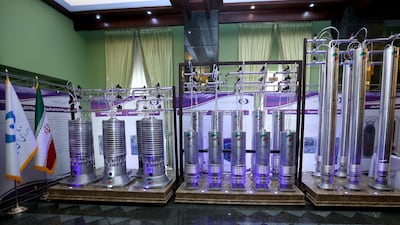
New generation Iranian centrifuges on display for Iran's National Nuclear Energy Day in Tehran, in April 2021. Iranian Presidency Office / Wana -

President Ebrahim Raisi, second right, is accompanied by Atomic Energy Organisation of Iran chief Mohammad Eslami, at Nuclear Technology Day in Tehran in April 2022. Iranian presidency / AFP -
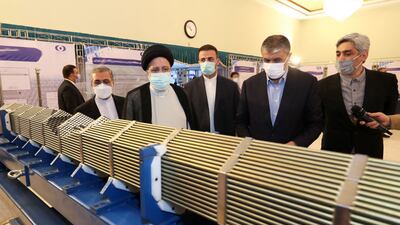
Mr Raisi and Mr Eslami at the April 2022 event. Iranian presidency / AFP -
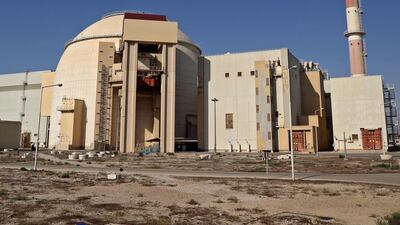
The Bushehr Nuclear Power Plant during a visit by Mr Raisi in October 2021. Iranian Presidency / AFP -
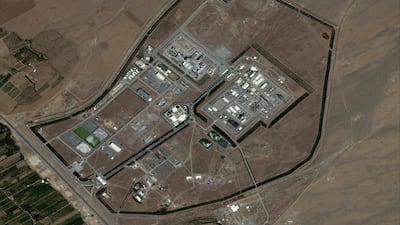
Iran's Arak Heavy Water Reactor complex, south of the capital Tehran in January 2020. Maxar Technologies / AFP -
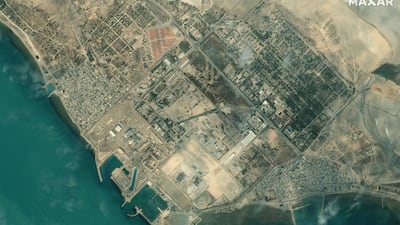
A satellite image of Iran's Bushehr Nuclear Power Plant in January 2020. Maxar Technologies / AFP -
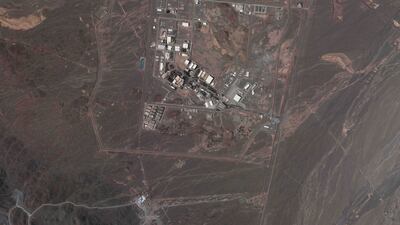
A satellite image of Iran's underground Natanz nuclear site in May 2022. Planet Labs PBC / AP -
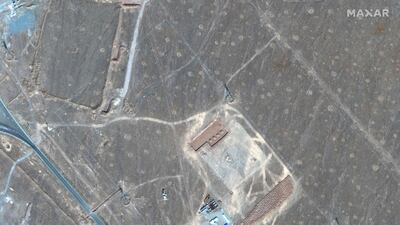
A satellite image in January 2020 of Iran's Fordow Fuel Enrichment Plant, north-east of the city of Qom. Maxar Technologies / AFP -
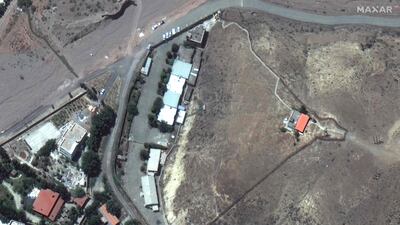
The Sanjarian nuclear centre, east of Tehran, in May 2021. Maxar Technologies / AFP


“If we can succeed in that effort [to restore the deal, and we are determined to succeed in that effort, the world, America and our allies will be safer … that will not stop us in any way from pushing back and speaking out on Iran’s brutal repression of its citizens and its women. We can and will do both,” Mr Sullivan told CBS News last week.
Mr Sullivan stressed that negotiations with Iran over its nuclear programme have no impact on US willingness to address the protests.
Eighteen months of negotiations with Iran are currently at an impasse as Tehran continually shifts demands on what it wants to see in an accord.
The Biden administration has already sanctioned Iran's notorious morality police over Amini's killing and taken a more vocal line than Barack Obama did in 2009 during what became known as the Green Movement.
Iran watchers faulted Mr Obama for his softly-softly approach that came as his administration focused on diplomacy and set the stage for the nuclear talks that eventually led to the 2015 Joint Comprehensive Plan of Action (JCPOA).
In another sign of a more aggressive approach towards Iran under Mr Biden, CIA Director William Burns told CBS News on Tuesday that the US government is “very committed” to helping protesters get access to the internet, in a possible hint that the US will help deliver Starlink terminals to Iran.
Kelsey Davenport, the director of non-proliferation policy at the Arms Control Association, credited the Biden administration’s approach of continuing to support a deal, while also backing demonstrators.
“Tehran's destabilising regional activity and its repression domestically will be all the more challenging to confront under the threat of a nuclear-armed Iran,” Ms Davenport told The National.
She said support for diplomacy and the protests “are not mutually exclusive”, and that the bigger problem hindering a deal is Iran’s lack of co-operation with the International Atomic Energy Agency (IAEA) and demand that it close its investigation into the country's nuclear inventory.
“Iran is legally bound to co-operate with the agency and provide an accounting of its nuclear material inventory. That cannot be negotiated away,” she said.
The US should not agree to “anything less than Iran's full, credible co-operation with the agency”, the expert added.

But returning to a the deal while Iran is killing its own citizens could prove to be a tough pill to swallow for the Biden team, argued Jason Brodsky, policy director at United Against Nuclear Iran.
“Politically the JCPOA is a more difficult sell now because reviving it entails significant sanctions relief, which will resource the very entities and individuals that are oppressing and abusing the Iranian people,” Mr Brodsky told The National.
A return to the JCPOA could lead to sanctions being lifted on industries and commercial entities tied to Iran's Islamic Revolutionary Guard Corps, whose security arm the Basij is attempting to quell the protests.
And Mr Brodsky noted that Trump-era executive sanctions against Iran's supreme leader Ayatollah Ali Khamenei and President Ebrahim Raisi will reportedly be revoked as a part of a deal.
“That's a non-nuclear executive order, and if it's rescinded, it will be rewarding the faces committing crimes against the Iranian people,” he said.
Even for Iran, the protests will increase its tendency towards intransigence in talks, he argued.
-
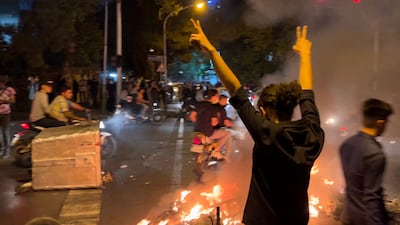
A protest for Mahsa Amini, a woman who died after being arrested by the Islamic republic's 'morality police', in Tehran. AFP -
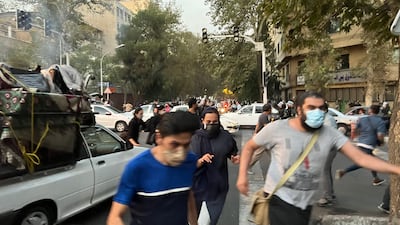
Demonstrators disperse during the protest for Amini, who died in a hospital in the capital Tehran on Friday. AFP -
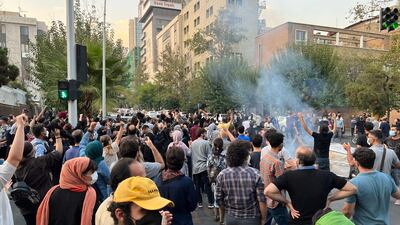
The crowd chanted 'Death to the dictator', meaning Supreme Leader Ayatollah Ali Khamenei, while some women took off their headscarves. AFP -
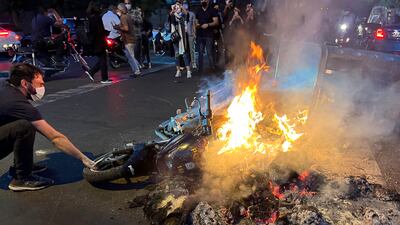
A man pulls out a police motorcycle set on fire during the protest. Amini had been detained for violating the country's conservative dress code. AP -
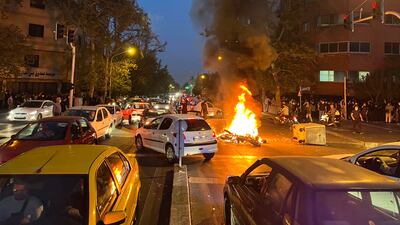
In recent months, rights activists have urged women to remove their veils in public, a gesture that would risk their arrest for defying a dress code as the country's rulers crack down on 'immoral behaviour'. AP -
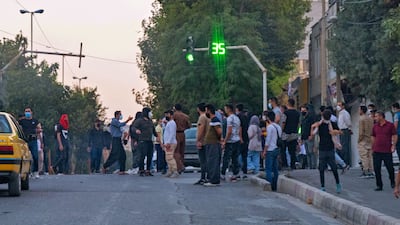
Iranians protest in Sanandaj, the capital of Iran's Kurdistan province, following the Amini's death while in custody. AFP -

Iranian police officers clash with demonstrators in Tehran. Police said Amini fell into a coma as she waited with other detained women at a morality police station, rejecting allegations that she was probably beaten. AFP


“In the short term, it [the leadership in Iran] wants to telegraph strength to the international community. It will hunker down, repress the protests, while staying optimistic publicly on the JCPOA,” Mr Brodsky added.
The mood inside the US negotiating team on Iran had soured even before the protests. A US official told The National on condition of anonymity that the odds of reaching a deal before the end of the year are “lower than 2 per cent”.
Ali Vaez, director of the Iran Project at the International Crisis Group, said the US has “no good options”.
“If it decides not to do a deal with Iran because of the brutal crackdown on the protesters, it might soon have to either bomb Iran or adjust to Iran with a [nuclear] bomb. If it decides to pursue a deal with Iran, many protesters will perceive it as a stab in the back,” Mr Vaez told The National.
He added, however, that the “only thing worse than an Iranian leadership that represses and kills its own people is a nuclear-armed Iranian leadership that does so”.

