
In a human first, Nasa on Monday deliberately rammed a spacecraft into an asteroid to deflect its orbit, in a key test of our ability to stop cosmic objects from devastating life on Earth.
The Double Asteroid Redirection Test (Dart) spaceship, launched from California last November, struck the asteroid at about 22,500kph.
The mission marks the first step towards a world capable of defending itself from a future existential threat.
Neither the asteroid moonlet Dimorphos, nor the big brother it orbits, called Didymos, pose any threat as the pair loop the Sun, passing about 11 million kilometres from Earth at their nearest approach.
But Nasa deemed the experiment important to carry out before an actual need is discovered.
By striking Dimorphos head on, Nasa hopes to push it into a smaller orbit, shaving 10 minutes off the time it takes to encircle Didymos — currently 11 hours and 55 minutes — in a change that will be detected by ground telescopes in the days or weeks to come.
The proof-of-concept experiment will make a reality of what has before only been tried in science fiction — notably in films such as Armageddon and Don't Look Up.
-
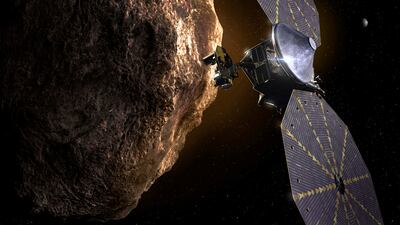
This image provided by the Southwest Research Institute depicts the 'Lucy' spacecraft approaching an asteroid. It will be the first space mission to explore a diverse population of small bodies known as the Jupiter Trojan asteroids. AP Photo -
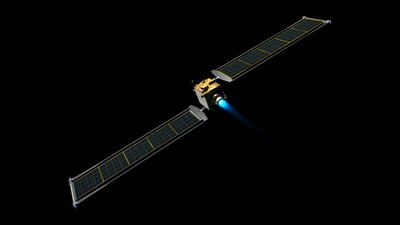
Nasa's Double Asteroid Redirection Test 'Dart' spacecraft will crash into an asteroid as part of a planetary defence experiment. The launch is scheduled for November 23. Photo: Nasa -
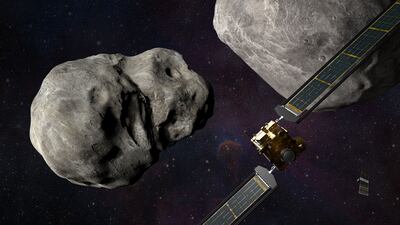
This artist's illustration obtained from Nasa shows the 'Dart' spacecraft and the Italian Space Agency’s LICIACube prior to impact at the Didymos binary system. AFP -
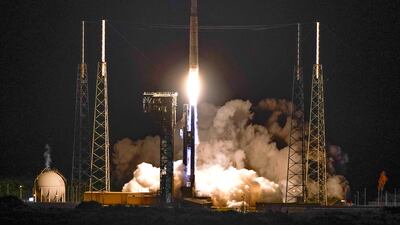
A United Launch Alliance Atlas V rocket carrying the 'Lucy' spacecraft lifts off from Launch Complex 41 at the Cape Canaveral Space Force Station. AP Photo -
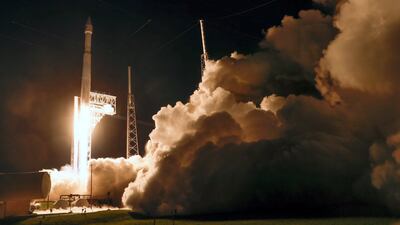
'Lucy' will observe Trojan asteroids, a unique family of asteroids that orbit the sun in front of and behind Jupiter. AP Photo -
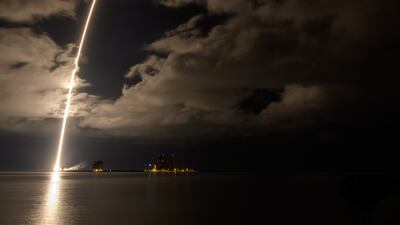
The United Launch Alliance Atlas V rocket with the 'Lucy' spacecraft takes off. EPA


As the craft propels itself through space, flying autonomously for the mission's final phase, its camera system will start to beam down the very first pictures of Dimorphos.
A toaster-sized satellite called LiciaCube, which separated from Dart a few weeks ago, will make a close pass of the site to capture images of the collision and the ejecta — the pulverised rock thrown off by the impact.
Pictures will be sent back in the next weeks and months.
An array of telescopes, on Earth and in space — including the recently operational James Webb — may have seen a brightening cloud of dust from the collision.
Very few of the billions of asteroids and comets in our solar system are considered hazardous to our planet, and none are expected in the next 100 years or so.
But “I guarantee to you that if you wait long enough, there will be an object," said Nasa's Thomas Zurbuchen.
The 10km-wide Chicxulub asteroid, for example, struck Earth 66 million years ago, plunging the world into a long winter that led to the mass extinction of 75 per cent of all species, including the dinosaurs.
An asteroid the size of Dimorphos, by contrast, would only cause a regional impact, such as devastating a city, albeit with greater force than any nuclear bomb in history.
How much momentum Dart has imparted on Dimorphos will depend on whether the asteroid is solid rock, or more like a “rubbish pile” of boulders bound by mutual gravity — a situation that is not yet known.
-
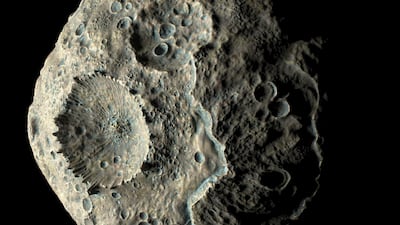
A rendering of the Psyche asteroid -

Hills are covered with fallen and burnt trees after a meteorite hit in 1908. Getty -
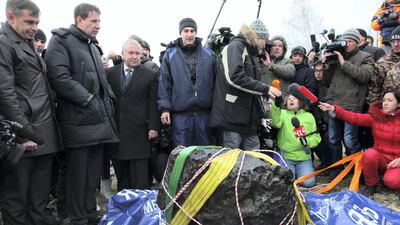
People look at what scientists believe to be a chunk of the Chelyabinsk meteor in 2013. AP -
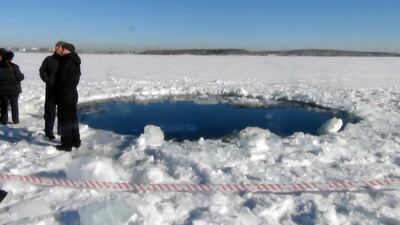
People standing near a six-metre hole in the ice of a frozen lake, reportedly the site of a meteor fall, outside the town of Chebakul in central Russia. AFP -
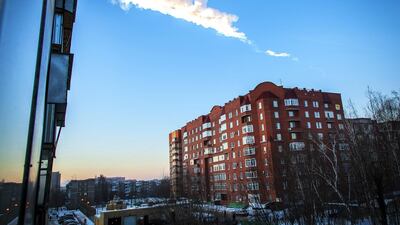
A meteorite trail is seen above a residential apartment block in the Urals city of Chelyabinsk in 2013. AFP -
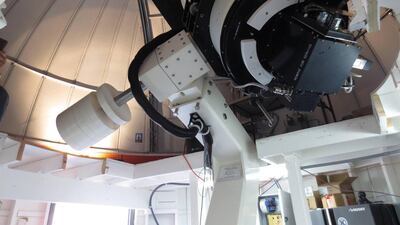
The Asteroid Terrestrial-impact Last Alert System (Atlas), pictured in Hawaii. -
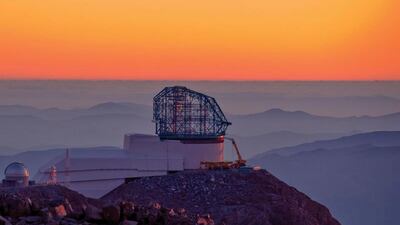
The Vera C. Rubin Observatory, under construction in 2019, promises to reveal more objects faster than any previous telescope. Photo: LSST -
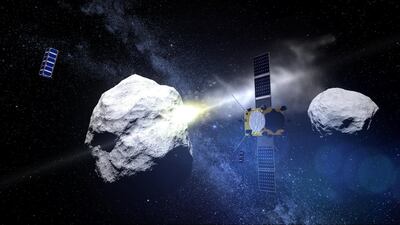
A computer-generated image shows the impact of the Dart projectile on the binary asteroid system, Didymos. ESA/AFP -
Spotlights illuminate the Saturn V booster rocket on the launch pad at the Kennedy Space Centre in Florida carrying the Apollo 8 spacecraft and its crew of three astronauts, on December 19, 1968. AP


Agence France-Presse contributed to this report

