The world is in “great peril” as nations around the world remain locked in “colossal global dysfunction” instead of tackling humanitarian and climate challenges, UN Secretary General Antonio Guterres said on Tuesday.
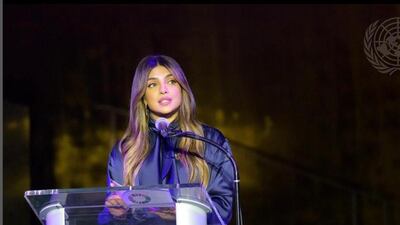
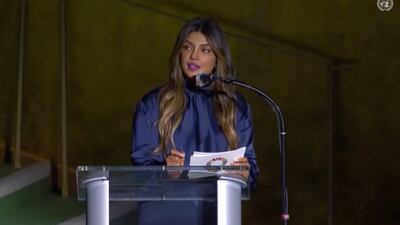
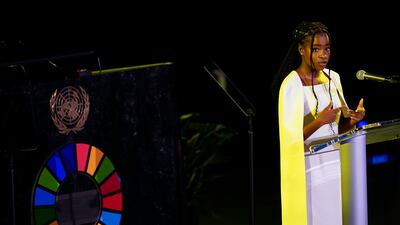
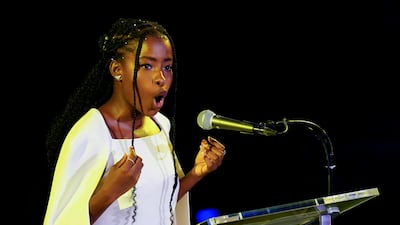
Speaking on the first day of General Debate at the annual UN General Assembly in New York, Mr Guterres urged leaders to tackle the “big dramatic challenges of our time”, from conflicts to the climate crisis and increasing poverty and inequality.
He said geopolitical divisions are “undermining the work of the Security Council and … people’s faith in democratic institutions”.
The speech began in a more hopeful tone to match the first full in-person version of the global meeting in three years, as Mr Guterres called for a return to the founding principles of the UN organisation: cooperation and dialogue.
“Let’s work as one, as a coalition of the world, as united nations”, he said. “No power or group alone can call the shots,” he said.
Mr Guterres showed a video to masked delegates of the UN's achievements over the year.
It included footage of the first UN-chartered ship carrying grain from Ukraine to the Horn of Africa, where millions of people are on the edge of famine.
The shipment was part of a deal between Ukraine and Russia that the United Nations and Turkey helped broker.
It was, Mr Guterres said, an example of promise and hope “in a world teeming with turmoil”.
But the recognition of issues ahead and a lack of global togetherness set the tone for the week-long meeting, known as the General Debate.
This year, the 193-member General Assembly returns to only in-person speeches, with a single exception — Ukrainian President Volodymyr Zelenskyy.
As nations continue to treat each other as adversaries, pressing issues of concern to all are left by the wayside, eroding people's trust in democratic institutions, he said.
“We need action across the board,” Mr Guterres said. “Let’s have no illusions, we are in rough seas, a winter of discontent is on the horizon.
“The cost of living crisis is raging, trust is crumbling, inequalities are exploding and our planet is burning.
“The divergence between developed and developing countries, between north and south, between the privileged and the rest, is becoming more dangerous by the day.
“It is at the root of the geopolitical tensions and lack of trust that poison every area of global cooperation, from vaccines to sanctions to trade.”
Mr Guterres also pointed to a potential global food shortage sparked by the loss of grain and fertiliser exports from Ukraine and Russia.
“If the fertiliser market is not stabilised, next year’s problem might be food supply itself,” he said.
“It’s essential to continue removing all obstacles to the export of Russian fertilisers and their ingredients, including ammonia. These products are not subject to sanctions.”
With the world’s spotlight on Ukraine, Mr Guterres reminded leaders of other conflicts and humanitarian crises that pose a threat to international stability.
“In Afghanistan, the economy is in ruins. In Ethiopia, fighting has resumed. In the Horn of Africa, an unprecedented drought is threatening the livelihoods of 22 million people. In Libya, divisions continue,” he said.
One such issue almost ignored by developed nations in the face of Covid-19 and conflict is the climate.
Mr Guterres pleaded with delegates to uphold their climate pledges before the Cop27 conference in Egypt this November.
He said greenhouse gas emissions are going up at record levels, on course for a 14 per cent increase this decade.
“I appeal to all leaders to realise the goals of the Paris Agreement,” he said.
“Loss and damage are happening now, hurting people and economies now, and must be addressed now — starting at Cop27.”
Mr Guterres' speech is usually followed by the US representative as host of the UN in New York.
But this year the death of Britain’s Queen Elizabeth II and her funeral in London on Monday disrupted the timetable.
President Joe Biden will now speak on Wednesday. Russia’s President Vladimir Putin is notable absentee, as well as China’s Xi Jinping.

Who's who in Yemen conflict
Houthis: Iran-backed rebels who occupy Sanaa and run unrecognised government
Yemeni government: Exiled government in Aden led by eight-member Presidential Leadership Council
Southern Transitional Council: Faction in Yemeni government that seeks autonomy for the south
Habrish 'rebels': Tribal-backed forces feuding with STC over control of oil in government territory
Essentials
The flights
Emirates, Etihad and Malaysia Airlines all fly direct from the UAE to Kuala Lumpur and on to Penang from about Dh2,300 return, including taxes.
Where to stay
In Kuala Lumpur, Element is a recently opened, futuristic hotel high up in a Norman Foster-designed skyscraper. Rooms cost from Dh400 per night, including taxes. Hotel Stripes, also in KL, is a great value design hotel, with an infinity rooftop pool. Rooms cost from Dh310, including taxes.
In Penang, Ren i Tang is a boutique b&b in what was once an ancient Chinese Medicine Hall in the centre of Little India. Rooms cost from Dh220, including taxes.
23 Love Lane in Penang is a luxury boutique heritage hotel in a converted mansion, with private tropical gardens. Rooms cost from Dh400, including taxes.
In Langkawi, Temple Tree is a unique architectural villa hotel consisting of antique houses from all across Malaysia. Rooms cost from Dh350, including taxes.
The specs
Engine: 2.0-litre 4cyl turbo
Power: 261hp at 5,500rpm
Torque: 405Nm at 1,750-3,500rpm
Transmission: 9-speed auto
Fuel consumption: 6.9L/100km
On sale: Now
Price: From Dh117,059
TCL INFO
Teams:
Punjabi Legends Owners: Inzamam-ul-Haq and Intizar-ul-Haq; Key player: Misbah-ul-Haq
Pakhtoons Owners: Habib Khan and Tajuddin Khan; Key player: Shahid Afridi
Maratha Arabians Owners: Sohail Khan, Ali Tumbi, Parvez Khan; Key player: Virender Sehwag
Bangla Tigers Owners: Shirajuddin Alam, Yasin Choudhary, Neelesh Bhatnager, Anis and Rizwan Sajan; Key player: TBC
Colombo Lions Owners: Sri Lanka Cricket; Key player: TBC
Kerala Kings Owners: Hussain Adam Ali and Shafi Ul Mulk; Key player: Eoin Morgan
Venue Sharjah Cricket Stadium
Format 10 overs per side, matches last for 90 minutes
When December 14-17
Timeline
2012-2015
The company offers payments/bribes to win key contracts in the Middle East
May 2017
The UK SFO officially opens investigation into Petrofac’s use of agents, corruption, and potential bribery to secure contracts
September 2021
Petrofac pleads guilty to seven counts of failing to prevent bribery under the UK Bribery Act
October 2021
Court fines Petrofac £77 million for bribery. Former executive receives a two-year suspended sentence
December 2024
Petrofac enters into comprehensive restructuring to strengthen the financial position of the group
May 2025
The High Court of England and Wales approves the company’s restructuring plan
July 2025
The Court of Appeal issues a judgment challenging parts of the restructuring plan
August 2025
Petrofac issues a business update to execute the restructuring and confirms it will appeal the Court of Appeal decision
October 2025
Petrofac loses a major TenneT offshore wind contract worth €13 billion. Holding company files for administration in the UK. Petrofac delisted from the London Stock Exchange
November 2025
180 Petrofac employees laid off in the UAE
The specs
AT4 Ultimate, as tested
Engine: 6.2-litre V8
Power: 420hp
Torque: 623Nm
Transmission: 10-speed automatic
Price: From Dh330,800 (Elevation: Dh236,400; AT4: Dh286,800; Denali: Dh345,800)
On sale: Now
How to watch Ireland v Pakistan in UAE
When: The one-off Test starts on Friday, May 11
What time: Each day’s play is scheduled to start at 2pm UAE time.
TV: The match will be broadcast on OSN Sports Cricket HD. Subscribers to the channel can also stream the action live on OSN Play.
ENGLAND SQUAD
Joe Root (captain), Dom Sibley, Rory Burns, Dan Lawrence, Ben Stokes, Ollie Pope, Ben Foakes (wicketkeeper), Moeen Ali, Olly Stone, Chris Woakes, Jack Leach, Stuart Broad
Groom and Two Brides
Director: Elie Semaan
Starring: Abdullah Boushehri, Laila Abdallah, Lulwa Almulla
Rating: 3/5
Benefits of first-time home buyers' scheme
- Priority access to new homes from participating developers
- Discounts on sales price of off-plan units
- Flexible payment plans from developers
- Mortgages with better interest rates, faster approval times and reduced fees
- DLD registration fee can be paid through banks or credit cards at zero interest rates
UAE currency: the story behind the money in your pockets
UAE tour of Zimbabwe
All matches in Bulawayo
Friday, Sept 26 – UAE won by 36 runs
Sunday, Sept 28 – Second ODI
Tuesday, Sept 30 – Third ODI
Thursday, Oct 2 – Fourth ODI
Sunday, Oct 5 – First T20I
Monday, Oct 6 – Second T20I
Mercer, the investment consulting arm of US services company Marsh & McLennan, expects its wealth division to at least double its assets under management (AUM) in the Middle East as wealth in the region continues to grow despite economic headwinds, a company official said.
Mercer Wealth, which globally has $160 billion in AUM, plans to boost its AUM in the region to $2-$3bn in the next 2-3 years from the present $1bn, said Yasir AbuShaban, a Dubai-based principal with Mercer Wealth.
“Within the next two to three years, we are looking at reaching $2 to $3 billion as a conservative estimate and we do see an opportunity to do so,” said Mr AbuShaban.
Mercer does not directly make investments, but allocates clients’ money they have discretion to, to professional asset managers. They also provide advice to clients.
“We have buying power. We can negotiate on their (client’s) behalf with asset managers to provide them lower fees than they otherwise would have to get on their own,” he added.
Mercer Wealth’s clients include sovereign wealth funds, family offices, and insurance companies among others.
From its office in Dubai, Mercer also looks after Africa, India and Turkey, where they also see opportunity for growth.
Wealth creation in Middle East and Africa (MEA) grew 8.5 per cent to $8.1 trillion last year from $7.5tn in 2015, higher than last year’s global average of 6 per cent and the second-highest growth in a region after Asia-Pacific which grew 9.9 per cent, according to consultancy Boston Consulting Group (BCG). In the region, where wealth grew just 1.9 per cent in 2015 compared with 2014, a pickup in oil prices has helped in wealth generation.
BCG is forecasting MEA wealth will rise to $12tn by 2021, growing at an annual average of 8 per cent.
Drivers of wealth generation in the region will be split evenly between new wealth creation and growth of performance of existing assets, according to BCG.
Another general trend in the region is clients’ looking for a comprehensive approach to investing, according to Mr AbuShaban.
“Institutional investors or some of the families are seeing a slowdown in the available capital they have to invest and in that sense they are looking at optimizing the way they manage their portfolios and making sure they are not investing haphazardly and different parts of their investment are working together,” said Mr AbuShaban.
Some clients also have a higher appetite for risk, given the low interest-rate environment that does not provide enough yield for some institutional investors. These clients are keen to invest in illiquid assets, such as private equity and infrastructure.
“What we have seen is a desire for higher returns in what has been a low-return environment specifically in various fixed income or bonds,” he said.
“In this environment, we have seen a de facto increase in the risk that clients are taking in things like illiquid investments, private equity investments, infrastructure and private debt, those kind of investments were higher illiquidity results in incrementally higher returns.”
The Abu Dhabi Investment Authority, one of the largest sovereign wealth funds, said in its 2016 report that has gradually increased its exposure in direct private equity and private credit transactions, mainly in Asian markets and especially in China and India. The authority’s private equity department focused on structured equities owing to “their defensive characteristics.”