

US President Joe Biden says the Covid-19 pandemic in the US is finished, despite the country recording hundreds of deaths a day from the virus.
“The pandemic is over,” Mr Biden said in a wide-ranging interview televised on CBS on Sunday, when he also sought to reassure Americans about high levels of inflation.
“We still have a problem with Covid. We're still doing a lotta work on it. … but the pandemic is over. If you notice, no one's wearing masks,” he said on the sidelines of the Detroit auto show that opened on Wednesday, after a two-year absence.
Coronavirus-related fatalities have fallen significantly over the past year with the increased accessibility of vaccines and other medications.
But almost 400 Americans are dying every day from Covid-19, data from the Centres for Disease and Control and Prevention shows.
Dozens of protesters gathered outside the White House on Monday, calling on Mr Biden's administration to declare long Covid a national emergency, start a public health education campaign on the disease and support people who are suffering from lingering symptoms.
-
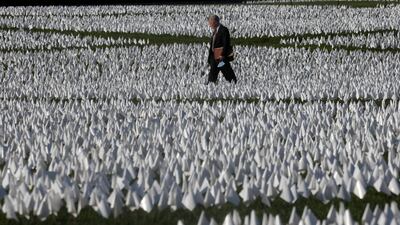
FILE PHOTO: People visit Suzanne Brennan Firstenberg's "In America: Remember", a memorial for Americans who died due to the coronavirus disease (COVID-19) as the national death toll nears 700,000, next to the Washington Monument in Washington, U.S., October 1, 2021. REUTERS/Leah Millis/File Photo -
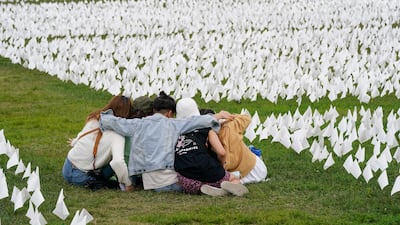
FILE - In this Sept. 21, 2021, file photo, visitors sit among white flags that are part of artist Suzanne Brennan Firstenberg's "In America: Remember," a temporary art installation to commemorate Americans who have died of COVID-19, on the National Mall in Washington. Firstenberg was struck by how strangers connected in their grief at the installation, which ended Oct. 3. (AP Photo / Patrick Semansky, File) -
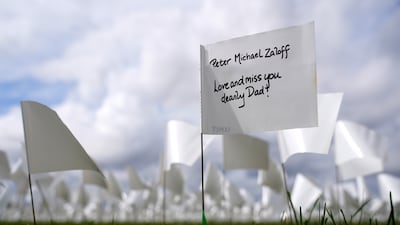
FILE - In this Sept. 21, 2021, file photo, message marks a white flag that is part of artist Suzanne Brennan Firstenberg's "In America: Remember," a temporary art installation to commemorate Americans who have died of COVID-19, on the National Mall in Washington. (AP Photo / Patrick Semansky, File) -
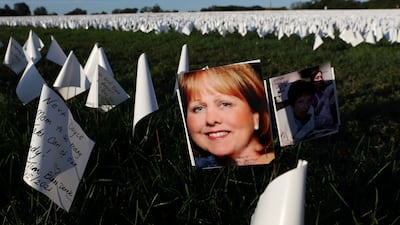
A photograph can be seen attached to a flag as part of Suzanne Brennan Firstenberg's "In America: Remember", a memorial for Americans who died due to the coronavirus disease (COVID-19) as the national death toll nears 700,000, next to the Washington Monument in Washington, U. S. , October 1, 2021. REUTERS/Leah Millis REFILE - CORRECTING FULL NAME. NO RESALES. NO ARCHIVES -
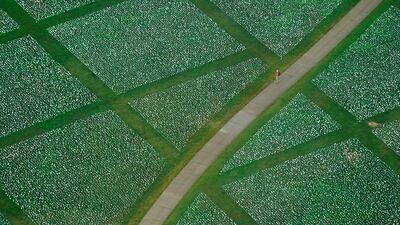
A visitor walks past artist Suzanne Brennan Firstenberg's "In America: Remember," a temporary art installation made up of white flags to commemorate Americans who have died of COVID-19, on the National Mall in Washington, Wednesday, Sept. 22, 2021. (AP Photo / Patrick Semansky) -

White flags that are part of artist Suzanne Brennan Firstenberg's "In America: Remember," a temporary art installation to commemorate Americans who have died of COVID-19, stand on the National Mall in Washington, Wednesday, Sept. 22, 2021. (AP Photo / Patrick Semansky) -
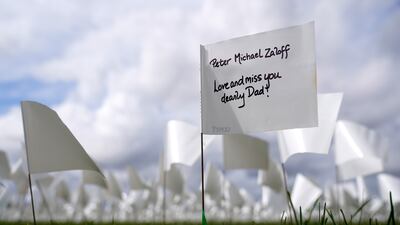
A message marks a white flag that is part of artist Suzanne Brennan Firstenberg's "In America: Remember," a temporary art installation to commemorate Americans who have died of COVID-19, on the National Mall in Washington, Tuesday, Sept. 21, 2021. (AP Photo / Patrick Semansky) -

People visit artist Suzanne Brennan Firstenberg's "In America: Remember," a temporary art installation made up of white flags to commemorate Americans who have died of COVID-19, on the National Mall in Washington, Tuesday, Sept. 21, 2021. (AP Photo / Patrick Semansky) -
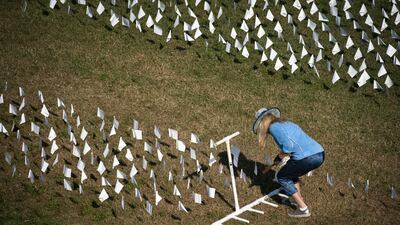
WASHINGTON, DC - SEPTEMBER 19: In this elevated view, artist Suzanne Brennan Firstenberg plants new white flags at 'In America: Remember' public art installation near the Washington Monument on September 19, 2021 in Washington, DC. The installation commemorates all the Americans who have died due to COVID-19. It's based on a concept by Firstenberg, and includes more than 650,000 small plastic flags, some with personal messages to those who have died, planted in 20 acres of the National Mall. Al Drago / Getty Images / AFP -
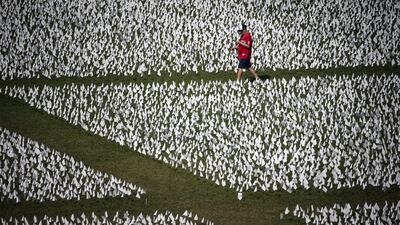
WASHINGTON, DC - SEPTEMBER 19: In this elevated view, people walk through the flags of the 'In America: Remember' public art installation near the Washington Monument on September 19, 2021 in Washington, DC. The installation commemorates all the Americans who have died due to COVID-19. It's based on a concept by artist Suzanne Brennan Firstenberg, and includes more than 650,000 small plastic flags, some with personal messages to those who have died, planted in 20 acres of the National Mall. Al Drago / Getty Images / AFP -

WASHINGTON, DC - SEPTEMBER 19: In this elevated view, people walk through the flags of the 'In America: Remember' public art installation near the Washington Monument on September 19, 2021 in Washington, DC. The installation commemorates all the Americans who have died due to COVID-19. It's based on a concept by artist Suzanne Brennan Firstenberg, and includes more than 650,000 small plastic flags, some with personal messages to those who have died, planted in 20 acres of the National Mall. Al Drago / Getty Images / AFP -

WASHINGTON, DC - SEPTEMBER 17: Runners pass 'In America: Remember,' a public art installation commemorating all the Americans who have died due to COVID-19 near the Washington Monument on September 17, 2021 in Washington, DC. The concept of artist Suzanne Brennan Firstenberg, the installation includes more than 660,000 small plastic flags, some with personal messages to those who have died, planted in 20 acres of the National Mall. Chip Somodevilla / Getty Images / AFP -

More than 660,000 white flags carpet the National Mall to commemorate the American lives lost to Covid in Washington, DC, USA, 16 September 2021. The installation, called ‘In America: Remember’ is the work of artist Suzanne Brennan Firstenberg. It officially opens to the public on 17 September. EPA / JIM LO SCALZO -
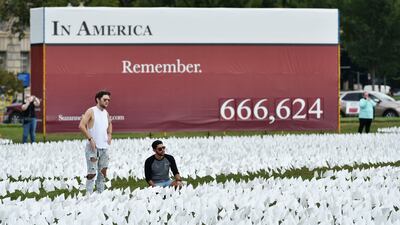
Men are seen in a field of white flags on the Mall near the Washington Monument in Washington, DC on September 16, 2021. - The project, by artist Suzanne Brennan Firstenberg, uses over 600,00 miniature white flags to symbolize the lives lost to Covid-19 in the US. (Photo by MANDEL NGAN / AFP) -
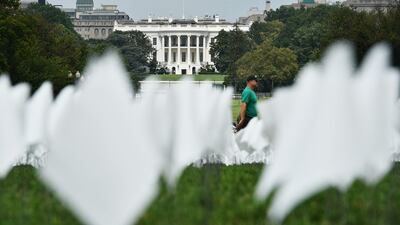
The White House is seen behind a field of white flags on the Mall, near the Washington Monument in Washington, DC on September 16, 2021. - The project, by artist Suzanne Brennan Firstenberg, uses over 600,00 miniature white flags to symbolize the lives lost to Covid-19 in the US. (Photo by MANDEL NGAN / AFP) -

WASHINGTON, DC - SEPTEMBER 21: People walk through 'In America: Remember,' a public art installation commemorating all the Americans who have died due to COVID-19, on the National Mall September 21, 2021 in Washington, DC. The concept of artist Suzanne Brennan Firstenberg, the installation includes more than 660,000 small plastic flags, some with personal messages to those who have died, planted in 20 acres of the National Mall. Drew Angerer / Getty Images / AFP


Long Covid can involve constant fatigue, respiratory and heart problems and other symptoms for months or years after an initial Covid-19 infection, the US Centres for Disease Control and Prevention says.
Some who are suffering long Covid also say they deal with ME/CFS [myalgic encephalomyelitis and chronic fatigue syndrome], which brings about extreme fatigue after physical or mental activity.
It is also leading to millions leaving the American workforce.
“We are sick and disabled with ME/CFS and long Covid," ” said Ben HsuBorger, of the ME Action Network, who has ME/CFS.
"But we are here today, putting our bodies on the line, to tell President Biden that the pandemic is not over, that millions of us are being disabled from post-viral disease and we need urgent action from our government."
Long Covid is recognised as a disability by the US Health and Human Services Department, and it is estimated that between 10 to 30 per cent of people infected with coronavirus may have it.
Mr Biden asked Congress for another $22.4 billion to prepare for a possible surge in cases this autumn.
-

People ride a New Jersey bus after the US government announced it would no longer enforce a mask mandate on public transport. Reuters -
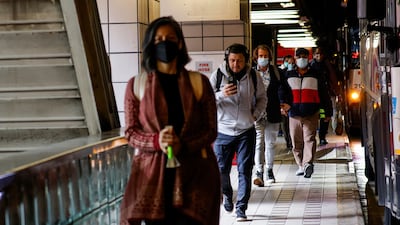
People arrive at a New Jersey transit station after the nationwide public transport mask mandate is repealed. Reuters -
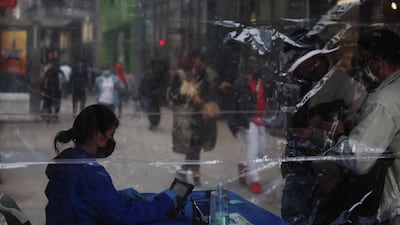
A healthcare administrator checks paperwork at a mobile Covid-19 testing centre outside Pennsylvania Station in New York City. Reuters -
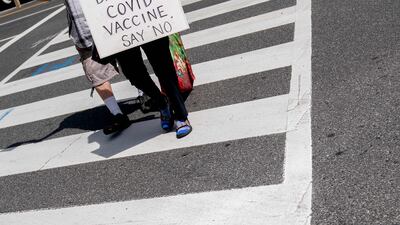
A person carries a sign protesting Covid-19 vaccines in Washington. AFP -
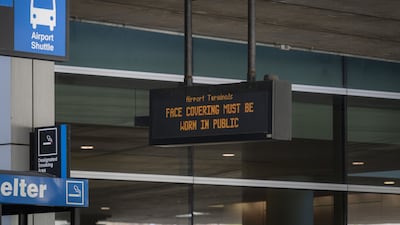
A sign urges passengers to wear masks at Logan International Airport in Boston, Massachusetts. Bloomberg -
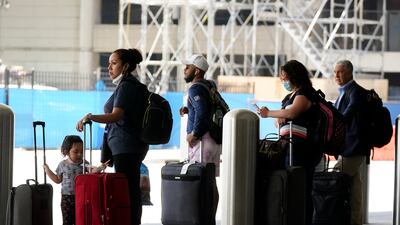
Travellers wait for transport outside of the Los Angeles International Airport. AP -
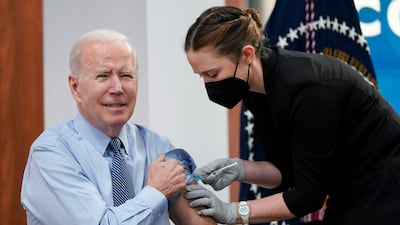
President Joe Biden receives his second Covid-19 booster shot on March 30, 2022, in Washington. AP -
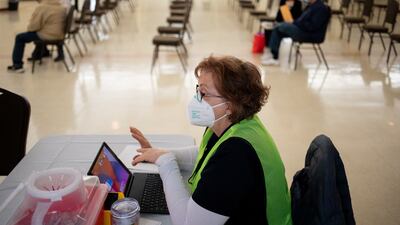
A nurse registers people for second booster shots of the Covid-19 vaccine in Waterford, Michigan. Reuters -
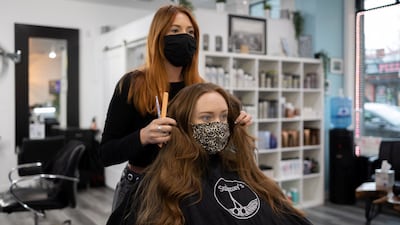
A woman gets a haircut as the indoor mask mandate is temporarily reinstated in Philadelphia, Pennsylvania. Reuters -
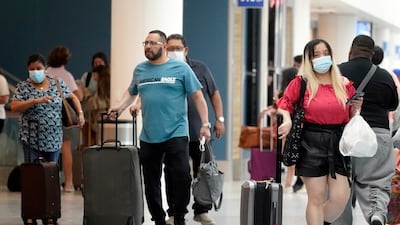
Travellers walk to their destinations at the Los Angeles International Airport. AP -
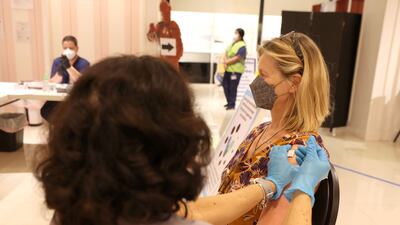
A nurse administers a Covid-19 booster vaccination at a clinic in San Rafael, California. AFP -
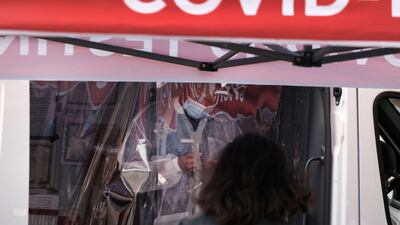
A medical worker administers Covid-19 tests in Brooklyn, New York. AFP -
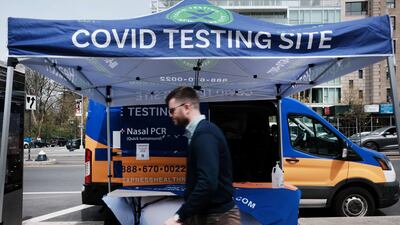
A Covid-19 testing site stands on a Brooklyn street corner in New York City. AFP -
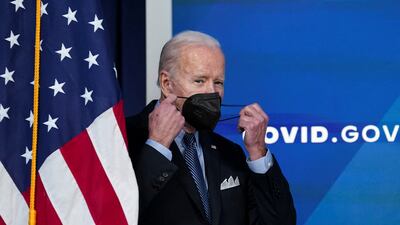
US President Joe Biden removes his face mask before delivering remarks at the White House in Washington. Reuters


His comments come as the Federal Reserve is geared to raise interest rates yet again, a sign of the central bank's overarching focus on battling inflation after spending much of the previous years providing support to the US economy in response to the pandemic.
The Fed has been taking aggressive action to tackle the nation's highest inflation rate in decades, raising interest rates by three-quarters of a percentage point in back-to-back meetings.
The central bank is expected to raise interest rates by 75 basis points again when it meets this week.
Raising the interest rates would make borrowing costs — such as taking out a mortgage, car loan or business loan — more expensive, which the Fed hopes would slow down the economy.
Fed Chairman Jerome Powell said his goal was to achieve a “soft landing” by slowing down the economy without driving it into a recession.
“I'm telling the American people that we're gonna get control of inflation,” Mr Biden said in the 60 Minutes interview, noting that he has his hopes of a soft landing.
The president has repeatedly pointed to the labour market as an indicator of a strong economy, but those gains could be undone by the Fed's weakening of the economy.
And the central bank's soft-landing goal took a hit last week when a government report showed US inflation over the past year was at 8.3 per cent.
Inflation has taken a toll on Americans, as a majority now say that price increases have caused financial hardship for their households, a new Gallup poll showed.
While lower petrol prices have provided some good news for the president, less than one-third of voters approve his handling of the economy.
Mr Biden's approval rating still hovers around 40 per cent, an indicator of Democrats' chances to retain their Congressional majorities after the midterm elections in November.
Up for re-election in 2024, Mr Biden said it was “much too early” to make a firm determination if he would run again, opening the possibility that he may decide against it.
“Look, my intention as I said to begin with is that I would run again. But it's just an intention. But is it a firm decision that I run again? That remains to be seen,” he told CBS.

