The Georgetown University campus in Washington. It will cost more than $61,000 to attend Georgetown for the 2022-2023 school year. AFP

Who is eligible for Biden's student loan forgiveness plan in the US?


  • English
  • Arabic

US President Joe Biden this week unveiled a plan that would eliminate between $10,000 and $20,000 in student loan debt for borrowers across the country.

Mr Biden said his long-awaited plan would “provide more breathing room” for people struggling to pay off student loans. The White House estimates that 45 million borrowers have accumulated $1.6 trillion in debt.

The average tuition for public, four-year universities in the US from 2020-21 cost $9,400. That number exceeds $37,000 per year for private, non-profit institutions, the National Centre for Education Statistics reported.

If the plan survives the probable legal challenges to come, it could wipe out student debt for 20 million people, Mr Biden said.

Who is eligible?

People who are single and have an income of under $125,000 qualify for the $10,000 student loan debt elimination. Those who are married and have a joint income of under $250,000 will also be eligible.

Eligibility is based on adjusted gross income and only federal student loan debt is eligible.

People who received a Pell Grant and do not exceed the income threshold will be eligible to have up to $20,000 in student loan debt cancelled.

Pell Grants, which generally do not have to be repaid, are reserved for university students with the most significant financial need. About 27 million Pell Grant recipients are eligible for loan forgiveness.

Students currently enrolled in university will qualify for the debt relief measure if their loans were issued before July 1 and if their parents earn less than $250,000 per year. The plan does not apply to future university students.

How do you apply?

Some people will not need to apply for the student loan debt relief because the US Department of Education has income data for a small portion of borrowers. Others will need to prove their incomes via an application process.

Applications will be available before the end of the year, officials said.

NYU in-person graduation - in pictures

  • Confetti drops on graduates as they celebrate during a graduation ceremony for New York University at Yankee Stadium. AP
    Confetti drops on graduates as they celebrate during a graduation ceremony for New York University at Yankee Stadium. AP
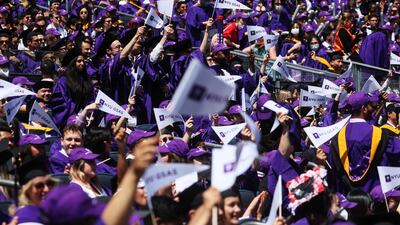
  • Students kept away from in-person ceremonies in 2020 and 2021 were given the opportunity to celebrate their accomplishments with friends. Reuters
    Students kept away from in-person ceremonies in 2020 and 2021 were given the opportunity to celebrate their accomplishments with friends. Reuters
  • It was a sea of purple and gold. Reuters
    It was a sea of purple and gold. Reuters
  • Graduates celebrate at New York University's 2022 commencement ceremony at Yankees Stadium in the Bronx borough. It was followed by special ceremonies for the classes of 2020 and 2021. EPA
    Graduates celebrate at New York University's 2022 commencement ceremony at Yankees Stadium in the Bronx borough. It was followed by special ceremonies for the classes of 2020 and 2021. EPA
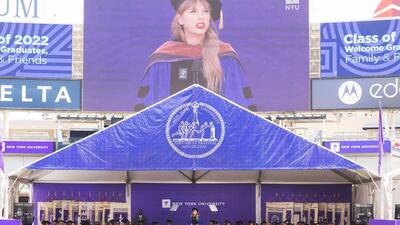
  • US singer Taylor Swift receives an honourary doctorate in fine arts. EPA
    US singer Taylor Swift receives an honourary doctorate in fine arts. EPA
  • Swift in the sea of celebrating graduates. Reuters
    Swift in the sea of celebrating graduates. Reuters
  • Swift addresses the graduates at the commencement ceremony. EPA
    Swift addresses the graduates at the commencement ceremony. EPA
  • Family and friends held up cardboard cutouts of the faces of graduating students in a show of pride. Reuters
    Family and friends held up cardboard cutouts of the faces of graduating students in a show of pride. Reuters
  • Some graduates still prefer social distancing. Reuters
    Some graduates still prefer social distancing. Reuters

Mercer, the investment consulting arm of US services company Marsh & McLennan, expects its wealth division to at least double its assets under management (AUM) in the Middle East as wealth in the region continues to grow despite economic headwinds, a company official said.

Mercer Wealth, which globally has $160 billion in AUM, plans to boost its AUM in the region to $2-$3bn in the next 2-3 years from the present $1bn, said Yasir AbuShaban, a Dubai-based principal with Mercer Wealth.

Within the next two to three years, we are looking at reaching $2 to $3 billion as a conservative estimate and we do see an opportunity to do so,” said Mr AbuShaban.

Mercer does not directly make investments, but allocates clients’ money they have discretion to, to professional asset managers. They also provide advice to clients.

“We have buying power. We can negotiate on their (client’s) behalf with asset managers to provide them lower fees than they otherwise would have to get on their own,” he added.

Mercer Wealth’s clients include sovereign wealth funds, family offices, and insurance companies among others.

From its office in Dubai, Mercer also looks after Africa, India and Turkey, where they also see opportunity for growth.

Wealth creation in Middle East and Africa (MEA) grew 8.5 per cent to $8.1 trillion last year from $7.5tn in 2015, higher than last year’s global average of 6 per cent and the second-highest growth in a region after Asia-Pacific which grew 9.9 per cent, according to consultancy Boston Consulting Group (BCG). In the region, where wealth grew just 1.9 per cent in 2015 compared with 2014, a pickup in oil prices has helped in wealth generation.

BCG is forecasting MEA wealth will rise to $12tn by 2021, growing at an annual average of 8 per cent.

Drivers of wealth generation in the region will be split evenly between new wealth creation and growth of performance of existing assets, according to BCG.

Another general trend in the region is clients’ looking for a comprehensive approach to investing, according to Mr AbuShaban.

“Institutional investors or some of the families are seeing a slowdown in the available capital they have to invest and in that sense they are looking at optimizing the way they manage their portfolios and making sure they are not investing haphazardly and different parts of their investment are working together,” said Mr AbuShaban.

Some clients also have a higher appetite for risk, given the low interest-rate environment that does not provide enough yield for some institutional investors. These clients are keen to invest in illiquid assets, such as private equity and infrastructure.

“What we have seen is a desire for higher returns in what has been a low-return environment specifically in various fixed income or bonds,” he said.

“In this environment, we have seen a de facto increase in the risk that clients are taking in things like illiquid investments, private equity investments, infrastructure and private debt, those kind of investments were higher illiquidity results in incrementally higher returns.”

The Abu Dhabi Investment Authority, one of the largest sovereign wealth funds, said in its 2016 report that has gradually increased its exposure in direct private equity and private credit transactions, mainly in Asian markets and especially in China and India. The authority’s private equity department focused on structured equities owing to “their defensive characteristics.”

UAE currency: the story behind the money in your pockets
EMILY%20IN%20PARIS%3A%20SEASON%203
%3Cp%3ECreated%20by%3A%20Darren%20Star%3C%2Fp%3E%0A%3Cp%3EStarring%3A%20Lily%20Collins%2C%20Philippine%20Leroy-Beaulieu%2C%20Ashley%20Park%3C%2Fp%3E%0A%3Cp%3ERating%3A%202.75%2F5%3C%2Fp%3E%0A
Updated: August 26, 2022, 8:28 AM