
Joseph Westphal, a former US ambassador to Saudi Arabia, has said the normalisation of ties between Saudi Arabia and Israel is “inevitable” and that President Joe Biden should seek a reset of relations with Riyadh during his coming trip.
“I think [normalisation is] coming, that’s absolutely coming and it's inevitable. It's inevitable,” Mr Westphal told The National on Monday.
Now a professor at the Lauder Institute at the University of Pennsylvania's Wharton School, Mr Westphal served as ambassador to Riyadh during former president Barack Obama's administration between 2014 and 2017.
Preparations under way for Biden Israel visit
Saudi Arabia never established diplomatic relations with Israel after its foundation in 1948, but recent efforts — including a push by the Biden administration before the president's trip to the region begins on Wednesday — have opened the door for the gradual improvement of ties.
Mr Westphal said the inevitability of normalisation is due to a generational shift in the kingdom, and a confluence of security and economic interests.
Saudi Arabia's "King Salman, who I got to know very well when I was there as ambassador and have huge respect for him, he is from the generation that really believes that we should do more to help the Palestinian people”, he said.
Crown Prince Mohammed bin Salman, however, “is of a different generation that sees the world with a different set of lenses”.
“Eventually it will shift as long as we [the US] continue to work to do something and support the Palestinian people,” Mr Westphal said.
Saudi Arabia's Prince Mohammed bin Salman receives Iraqi Prime Minister — in pictures
-
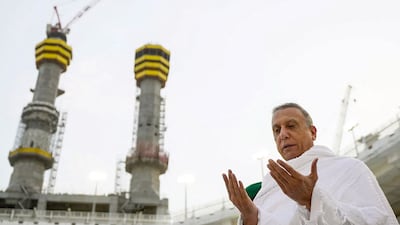
Iraqi Prime Minister Mustafa Al Kadhimi prays by the Kaaba at the Grand Mosque complex in the Saudi Arabian holy city of Makkah, as he performs Umrah. AFP -
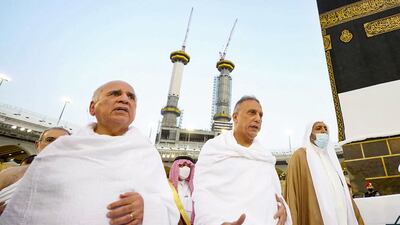
Mustafa Al Kadhimi circumambulates the Kaaba at the Grand Mosque. AFP -
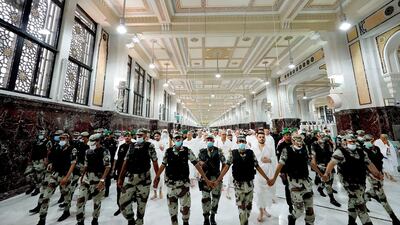
Mustafa Al Kadhimi, surrounded by security forces at the Grand Mosque complex in Makkah. AFP -
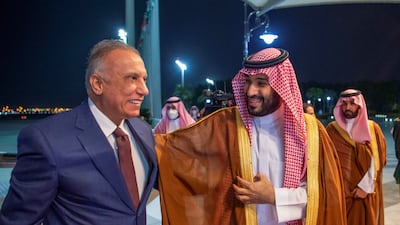
Saudi Arabia's Crown Prince Mohammed bin Salman meets Iraqi Prime Minister Mustafa Al Kadhimi, upon his arrival in Jeddah, Saudi Arabia. Reuters -

The two leaders embrace. Reuters -
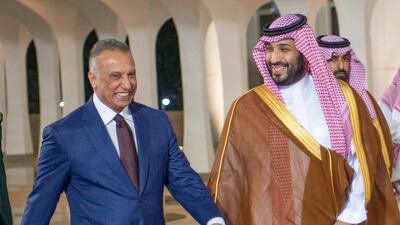
Saudi Crown Prince Mohammed bin Salman accompanies Iraqi Prime Minister Mustafa Al Kadhimi, upon his arrival at King Abdulaziz International Airport in Jeddah. Saudi Royal Palace/AP -

Saudi Crown Prince Mohammed bin Salman meets Iraqi Prime Minister Mustafa Al Kadhimi, in Jeddah. Reuters -

Saudi Crown Prince Mohammed bin Salman meets Iraqi Prime Minister Mustafa Al Kadhimi, in Jeddah. Reuters -

Saudi Crown Prince Mohammed bin Salman meets Iraqi Prime Minister Mustafa Al Kadhimi, in Jeddah. Reuters -

Saudi Crown Prince Mohammed bin Salman meets Iraqi Prime Minister Mustafa Al Kadhimi, in Jeddah. Reuters -
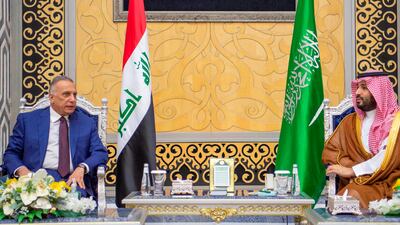
Saudi Crown Prince Mohammed bin Salman meets Iraqi Prime Minister Mustafa Al Kadhimi, in Jeddah. Saudi Royal Palace / AP -

Saudi Crown Prince Mohammed bin Salman meets Iraqi Prime Minister Mustafa Al Kadhimi, in Jeddah. Reuters -

Saudi Crown Prince Mohammed bin Salman meets Iraqi Prime Minister Mustafa Al Kadhimi, in Jeddah. Reuters


The diplomat and former secretary of the US Army said the normalisation would be gradual.
“You’ll see more and more Saudi Arabia and Israel coming together and [establishing] diplomatic relations,” he said.
He pointed to technological, cyber, economic and security co-operation with Israel as some of the main incentives for Riyadh.
Mr Biden will be the first US president to fly from Israel to Saudi Arabia on Friday. His predecessor, Donald Trump, was the first to make the journey from Riyadh to Tel Aviv in 2017.
The former ambassador described Mr Biden's visit as extremely important in the context of bilateral, regional and global politics, especially due to the fact that current US-Saudi relations are “fractured”.
For the past year and a half, US-Saudi tension has increased due to the killing of Saudi journalist Jamal Khashoggi and Riyadh's position on oil production, particularly following the Russian invasion of Ukraine.
“[The relationship is] fractured for a lot of reasons, some of which are political posturing on the part of everybody involved,” Mr Westphal said. “It’s time to reset it.”
Biden: Middle East trip not aimed at pressuring Gulf states for oil
The situation is becoming urgent for the US, he said, pointing to how China has made inroads in the Middle East both financially and economically.
“And that's not in our best interest,” he said. “We're losing a huge trade opportunity and a huge commercial opportunity.”
Mr Westphal — who worked directly with Mr Biden from 2009 to 2016 when he was vice president — expressed optimism over the president's ability to establish a working relationship with Prince Mohammed despite past remarks and criticism of Saudi Arabia's human rights record.
“I know President Biden. I've known him forever … One of his strongest characteristics is [that] he is a negotiator,” Mr Westphal said.
“He is a bridge builder. He did it for years and years in the Senate, with Republican opponents and sometimes with his own Democrats who opposed him … He will come around and find a way to work with Prince Mohammed and to restore this relationship in a positive [manner].”
The former ambassador added that Prince Mohammed has enacted sweeping social and economic reforms.
“We have to recognise that this is a leader that has made significant progress … along the way, he's made mistakes and he's realised those mistakes and now it's time to you to put everything on the table,” Mr Westphal said.
“It's time to recommit to our relationship and go forward.”
Security and regional defence issues will be at the top of the agenda during Mr Biden's visit, Mr Westphal said, especially during the meetings with the Gulf Corporation Council and Jordan, Iraq and Egypt (GCC+3), which will take place on Saturday.
The US plays unique role in the security of the region, he said.
“We have to step up. We can't say we're going to protect the sovereignty of a country and then when they get attacked, we don't do anything, which is what happened when the Iranians bombed Aramco [in 2019].”
Mr Trump decided not to respond to the attack despite his bombastic rhetoric on Tehran.
Mr Westphal supported the idea of a regional defence coalition within the GCC+3 framework.
“It focuses on things like security, cyber security, intelligence, as well as economic trade and development. In other words, to create a better union of these countries to protect the trade routes.”
This would require the US providing those countries “with the right defence mechanisms and equipment that they need, whether it's Patriot batteries or missile systems to equipment to counter ballistic missiles”.
Asked what would constitute a successful visit, the former ambassador said the proof would be in the follow-up meetings.
“This would be just the beginning, the first step, then we will send the secretary of defence, the secretary of state, the secretary of commerce, engage the private sector and others within the region to talk about how we work on all these issues,” Mr Westphal said.

