

A bipartisan group in the US Congress on Thursday unveiled an ambitious bill that would require the Pentagon to co-operate with Middle East allies and enact an integrated air and missile defence capability to protect against strikes from Iran.
The so-called Defend Act (Deterring Enemy Forces and Enabling National Defences) marks the first legislative effort of the Abraham Accords caucus, which was formed in January.
The bill envisions a regional defence strategy that would “protect the people, infrastructure and territory of such countries from cruise and ballistic missiles, manned and unmanned aerial systems, and rocket attacks from Iran and groups linked to Iran”.
“The full potential of the Abraham Accords — economic co-operation, education exchanges, trade agreements between Israel and our Middle Eastern partners — cannot be achieved without a commitment to collective security,” Joni Ernst, a Republican senator, said.
In addition to the signatories to the Abraham Accords — the UAE, Bahrain and Morocco — the defensive shield would also benefit Gulf Co-operation Council countries as well as Iraq, Israel, Jordan and Egypt.
The legislation requires the Department of Defence to issue a report to Congress on the possibility of establishing a fund for an integrated defence system to counter threats, including cruise and ballistic missiles, drone systems and rocket attacks from Iran.
It enjoys bipartisan support from high-ranking senators such as Cory Booker, Jacky Rosen and James Lankford.
“As US forces and our partners in the Middle East face increasingly sophisticated air and missile threats from Iran and its terrorist proxies, we must act in a co-ordinated way to defend against shared threats,” Ms Rosen said.
“As missile threats against our partners in the Middle East increase, this bipartisan legislation is critical to ensuring the safety and security of the region,” Mr Booker said.
The Abraham Accords caucus was formed in the Senate and the House to build on the success of the historic agreements that led to UAE, Bahrain and Morocco normalising diplomatic relations with Israel.
It was not immediately clear how the legislation would be received in the region.
-
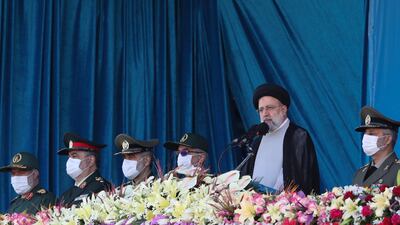
Iranian President Ebrahim Raisi speaking during celebrations marking the annual National Army Day in Tehran. EPA -
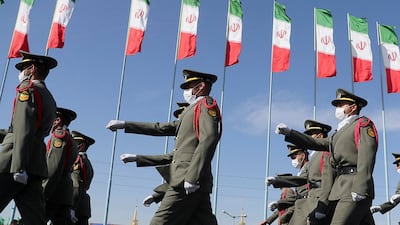
Iranian armed forces personnel march during the ceremony. Wana (West Asia News Agency) -
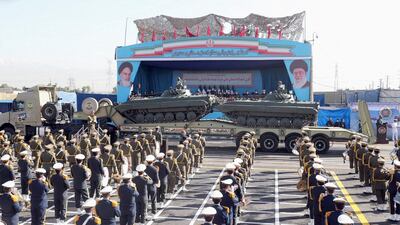
Mr Raisi made a televised speech as talks stalled in Vienna over a deal to rein in Iran’s nuclear capabilities, which Tehran says are for energy and medical purposes. Reuters -
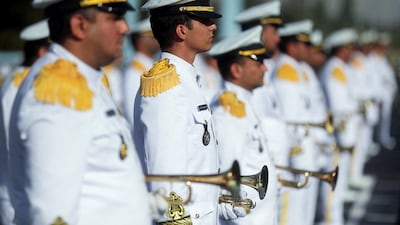
Israel says it will not be bound by any Iran nuclear deal and could eventually take unilateral action against Iranian nuclear sites. Reuters -

Mr Raisi said Iran watches any move by Israel closely. Tehran supports anti-Israeli extremist groups such as Hamas and Hezbollah. AFP -
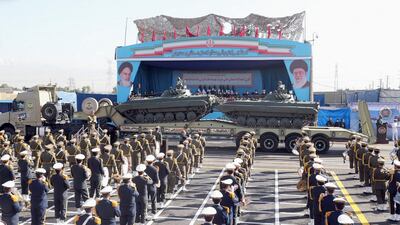
Iran's military had managed to improve its capabilities, despite years of sanctions imposed on the country over its nuclear programme, Mr Raisi said. Reuters -

Missiles on display at the military parade. AFP -

Iran's combat drone the Kaman-22 was on display in Tehran. AFP -
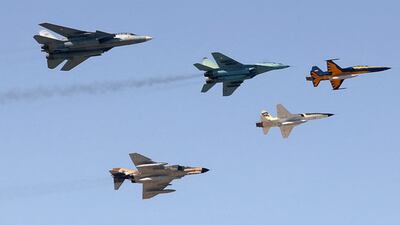
Iranian fighter jets fly over the parade. AFP -
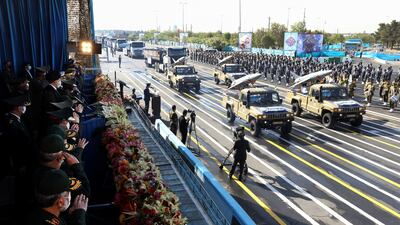
Despite Tehran agreeing to reduce its nuclear stockpile in return for sanctions being eased, the 2015 deal has collapsed and Iran has expanded its nuclear work. Reuters



