

US special envoy for Iran Robert Malley told Congress on Wednesday that the prospects of reviving the Iran nuclear deal were bleak, with the odds for failure outweighing those for success.
In his first public testimony to the Senate Foreign Relations Committee since taking up his position last year, Mr Malley described negotiations to return to the 2015 nuclear deal as “tenuous”.
President Joe Biden's administration has engaged in eight rounds of indirect talks with Iran in Vienna to resurrect that deal, formally known as Joint Comprehensive Plan of Action (JCPOA), which is designed to cap Tehran’s nuclear activities and prevent it from developing a nuclear weapon.
Those efforts unravelled in March after Iran insisted that Washington remove the Islamic Revolutionary Guard Corps from its terrorist organisations list — a demand the Biden administration has rejected.
Now Mr Malley says that Iran’s breakout time to achieve nuclear weapons capability is “as short as a matter of weeks” and that the chances for a diplomatic breakthrough are slipping away.
“The odds of a successful negotiation are lower than the odds of failure,” the US envoy said.
Mr Malley, however, committed to continue the negotiations to return to the deal as long as the agreement's non-proliferation benefits stand.
-
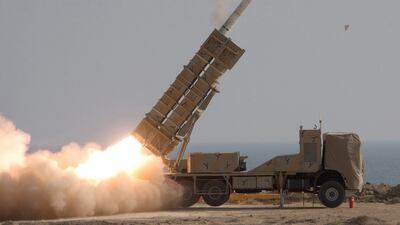
Iranian soldiers fire a missile in Baluchestan, near the shore of the Sea of Oman, during a military exercise on November 8, 2021. Iranian Army via AFP -
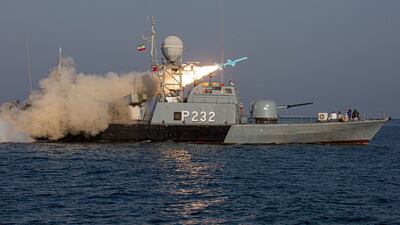
Iranian troops fire a Ghaidr missile during the second day of military exercise in the northern Sea of Oman, on November 8, 2021. Iranian Army via EPA -
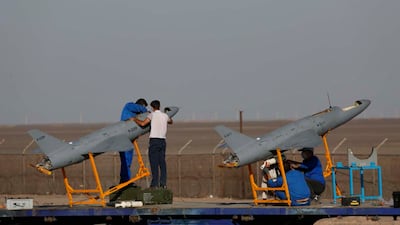
Iranian Army and Air Force personnel work on missile air-defence systems during an exercise at an undisclosed site in Iran on October 21, 2021, when the country began a nationwide air force drill. Iranian Army via EPA -
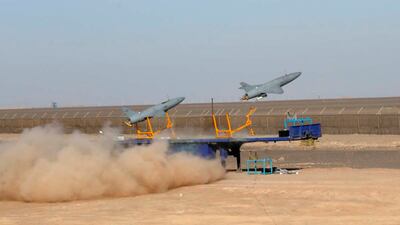
One week earlier, it had conducted a massive air defence exercise, state media reported. Iranian Army via EPA -
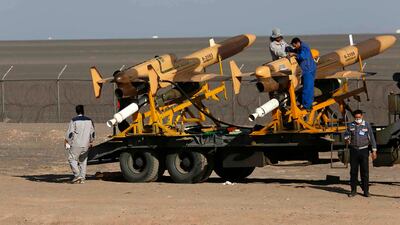
Iranian Air Force personnel work on air defence missiles during a nationwide drill on October 21, 2021. Iranian Army via AP -
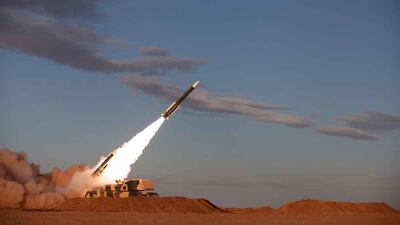
Iran holds a major air defence drill. In this image, made available on October 12, 2021, missiles are launched during a joint exercise between the Iranian Army and the country’s Islamic Revolutionary Guard Corps, in the desert of central Iran. Iranian Army via EPA


“We are prepared to get back into the JCPOA for as long as our assessment is that its non-proliferation benefits are worth the sanctions relief,” he said.
Some of the clauses of the JCPOA, such as restrictions on ballistic missile procurement, will expire in 16 months, while others related to the development of centrifuges will last until 2025.
If a deal is not reached, Mr Malley predicted an escalation in sanctions and economic measures against Iran.
The US, he said, is “ready to continue to enforce and further tighten our sanctions”.
On Wednesday, the US Treasury Department said it would impose sanctions on a network backed by the IRGC and Russian officials for shipping hundreds of millions of dollars in oil in breach of US sanctions.
Washington also remains ready “to respond strongly to any Iranian escalation [by] working in concert with Israel and our regional partners”, Mr Malley stressed.
-
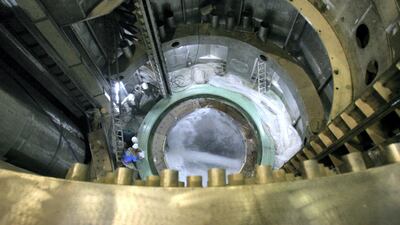
Russian contractors work at the Bushehr nuclear reactor site in 2007. The plant opened four years later. Bloomberg -
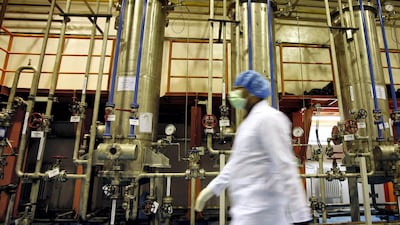
An Iranian technician at the International Atomic Energy Agency inspects the country's Isfahan plant in 2007. Tehran is no longer co-operating with the agency at nuclear sites across the country. EPA -

Workers wait to begin constructing a second reactor at the Bushehr nuclear power plant in 2019. AFP -
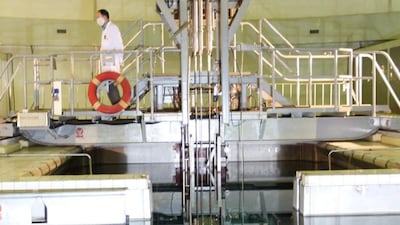
A metal-encased rod with 20 per cent enriched nuclear fuel is inserted into a reactor in Tehran in 2012. AFP -
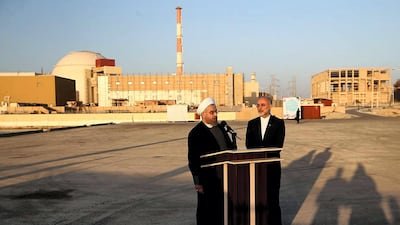
Fomer Iranian President Hassan Rouhani and the country's Atomic Energy Organisation chief Ali Akbar Salehi speak at the Bushehr nuclear site in 2015. AFP -
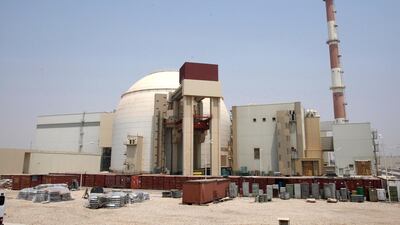
Iran's Bushehr nuclear plant has been restarted. EPA -
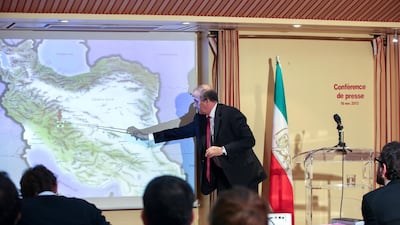
Mehdi Abrichamtchi, chairman of the Peace and Security Committee at the National Council of Resistance of Iran, shows journalists the location of a secret nuclear site in Iran in 2013. AFP -
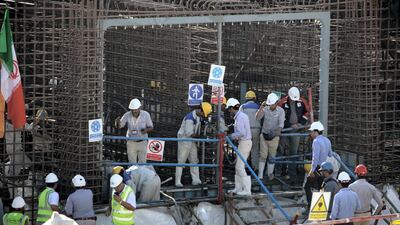
Workers prepare to begin the construction of a second reactor at the Bushehr site. AFP


The US envoy cast doubt on the strength of the Iranian regime in the face of internal upheaval and growing sanctions.
“I don't think this is a strong regime that is basking in being able to circumvent sanctions … it is a regime under duress and that's because of its own mismanagement and our sanctions,” he said.
While the US envoy said all options remain on the table, he argued there are limitations to the military route.
“The military option cannot resolve this issue — it can set it back and we are happy to talk about it in a classified setting … But let’s leave at this: the only real solution here is diplomatic,” he said.

