


UN diplomats on Thursday criticised the hardline Taliban rulers of Afghanistan for their “cruel” decision to demand women wear face coverings in public, saying it will worsen the country’s economic collapse.
Ireland’s UN envoy Geraldine Byrne Nason said it was “abundantly clear” the Taliban were reneging on pledges to uphold women’s rights they made after ousting the US-backed government from Kabul in August.
She spoke with reporters before private UN Security Council talks on the Taliban’s face-covering decree, a return to the group's hardline past and an escalation of restrictions on women and girls that has provoked global outrage.
“What we feared is becoming the reality — they are returning to their cruel ways of the past,” Ms Byrne Nason said in New York.
“We must be united in condemning policies that seek to exclude half of a country's population from public life.”
-

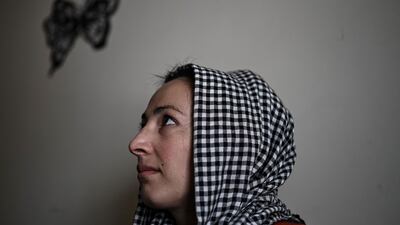
Zakia, an economics student who had to abandon her studies when the Taliban took control of Afghanistan in August, at her home in the capital Kabul, where women are coming together to stand against the hardline regime. All photos: AFP -
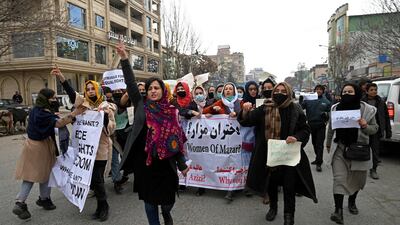
She is part of a growing group that started with 15 activists, mostly women in their 20s who already knew each other. Now a network of dozens of women work in secret to organise protests. -
Hoda Khamosh, a published poet and former NGO worker who organised workshops to help empower women, vets newcomers to the group to ensure they can be trusted. -
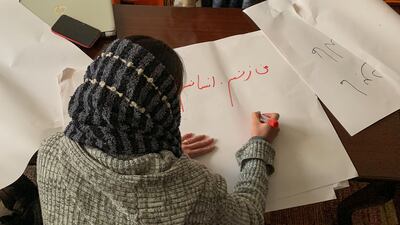
One test she sets is to ask them to prepare banners or slogans at short notice - she can sense passion for the cause from women who deliver quickly. -

Other tests yield even clearer results. Hoda says one potential recruit was given a fake date and time for a demonstration. The Taliban turned up ahead of the supposed protest, and all contact was cut with the woman suspected of tipping off officials. -

A core group of the activists use a dedicated phone number to co-ordinate on the day of a protest. That number is later disconnected to ensure it is not being tracked. -
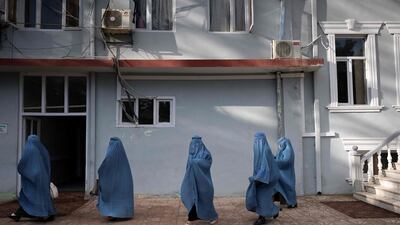
"We usually carry an extra scarf or an extra dress. When the demonstration is over, we change our clothes so we cannot be recognised," says Hoda. -

She has changed her phone number several times and her husband has received threats. "We could still be harmed, it's exhausting. But all we can do is persevere," she says.


Norway has proposed a draft council statement condemning the edict, which could be agreed upon and released within days.
Trine Heimerback, Oslo’s deputy UN envoy, slammed the hardliners for “oppressing women and girls rather than addressing the economic crisis”.
“They need to understand that if they want to bring this country out of the financial economic crisis, they need to bring with them an educated 100 per cent of the population,” she said.
Earlier on Thursday, the Group of Seven industrialised democracies condemned the Taliban’s growing list of curbs on women and girls, saying they were isolating the landlocked nation of 39 million people.
In a statement, the foreign ministers of Canada, France, Germany, Italy, Japan, Britain and the US condemned the Taliban's “imposition of increasingly restrictive measures” and urged the group to reverse them.
Under Taliban rule from 1996 to 2001, women were forced to cover their faces in public and could not work, while girls were banned from school. The group promised to respect women's rights after seizing power in August.
But in March, they backtracked on their announcement that high school classes would resume for girls, saying they would remain closed until a plan was drawn up to reopen them.
The Taliban’s supreme leader Hibatullah Akhundzada issued the new decree on Saturday, saying if a woman did not cover her face outside the home, her father or closest male relative would face jail or lose out on state jobs.
Most Afghan women wear headscarves for religious reasons, but many in the big cities do not cover their faces. Protective masks worn by men and women amid the Covid-19 pandemic complicate the situation further.
Many women in Kabul are delaying a return to fully covering their faces in public in defiance of the Taliban’s orders, others are staying at home and some have been wearing coronavirus face masks anyway.
It was not clear whether any men had yet faced consequences. Taliban authorities said they would first focus on “encouraging” adherence than on punishing violations. At least two protests took place against the rules in recent days.

