

Live updates: follow the latest news on Russia-Ukraine
The US House of Representatives has approved nearly $40 billion in military and economic aid to Ukraine, signalling a bipartisan commitment to thwart Russia's invasion.
The $39.8bn package sailed through the lower chamber of Congress in a 368-57 vote on Tuesday night and is nearly $7bn more than US President Joe Biden initially requested last month. The bill is aimed at assisting Ukraine militarily and economically, replenishing weapons the Pentagon has already shipped and providing $5bn to address global food shortages.
In a tweet, Ukrainian President Volodymyr Zelenskyy thanked House Speaker Nancy Pelosi for the "quick approval of the law" and said he looked forward to the US Senate's consideration of the bill.
In a letter to colleagues before the vote, Ms Pelosi said: "Time is of the essence – and we cannot afford to wait. With this aid package, America sends a resounding message to the world of our unwavering determination to stand with the courageous people of Ukraine until victory is won."
The new legislation would bring American support for the effort to nearly $54bn, including the $13.6bn in support Congress enacted in March. The total amounts to about $6bn more than the US spent on its entire foreign and military aid in 2019, a January report by the nonpartisan Congressional Research Service indicated. It is also about 1 per cent of the entire federal budget.
The new measure includes $6bn to arm and train Ukrainian forces, $8.7bn to restore US stores of weapons shipped to Ukraine and $3.9bn for US forces posted to the area.
There is also $8.8bn in economic support for Ukraine, $4bn to help Kyiv and its allies finance arms and equipment purchases and $900m for housing, education and other help for Ukrainian refugees in the US.
Tuesday night's vote came hours after Mr Biden hosted Ms Pelosi and other members of a Congressional delegation who visited Mr Zelenskyy in Kyiv last month.
-

Ukraine's President Volodymyr Zelenskyy presents the Order of Princess Olga to US Speaker of the House of Representatives Nancy Pelosi during her visit to Kyiv. AFP / Ukrainian Presidential Press Service -
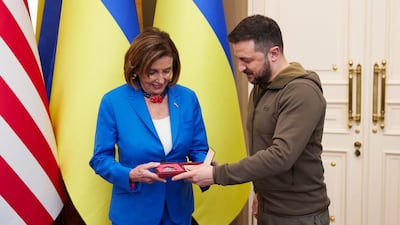
The award was to highlight Ms Pelosi's 'significant personal contribution' to strengthening America’s ties with Ukraine. AFP / Ukrainian Presidential Press Service -

Nancy Pelosi in Kyiv. AFP / Ukrainian Presidential Press Service -
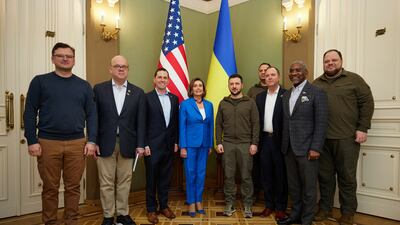
Mr Zelenskyy and Ms Pelosi pose for a picture with members of their delegations in Kyiv. AFP / Ukrainian Presidential Press Service -
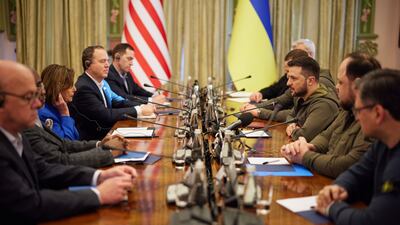
The US and Ukrainian delegations meet in Kyiv. AFP / Ukrainian Presidential Press Service -
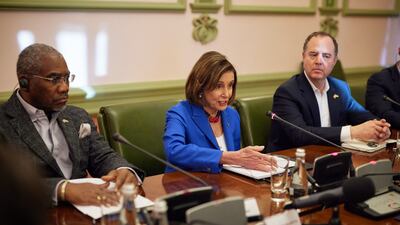
Ms Pelosi speaking during her meeting with Mr Zelenskyy and Ukrainian officials. AFP / Ukrainian Presidential Press Service -

US congressmen Jim McGovern (L) and Adam Schiff in Kyiv with Ms Pelosi. Getty -
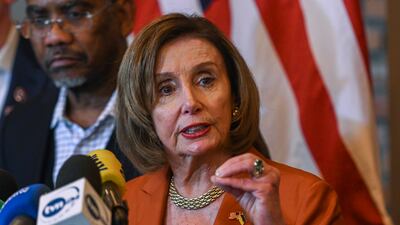
Nancy Pelosi speaks to the media after her meeting with Mr Zelenskyy in Kyiv. Getty


Ms Pelosi told the US president that the delegation had a "long and detailed meeting" with Mr Zelenskyy on security, sanctions, humanitarian and diplomatic assistance.
Congressman Jason Crow said Ukraine needed "more advanced drones", "longer anti-ship missile systems" and a rotational training system.
Russian attacks on Ukraine’s southern port of Odesa have intensified in what appears to be an attempt to hamper deliveries of western arms. Those weapons have helped Ukraine to hold its own against Moscow but the grinding war is taking its toll.
A timetable for a Senate vote on the $39.8bn package remained unclear, though Senate majority leader Chuck Schumer said the upper chamber would move "swiftly" to vote on the measure.
In an effort to accelerate the bill's passage, the House bill abandoned plans to include funds that would bulk up US supplies of vaccines, medicine and Covid-19 tests.
Senate minority leader Mitch McConnell said he was focused on Ukrainian aid.
“I think we’re on a path to getting that done,” he told reporters. “It needs to be clean of extraneous matters, directly related to helping the Ukrainians win the war.”
First lady Jill Biden visited Ukraine over the weekend, making her the highest-ranking US representative to enter the war-torn country.
-
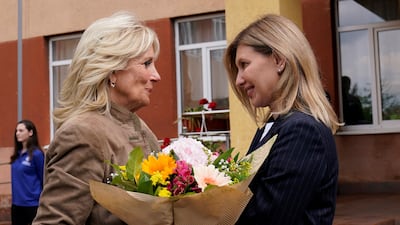
Jill Biden, the US first lady, gives flowers to Olena Zelenska, wife of Ukraine's President Volodymyr Zelenskyy, at a school in Uzhhorod, Ukraine. Reuters -

Ms Biden talks to Ms Zelenska at the end of their visit to a public school that has taken in displaced pupils in Uzhhorod, Ukraine. AP -

Ms Zelenska hugs Mrs Biden, who made the unannounced visit to Ukraine by crossing the border from Slovakia. Reuters -
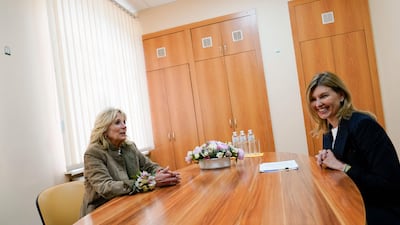
Ms Biden with Ms Zelenska inside the school. AFP -
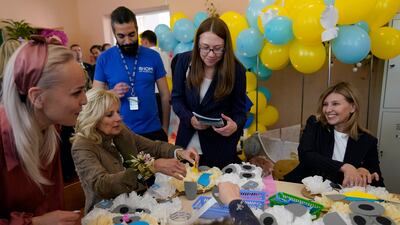
The presidents' wives take part in school crafts. AP Photo -
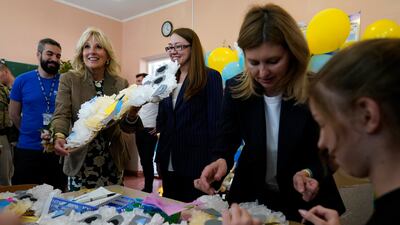
The VIP visitors helped children make tissue-paper bears to give as Mother's Day gifts. AP -

Ms Biden met Ms Zelenska as part of a four-day visit to Europe. AP -

First lady Jill Biden meets refugees in the western Ukrainian city of Uzhgorod. EPA -
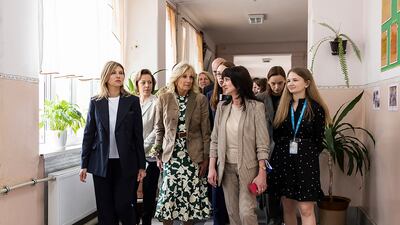
Jill Biden meets Olena Zelenska. EPA -

Ms Biden and Ms Zelenska meet refugees in Uzhgorod. EPA


The Associated Press contributed to this report

