• Former US President Donald Trump attends a rally to boost Ohio Republican candidates before the May 3 primary election. Reuters
    Former US President Donald Trump attends a rally to boost Ohio Republican candidates before the May 3 primary election. Reuters
  • US Senate Republican candidate JD Vance, a writer and lawyer, was endorsed by Donald Trump for the coming primary elections. Reuters
    US Senate Republican candidate JD Vance, a writer and lawyer, was endorsed by Donald Trump for the coming primary elections. Reuters
  • Supporters of former US president Donald Trump gather for a Save America rally at the Delaware County Fairgrounds in Ohio. EPA
    Supporters of former US president Donald Trump gather for a Save America rally at the Delaware County Fairgrounds in Ohio. EPA
  • Supporters of former US president Donald Trump at Saturday's Save America rally. EPA
    Supporters of former US president Donald Trump at Saturday's Save America rally. EPA
  • The crowd at the Save America rally at the Delaware County Fairgrounds in Delaware, Ohio. EPA
    The crowd at the Save America rally at the Delaware County Fairgrounds in Delaware, Ohio. EPA
  • At the Save America rally. Reuters
    At the Save America rally. Reuters
  • Ohio Secretary of State Frank LaRose was acknowledged by former president Donald Trump at Saturday's Save America rally at the Delaware County Fairgrounds. AP
    Ohio Secretary of State Frank LaRose was acknowledged by former president Donald Trump at Saturday's Save America rally at the Delaware County Fairgrounds. AP
  • A Trump supporter at Saturday's rally holds up an image of the former US president. AP
    A Trump supporter at Saturday's rally holds up an image of the former US president. AP
  • A Trump supporter wears a 'God and guns' T-shirt as she waves two American flags at the Save America rally on Saturday. AP
    A Trump supporter wears a 'God and guns' T-shirt as she waves two American flags at the Save America rally on Saturday. AP

Latinos should not vote for US politicians who 'mistreated' them, Mexican president says


  • English
  • Arabic

Mexican President Andres Manuel Lopez Obrador on Monday urged Latinos in the US not to vote in November's midterm elections for politicians who have "mistreated" them, in response to a comment by former US president Donald Trump.

Mr Trump boasted at a rally in Ohio at the weekend that while in office, he had forced Mr Lopez Obrador to post 28,000 soldiers along the border to keep out migrants after threatening to introduce tariffs on Mexican goods.

A rally-goer wears Trump socks while watching former US president Donald Trump speak at an event in Delaware, Ohio, on April 23. AFP

Asked about Mr Trump's comments, Mr Lopez Obrador said no US political party should "use Mexico as a pinata" and that those with the right to vote should exercise it carefully.

He told Americans of Mexican and Latino descent that "if Mexico or some country in Latin America and the Caribbean is mistreated, do not vote for those parties and for those candidates, whether they are from the Democratic or Republican party”.

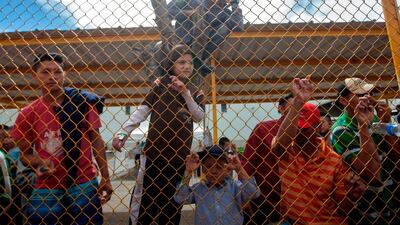
  • A Honduran migrant boy looks thorugh the fence of a warehouse used as shelter in Piedras Negras, Coahuila, Mexico, on the border with the US. AFP
    A Honduran migrant boy looks thorugh the fence of a warehouse used as shelter in Piedras Negras, Coahuila, Mexico, on the border with the US. AFP
  • A Border Patrol unit drives near a section of reinforced US-Mexico border fence seen from Tijuana, Baja California state, Mexico. AFP
    A Border Patrol unit drives near a section of reinforced US-Mexico border fence seen from Tijuana, Baja California state, Mexico. AFP
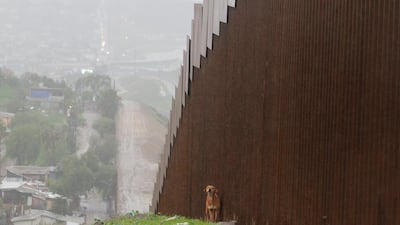
  • A dog barks while standing next to the border fence between Mexico and the US. Reuters
    A dog barks while standing next to the border fence between Mexico and the US. Reuters
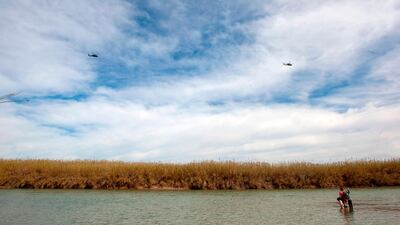
  • Central American migrants try to cross the Rio Grande, which divides the cities of Eagle Pass, in Texas and Piedras Negras, in Coahuila state, Mexico. AFP
    Central American migrants try to cross the Rio Grande, which divides the cities of Eagle Pass, in Texas and Piedras Negras, in Coahuila state, Mexico. AFP
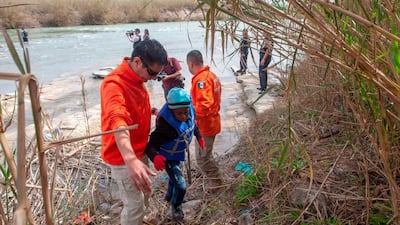
  • Members of the Beta group of Mexican National Institute of Migration, dedicated to the protection and defence of human rights of migrants, rescue a Honduran migrant child trying to cross the Rio Grande. AFP
    Members of the Beta group of Mexican National Institute of Migration, dedicated to the protection and defence of human rights of migrants, rescue a Honduran migrant child trying to cross the Rio Grande. AFP
  • Honduran migrants try to cross the Rio Grande. AFP
    Honduran migrants try to cross the Rio Grande. AFP
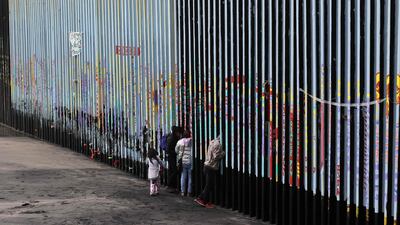
  • A family of Central American migrants look through the US-Mexico border fence, as seen from Playas de Tijuana. AFP
    A family of Central American migrants look through the US-Mexico border fence, as seen from Playas de Tijuana. AFP
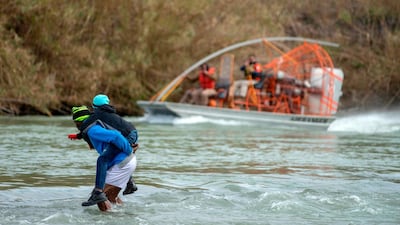
  • Members of the Beta group of Mexican National Institute of Migration, dedicated to the protection and defense of human rights of migrants, rescue a Central American migrant child and a woman trying to cross the Rio Grande. AFP
    Members of the Beta group of Mexican National Institute of Migration, dedicated to the protection and defense of human rights of migrants, rescue a Central American migrant child and a woman trying to cross the Rio Grande. AFP
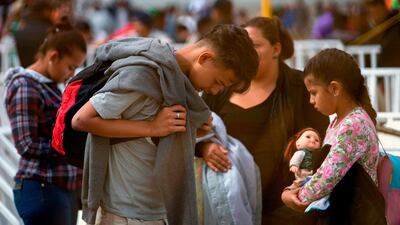
  • Central American migrants remain at a warehouse used as shelter in Piedras Negras, Coahuila, Mexico. AFP
    Central American migrants remain at a warehouse used as shelter in Piedras Negras, Coahuila, Mexico. AFP
  • Central American migrants remain at a warehouse used as shelter in Piedras Negras, Coahuila, Mexico. AFP
    Central American migrants remain at a warehouse used as shelter in Piedras Negras, Coahuila, Mexico. AFP
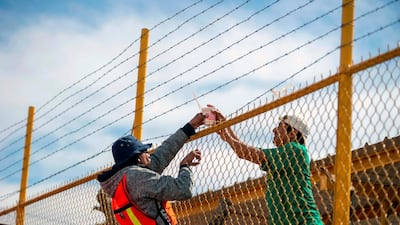
  • Central American migrants pass food through the fence. AFP
    Central American migrants pass food through the fence. AFP
  • A migrant is held by US border patrol agents after climbing the US side of the Rio Grande.
    A migrant is held by US border patrol agents after climbing the US side of the Rio Grande.
  • A Border Patrol unit remains near a section of reinforced US-Mexico border fence seen from Tijuana, Baja California state, Mexico. AFP
    A Border Patrol unit remains near a section of reinforced US-Mexico border fence seen from Tijuana, Baja California state, Mexico. AFP
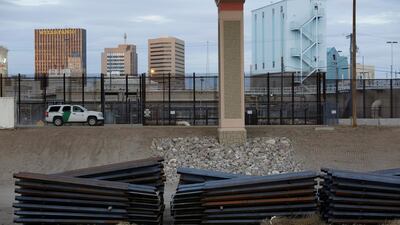
  • An U.S. Customs and Border Protection van in El Paso. Reuters
    An U.S. Customs and Border Protection van in El Paso. Reuters
  • An U.S. Customs and Border Protection van in El Paso. Reuters
    An U.S. Customs and Border Protection van in El Paso. Reuters

"When someone goes too far and causes offence, we'll call them out so that our countrymen help us, because there are 40 million of us," Mr Lopez Obrador said. "Don't forget your origins."

Mexicans made up the largest population of Hispanic origin in the US in 2017, at 36.6 million, a Pew Research Centre report found.

Mr Trump sparked outrage while campaigning for the presidency in 2016 by calling Mexican migrants rapists and drug runners.

Mr Lopez Obrador, then in opposition, in 2017 likened Mr Trump's attitude to migrants to Nazi Germany's treatment of Jews.

As a leader, he spoke warmly of Mr Trump. On Monday he said he "liked Trump even though he is a capitalist" and that his presidency was good for both countries.

Foreign Minister Marcelo Ebrard, one of the favourites to succeed Mr Lopez Obrador in 2024, rebuffed Mr Trump's comments.

"What happened yesterday is a man campaigning for the anti-Mexicanism that characterises him," Mr Ebrard wrote on Twitter in reference to Mr Trump's remarks.

"In this government, we're patriots. And we have nothing to be ashamed about."

Republicans are favourites to win control of the House of Representatives and possibly the Senate in the elections amid frustration with the administration of US President Joe Biden.


Updated: April 25, 2022, 8:42 PM