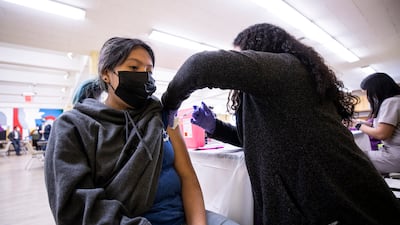
The US government is cancelling a planned order of monoclonal antibody treatments for Covid-19 infections and said that the country could eventually run short of vaccines because of a lack of funding.
The White House made the announcement on Tuesday as it renews calls for Congress to authorise a fresh round of funding for the government’s Covid-19 response.
Weeks of effort have fallen flat, leaving the administration to begin to claw back shipments and warn they may soon end.
The funding is needed for new orders of treatments, to ensure fourth doses of vaccines are available for all Americans if needed and to continue to test and treat people at home and abroad, officials said on a Tuesday briefing call, speaking on condition of anonymity.
The administration’s warning comes as it presses for more money after its request for $22.5 billion failed to be included in an omnibus funding package. Republicans were seeking offsets for about $15.6bn in new Covid funding and Democrats balked at those demands.
The White House is still seeking $22.5bn, the officials said.
The flow of monoclonal antibodies will run dry in May without new funding this month and the supply of a pre-exposure treatment for immunocompromised people will run out in July, administration officials have said in a series of briefings and letters to Congress.
In the Tuesday call, the officials said a planned order of hundreds of thousands of courses of monoclonal treatments is being cancelled because the necessary funding is not available. The administration has so far ordered enough of Pfizer's antiviral pill, Paxlovid, for 20 million people.
The US will also need new funding in the event that a fourth dose or a variant-specific vaccine is needed, the officials said.
As of now, they haven’t ordered enough to allow for all people to receive a fourth shot if needed. The US needs to place orders now to ensure arrival in the coming months.
The lack of additional funding will also hobble efforts to vaccinate the world, the officials said — and thereby reduce the chance a new variant will arise and eventually hit the US. It would impede development of new treatments and drugs, including antiviral treatments that require people to take fewer pills.
Test production will also slow in the summer without new funding, the officials said, raising the risk of a repeat of 2021, when production slowed in the summer amid lower case counts, leading to test shortages during the fall and winter surge.
Since January, the administration has briefed Congress at least three dozen times on the approaching cliffs in supply, one official familiar with the process said. The White House has also written repeatedly, providing tables and figures detailing the need, the official added.
A fund for testing, treating and vaccinating the uninsured will be scaled back this month and ended completely in April. The White House has also said that the federal supply of antiviral pills will be exhausted by September.

The%20Woman%20King%20
%3Cp%3E%3Cstrong%3EDirector%3A%3C%2Fstrong%3E%20Gina%20Prince-Bythewood%3C%2Fp%3E%0A%3Cp%3E%3Cstrong%3EStars%3A%3C%2Fstrong%3E%20Viola%20Davis%2C%20Thuso%20Mbedu%2C%20Sheila%20Atim%2C%20Lashana%20Lynch%2C%20John%20Boyega%C2%A0%3C%2Fp%3E%0A%3Cp%3E%3Cstrong%3ERating%3A%3C%2Fstrong%3E%203%2F5%3C%2Fp%3E%0A
More from Neighbourhood Watch:
Mercer, the investment consulting arm of US services company Marsh & McLennan, expects its wealth division to at least double its assets under management (AUM) in the Middle East as wealth in the region continues to grow despite economic headwinds, a company official said.
Mercer Wealth, which globally has $160 billion in AUM, plans to boost its AUM in the region to $2-$3bn in the next 2-3 years from the present $1bn, said Yasir AbuShaban, a Dubai-based principal with Mercer Wealth.
“Within the next two to three years, we are looking at reaching $2 to $3 billion as a conservative estimate and we do see an opportunity to do so,” said Mr AbuShaban.
Mercer does not directly make investments, but allocates clients’ money they have discretion to, to professional asset managers. They also provide advice to clients.
“We have buying power. We can negotiate on their (client’s) behalf with asset managers to provide them lower fees than they otherwise would have to get on their own,” he added.
Mercer Wealth’s clients include sovereign wealth funds, family offices, and insurance companies among others.
From its office in Dubai, Mercer also looks after Africa, India and Turkey, where they also see opportunity for growth.
Wealth creation in Middle East and Africa (MEA) grew 8.5 per cent to $8.1 trillion last year from $7.5tn in 2015, higher than last year’s global average of 6 per cent and the second-highest growth in a region after Asia-Pacific which grew 9.9 per cent, according to consultancy Boston Consulting Group (BCG). In the region, where wealth grew just 1.9 per cent in 2015 compared with 2014, a pickup in oil prices has helped in wealth generation.
BCG is forecasting MEA wealth will rise to $12tn by 2021, growing at an annual average of 8 per cent.
Drivers of wealth generation in the region will be split evenly between new wealth creation and growth of performance of existing assets, according to BCG.
Another general trend in the region is clients’ looking for a comprehensive approach to investing, according to Mr AbuShaban.
“Institutional investors or some of the families are seeing a slowdown in the available capital they have to invest and in that sense they are looking at optimizing the way they manage their portfolios and making sure they are not investing haphazardly and different parts of their investment are working together,” said Mr AbuShaban.
Some clients also have a higher appetite for risk, given the low interest-rate environment that does not provide enough yield for some institutional investors. These clients are keen to invest in illiquid assets, such as private equity and infrastructure.
“What we have seen is a desire for higher returns in what has been a low-return environment specifically in various fixed income or bonds,” he said.
“In this environment, we have seen a de facto increase in the risk that clients are taking in things like illiquid investments, private equity investments, infrastructure and private debt, those kind of investments were higher illiquidity results in incrementally higher returns.”
The Abu Dhabi Investment Authority, one of the largest sovereign wealth funds, said in its 2016 report that has gradually increased its exposure in direct private equity and private credit transactions, mainly in Asian markets and especially in China and India. The authority’s private equity department focused on structured equities owing to “their defensive characteristics.”
Real estate tokenisation project
Dubai launched the pilot phase of its real estate tokenisation project last month.
The initiative focuses on converting real estate assets into digital tokens recorded on blockchain technology and helps in streamlining the process of buying, selling and investing, the Dubai Land Department said.
Dubai’s real estate tokenisation market is projected to reach Dh60 billion ($16.33 billion) by 2033, representing 7 per cent of the emirate’s total property transactions, according to the DLD.
The specs
- Engine: 3.9-litre twin-turbo V8
- Power: 640hp
- Torque: 760nm
- On sale: 2026
- Price: Not announced yet
Results
Stage three:
1. Stefan Bissegger (SUI) EF Education-EasyPost, in 9-43
2. Filippo Ganna (ITA) Ineos Grenadiers, at 7s
3. Tom Dumoulin (NED) Jumbo-Visma, at 14s
4. Tadej Pogacar (SLO) UAE-Team Emirates, at 18s
5. Joao Almeida (POR) UAE-Team Emirates, at 22s
6. Mikkel Bjerg (DEN) UAE-Team Emirates, at 24s
General Classification:
1. Stefan Bissegger (SUI) EF Education-EasyPost, in 9-13-02
2. Filippo Ganna (ITA) Ineos Grenadiers, at 7s
3. Jasper Philipsen (BEL) Alpecin Fenix, at 12s
4. Tom Dumoulin (NED) Jumbo-Visma, at 14s
5. Tadej Pogacar (SLO) UAE-Team Emirates, at 18s
6. Joao Almeida (POR) UAE-Team Emirates, at 22s
Who's who in Yemen conflict
Houthis: Iran-backed rebels who occupy Sanaa and run unrecognised government
Yemeni government: Exiled government in Aden led by eight-member Presidential Leadership Council
Southern Transitional Council: Faction in Yemeni government that seeks autonomy for the south
Habrish 'rebels': Tribal-backed forces feuding with STC over control of oil in government territory
All or Nothing
Amazon Prime
Four stars
War
Director: Siddharth Anand
Cast: Hrithik Roshan, Tiger Shroff, Ashutosh Rana, Vaani Kapoor
Rating: Two out of five stars
Bawaal%20
%3Cp%3E%3Cstrong%3EDirector%3A%3C%2Fstrong%3E%20Nitesh%20Tiwari%3C%2Fp%3E%0A%3Cp%3E%3Cstrong%3EStars%3A%3C%2Fstrong%3E%20Varun%20Dhawan%2C%20Janhvi%20Kapoor%3C%2Fp%3E%0A%3Cp%3E%3Cstrong%3ERating%3A%3C%2Fstrong%3E%201%2F5%3C%2Fp%3E%0A
BULKWHIZ PROFILE
Date started: February 2017
Founders: Amira Rashad (CEO), Yusuf Saber (CTO), Mahmoud Sayedahmed (adviser), Reda Bouraoui (adviser)
Based: Dubai, UAE
Sector: E-commerce
Size: 50 employees
Funding: approximately $6m
Investors: Beco Capital, Enabling Future and Wain in the UAE; China's MSA Capital; 500 Startups; Faith Capital and Savour Ventures in Kuwait
Meg%202%3A%20The%20Trench
%3Cp%3E%3Cstrong%3EDirector%3A%20%3C%2Fstrong%3EBen%20Wheatley%3Cbr%3E%3Cstrong%3EStars%3A%20%3C%2Fstrong%3EJason%20Statham%2C%20Jing%20Wu%2C%20Cliff%20Curtis%2C%20Page%20Kennedy%2C%20Cliff%20Curtis%2C%20Melissanthi%20Mahut%20and%20Shuya%20Sophia%20Cai%3Cbr%3E%3Cstrong%3ERating%3A%20%3C%2Fstrong%3E2%2F5%3C%2Fp%3E%0A