

President Joe Biden on Friday signed an executive order to unlock $7 billion of the Afghan Central Bank’s assets frozen in the US banking system.
Half of the money will be used to fund humanitarian aid in Afghanistan and half to create a trust fund to compensate victims still seeking relief for the 9/11 attacks.
No money would immediately be released, but the order requires US financial institutions to allow access to $3.5bn of assets for Afghan relief and basic needs. The other $3.5bn would remain in the US and be used to fund ongoing litigation by US victims of terrorism, a US official said.
The US Secretary of State, Antony Blinken, said: "The people of Afghanistan face enormous challenges: an economic crisis born of decades of dependence on international aid, severe drought, COVID-19, and endemic corruption. In response to the worsening humanitarian and economic crisis, President Biden signed an Executive Order today as part of an effort to set aside $3.5 billion in Afghan central bank assets for the benefit of the Afghan people.
"We also recognise that victims of terrorism, including of the September 11 terrorist attacks, have brought claims against the Taliban and are pursuing the central bank’s remaining assets in federal court."
He added that "America’s ties to the people of Afghanistan, built during two decades of working side-by-side, are steadfast and enduring."
A spokesman for the Taliban government described Mr Biden's order as "theft".
-
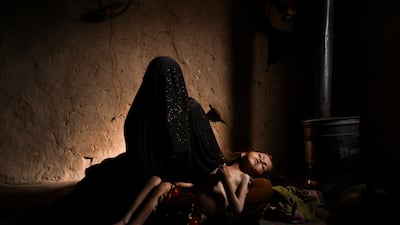
Fatima holds her daughter Nazia, 4, who is suffering from acute malnutrition, at their house near Herat, western Afghanistan, December 16, 2021. Two years ago, Nazia was a plump toddler, Fatima says. Aid groups say more than half the population faces acute food shortages. AP Photo -
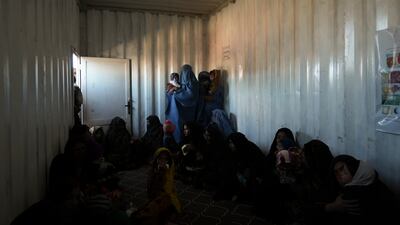
Afghan women at a makeshift clinic run by World Vision at a settlement near Herat. The aid-dependent country’s economy was already teetering when the Taliban seized power in mid-August. The consequences have been devastating for a country battered by four decades of war, a punishing drought and the coronavirus pandemic. AP Photo -
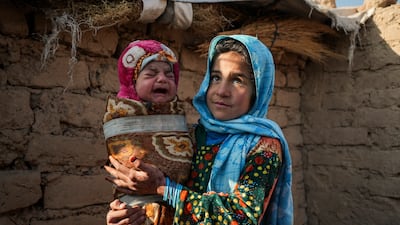
Qandi Gul holds her brother outside their home in a camp for those displaced by war and drought near Herat. Qandi's father sold her into marriage without telling his wife, taking a down payment so he could feed his family of five children. AP Photo -
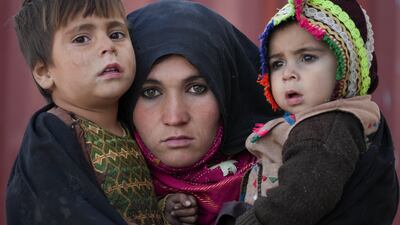
An Afghan woman with her children outside a makeshift clinic at a sprawling settlement of mud brick huts housing those displaced by war and drought near Herat. AP Photo -
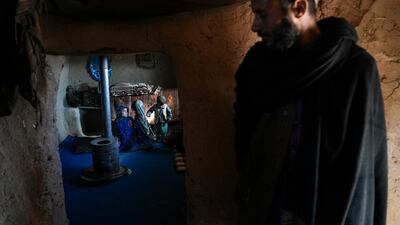
Hamid Abdullah outside a room where his children are playing at a settlement near Herat. Mr Abdullah is selling his young daughters into arranged marriages, desperate for money to treat his chronically ill wife, who is pregnant with their fifth child. AP Photo -
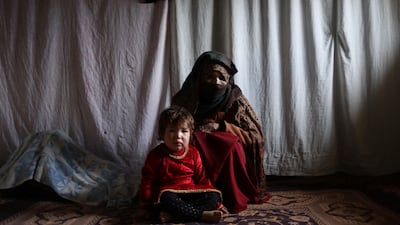
Kubra, 57, with her grandchild in a house in Bamiyan, Afghanistan, December 22, 2021. 'We got two sacks of flour last spring that we're still using. After that, we have to have faith that God will help us," Kubra says. Reuters -
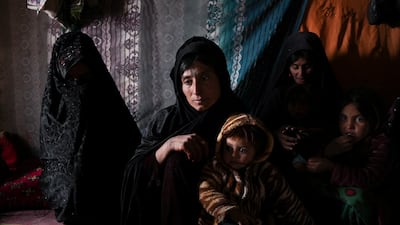
Guldasta and members of her family in their house at a settlement near Qala-e-Naw, Afghanistan. Guldasta says that after days with nothing to eat, she told her husband to take their son Salahuddin, 8, to the bazaar and sell him to buy food for the others. AP Photo -
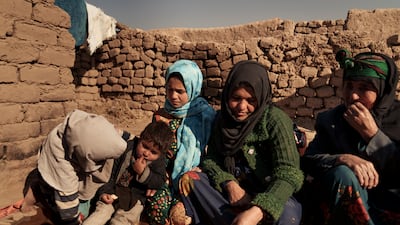
Aziz Gul, second from right, and her 10-year-old daughter Qandi, centre, outside their home with other family members, near Hera. Qandi's father sold her into marriage without telling his wife, Aziz, taking a down-payment so he could feed his family. AP Photo


Mr Biden's order pre-empted a deadline for the US Justice Department, which had until Friday to submit an opinion detailing what it considers to be the national security interests of the US in handling the frozen reserves.
A federal judge last year extended the department’s deadline to until January 28 to give the Biden administration time to sort through the complex legal and geopolitical issues at play.
Handing the reserves to the Taliban could be interpreted as a US recognition of their rule, while continuing to withhold them could further exacerbate the economic and humanitarian crises in the country.
International funding to Afghanistan was suspended and billions of dollars of the country’s assets abroad, mostly in the US, were frozen after the Taliban took control of the country in mid-August.
The White House said in a statement that the order “is designed to provide a path for the funds to reach the people of Afghanistan, while keeping them out of the hands of the Taliban and malicious actors.”
The country’s troubled economy has been in a tailspin since the Taliban takeover. Nearly 80 per cent of Afghanistan’s previous government’s budget came from the international community.
That money, now cut off, financed hospitals, schools, factories and government ministries. Desperation for basic necessities has been further exacerbated by the pandemic, healthcare shortages, drought and malnutrition.
The official noted that US courts where 9/11 victims have filed claims against the Taliban will also have to take action for the victims to be compensated.
A UN spokesman said the world body was "encouraged" by the allocation of funds for aid, but said money alone would not avert a humanitarian catastrophe. He called for a "restart" of the country's battered and sanctioned economy.
The Taliban have called on the international community to release funds and help stave off a humanitarian disaster. The group opposed the split and criticised the Biden administration for not releasing all funds to Afghanistan. The country has more than $9bn in reserves — including the $7bn in the US.
In January, the group managed to pay salaries of its ministries but was struggling to keep employees at work.
They have promised to open schools for girls after the Afghan new year at the end of March, but humanitarian organisations say money is needed to pay teachers.
Universities for women have reopened in several provinces, with the Taliban saying the staggered opening of all universities will be completed by the end of February.
AP contributed to this report.

