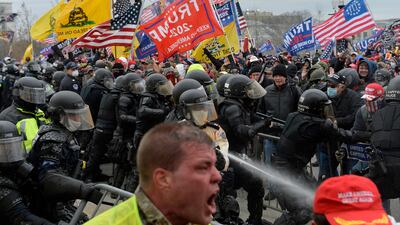
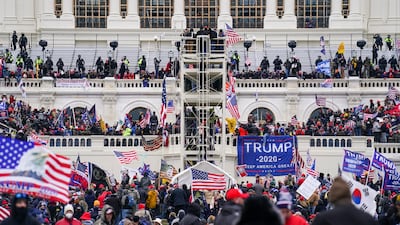
Rioters on the West Front at the US Capitol on January 6, 2021, in Washington. AP Photo

Americans fear for democracy as Capitol riot anniversary looms


  • English
  • Arabic

One year after the violent assault on the US Capitol, Americans remain deeply concerned about the health of their democracy and about a third say violence against the government can sometimes be justified, according to two polls published on Sunday.

The January 6 attack on the seat of Congress, led by supporters of Donald Trump, was "a harbinger of increasing political violence," and American democracy "is threatened," according to two-thirds of those surveyed for a CBS News poll.

With the January 6 anniversary nearing, the polls offer specific causes for concern: CBS found that 28 percent of respondents believe force can be used to defend the result of an election, while 34 percent told The Washington Post that a violent action against government can sometimes be justified -- the largest percentage in decades.

The results underscore the seemingly almost irreconcilable views dividing American society, which President Joe Biden -- who took office 14 days after the Capitol rioting -- has promised to overcome.

Two-thirds of Trump supporters continue to believe his baseless charge that Biden is not the legitimately elected president.

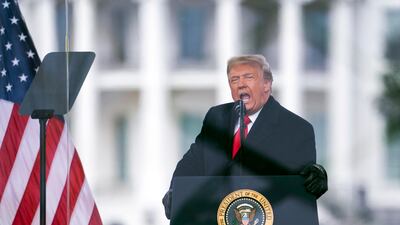
  • Donald Trump, the president at the time, speaks during a rally protesting the electoral college certification of Joe Biden as president in Washington on January 6, 2021. AP
    Donald Trump, the president at the time, speaks during a rally protesting the electoral college certification of Joe Biden as president in Washington on January 6, 2021. AP
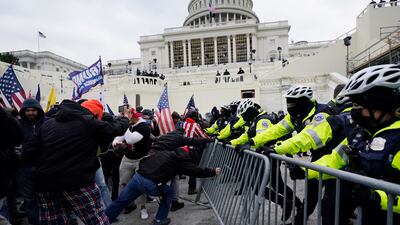
  • A mob loyal to Mr Trump tries to break through a police barrier at the Capitol. AP
    A mob loyal to Mr Trump tries to break through a police barrier at the Capitol. AP
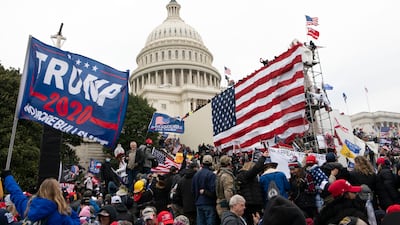
  • The mob waves pro-Trump flags in front of the Capitol building. AP
    The mob waves pro-Trump flags in front of the Capitol building. AP
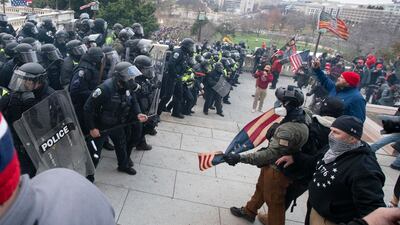
  • Riot police push back a crowd of rioters at the Capitol building. AFP
    Riot police push back a crowd of rioters at the Capitol building. AFP
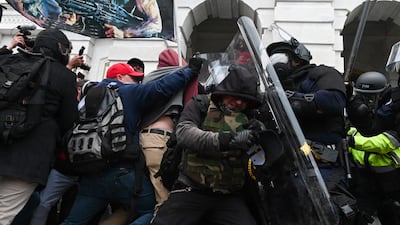
  • Trump supporters clash with police and security forces as people try to storm the US Capitol building. AFP
    Trump supporters clash with police and security forces as people try to storm the US Capitol building. AFP
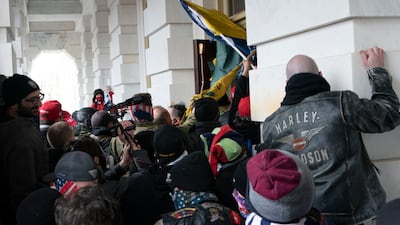
  • Insurrectionists loyal to Mr Trump try to open a door of the US Capitol building as they riot in Washington. AP
    Insurrectionists loyal to Mr Trump try to open a door of the US Capitol building as they riot in Washington. AP
  • US Capitol Police push back rioters trying to enter the US Capitol. AP
    US Capitol Police push back rioters trying to enter the US Capitol. AP
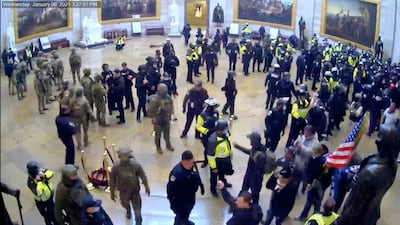
  • Police and rioters confront each other in the Rotunda of the Capitol. US Capitol Police via AP
    Police and rioters confront each other in the Rotunda of the Capitol. US Capitol Police via AP
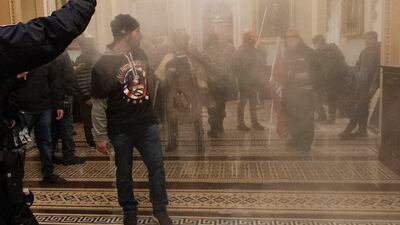
  • Smoke fills the hallway outside the Senate chamber of the Capitol. AP
    Smoke fills the hallway outside the Senate chamber of the Capitol. AP
  • Insurrectionists loyal to Mr Trump breach the Capitol in Washington. AP
    Insurrectionists loyal to Mr Trump breach the Capitol in Washington. AP
  • Trump supporters, including Doug Jensen, centre, confront US Capitol Police in the hallway outside the Senate chamber at the Capitol. AP
    Trump supporters, including Doug Jensen, centre, confront US Capitol Police in the hallway outside the Senate chamber at the Capitol. AP
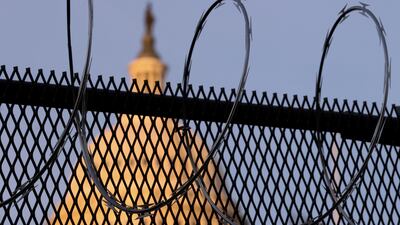
  • Newly installed razor wire tops the fence surrounding the US Capitol following the January 6 riot. Reuters
    Newly installed razor wire tops the fence surrounding the US Capitol following the January 6 riot. Reuters
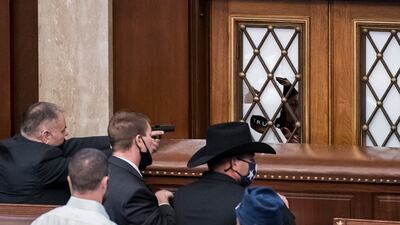
  • Security agents and members of Congress barricade the door to the House chamber as the violent mob breaches the Capitol. AP
    Security agents and members of Congress barricade the door to the House chamber as the violent mob breaches the Capitol. AP
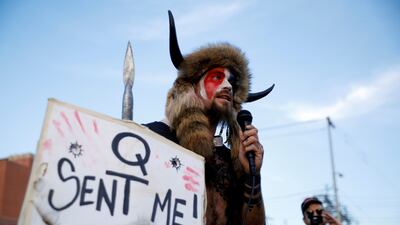
  • Rioter Jacob Chansley holds a sign referencing QAnon as supporters of Mr Trump gather to protest the early results of the 2020 presidential election. Reuters
    Rioter Jacob Chansley holds a sign referencing QAnon as supporters of Mr Trump gather to protest the early results of the 2020 presidential election. Reuters

Mr Trump had addressed thousands of supporters shortly before the Capitol assault, telling them the election had been "rigged" and that they should "fight like hell."

Some 60 percent of those polled say Trump bears heavy responsibility for the invasion of the Capitol just as lawmakers were set to certify Biden's victory.

'Co-ordinated effort'

There again, opinion follows partisan lines: 83 percent of Trump voters placed his level of responsibility at only "some" or "none," the Post survey found.

And 26 percent of Americans want him to run again in 2024, according to CBS.

A select committee of the House of Representatives has spent months working to establish the roles and responsibility of those who incited or may have organized the protest.

Despite limited cooperation from Trump's inner circle, the panel has conducted more than 300 interviews and collected thousands of documents.

"We have uncovered some things that cause us real concern, things like people trying to ... undermine the integrity of our democracy," the panel's chairman, Representative Bennie Thompson, said Sunday on ABC.

"It appeared to be a co-ordinated effort on the part of a number of people to undermine the election," he said.

"It could be people in the executive branch. It could be people in the Department of Defence... and some very wealthy individuals."

He said he would not hesitate to refer any evidence of illegality to the Justice Department.

Liz Cheney, one of only two Republicans on the panel, on Sunday strongly condemned Trump for waiting hours before urging the Capitol rioters to stand down.

He could easily have issued such a call, she told ABC's "This Week".

"He failed to do so. It's hard to imagine a more significant and more serious dereliction of duty," Ms Cheney said.

“Any man who would watch television as police officers were being beaten, as his supporters were invading the Capitol of the United States, is clearly unfit for future office."

A year removed from the riots, threats to members of Congress continue to increase, US Capitol Police Chief Thomas Manger said on “Fox News Sunday.”

While law enforcement has addressed some of the intelligence failures of January 6, the biggest challenge is a staffing shortage after 130 officers retired or resigned following the capitol siege, he said.

Agencies contributed to this report.

Abdul Jabar Qahraman was meeting supporters in his campaign office in the southern Afghan province of Helmand when a bomb hidden under a sofa exploded on Wednesday.

The blast in the provincial capital Lashkar Gah killed the Afghan election candidate and at least another three people, Interior Minister Wais Ahmad Barmak told reporters. Another three were wounded, while three suspects were detained, he said.

The Taliban – which controls much of Helmand and has vowed to disrupt the October 20 parliamentary elections – claimed responsibility for the attack.

Mr Qahraman was at least the 10th candidate killed so far during the campaign season, and the second from Lashkar Gah this month. Another candidate, Saleh Mohammad Asikzai, was among eight people killed in a suicide attack last week. Most of the slain candidates were murdered in targeted assassinations, including Avtar Singh Khalsa, the first Afghan Sikh to run for the lower house of the parliament.

The same week the Taliban warned candidates to withdraw from the elections. On Wednesday the group issued fresh warnings, calling on educational workers to stop schools from being used as polling centres.

Mission%3A%20Impossible%20-%20Dead%20Reckoning%20Part%20One
%3Cp%3E%3Cstrong%3EDirector%3A%3C%2Fstrong%3E%20Christopher%20McQuarrie%3Cbr%3E%3Cstrong%3EStars%3A%3C%2Fstrong%3E%20Tom%20Cruise%2C%20Hayley%20Atwell%2C%20Pom%20Klementieff%2C%20Simon%20Pegg%3Cbr%3E%3Cstrong%3ERating%3A%3C%2Fstrong%3E%204%2F5%3C%2Fp%3E%0A
Analysis

Members of Syria's Alawite minority community face threat in their heartland after one of the deadliest days in country’s recent history. Read more

Mercer, the investment consulting arm of US services company Marsh & McLennan, expects its wealth division to at least double its assets under management (AUM) in the Middle East as wealth in the region continues to grow despite economic headwinds, a company official said.

Mercer Wealth, which globally has $160 billion in AUM, plans to boost its AUM in the region to $2-$3bn in the next 2-3 years from the present $1bn, said Yasir AbuShaban, a Dubai-based principal with Mercer Wealth.

Within the next two to three years, we are looking at reaching $2 to $3 billion as a conservative estimate and we do see an opportunity to do so,” said Mr AbuShaban.

Mercer does not directly make investments, but allocates clients’ money they have discretion to, to professional asset managers. They also provide advice to clients.

“We have buying power. We can negotiate on their (client’s) behalf with asset managers to provide them lower fees than they otherwise would have to get on their own,” he added.

Mercer Wealth’s clients include sovereign wealth funds, family offices, and insurance companies among others.

From its office in Dubai, Mercer also looks after Africa, India and Turkey, where they also see opportunity for growth.

Wealth creation in Middle East and Africa (MEA) grew 8.5 per cent to $8.1 trillion last year from $7.5tn in 2015, higher than last year’s global average of 6 per cent and the second-highest growth in a region after Asia-Pacific which grew 9.9 per cent, according to consultancy Boston Consulting Group (BCG). In the region, where wealth grew just 1.9 per cent in 2015 compared with 2014, a pickup in oil prices has helped in wealth generation.

BCG is forecasting MEA wealth will rise to $12tn by 2021, growing at an annual average of 8 per cent.

Drivers of wealth generation in the region will be split evenly between new wealth creation and growth of performance of existing assets, according to BCG.

Another general trend in the region is clients’ looking for a comprehensive approach to investing, according to Mr AbuShaban.

“Institutional investors or some of the families are seeing a slowdown in the available capital they have to invest and in that sense they are looking at optimizing the way they manage their portfolios and making sure they are not investing haphazardly and different parts of their investment are working together,” said Mr AbuShaban.

Some clients also have a higher appetite for risk, given the low interest-rate environment that does not provide enough yield for some institutional investors. These clients are keen to invest in illiquid assets, such as private equity and infrastructure.

“What we have seen is a desire for higher returns in what has been a low-return environment specifically in various fixed income or bonds,” he said.

“In this environment, we have seen a de facto increase in the risk that clients are taking in things like illiquid investments, private equity investments, infrastructure and private debt, those kind of investments were higher illiquidity results in incrementally higher returns.”

The Abu Dhabi Investment Authority, one of the largest sovereign wealth funds, said in its 2016 report that has gradually increased its exposure in direct private equity and private credit transactions, mainly in Asian markets and especially in China and India. The authority’s private equity department focused on structured equities owing to “their defensive characteristics.”

Updated: January 03, 2022, 5:11 AM