


Israeli Prime Minister Naftali Bennett told a US summit on Thursday that Iran's nuclear advances could prompt the rest of the Middle East to develop their own atomic weapons, and called for a united front to keep up pressure on Tehran.
“Just imagine if Iran goes nuclear. You're going to get Turkey, Egypt, Saudi Arabia, the whole Middle East will go nuclear,” Mr Bennett said, speaking virtually at the New York-based United Against Nuclear Iran’s annual conference.
“That's a huge threat for world peace.”
His comments came one day after the US and Iran agreed to resume indirect talks to revive the nuclear deal — formally known as the Joint Comprehensive Plan of Action — signed in 2015, which placed restrictions on Tehran's nuclear programme in exchange for sanctions relief.
Mr Bennett, who opposes any deal with Iran, called for a united front.
“We have to keep up our pressure on Iran,” said Mr Bennett. “And we have to stay united in our efforts to do so.”
Bob Menendez, the Democratic chairman of the Senate Foreign Relations Committee, and his Republican colleague Lindsey Graham also addressed the conference to tout their alternative proposal to the deal.
The proposal, which Mr Menendez and Mr Graham first put forth in June, calls for a regional fuel bank that would give all countries in the Gulf access to domestic nuclear power without enriching uranium that could be used in a weapons programme.
“We're proposing — to the world really — that the Iranians can have nuclear power … the Sunni Arab nations who want nuclear power, that all of them have nuclear power,” said Mr Graham.
-
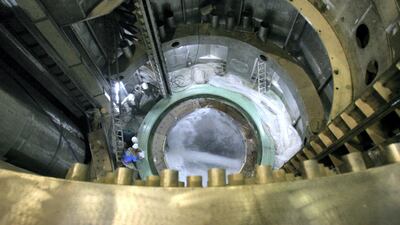
Russian contractors work at the Bushehr nuclear reactor site in 2007. The plant opened four years later. Bloomberg -
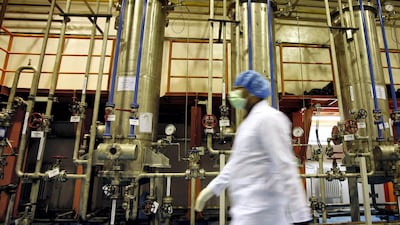
An Iranian technician at the International Atomic Energy Agency inspects the country's Isfahan plant in 2007. Tehran is no longer co-operating with the agency at nuclear sites across the country. EPA -

Workers wait to begin constructing a second reactor at the Bushehr nuclear power plant in 2019. AFP -
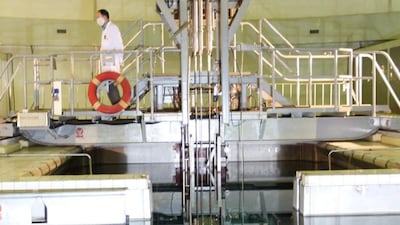
A metal-encased rod with 20 per cent enriched nuclear fuel is inserted into a reactor in Tehran in 2012. AFP -
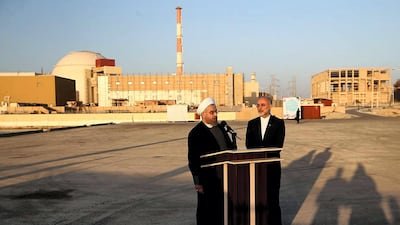
Fomer Iranian President Hassan Rouhani and the country's Atomic Energy Organisation chief Ali Akbar Salehi speak at the Bushehr nuclear site in 2015. AFP -
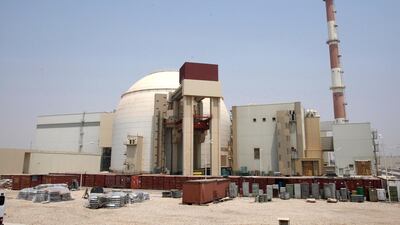
Iran's Bushehr nuclear plant has been restarted. EPA -
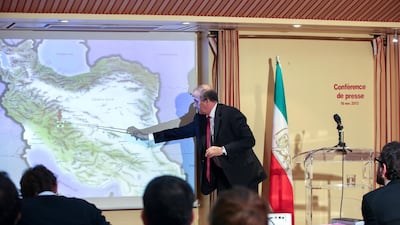
Mehdi Abrichamtchi, chairman of the Peace and Security Committee at the National Council of Resistance of Iran, shows journalists the location of a secret nuclear site in Iran in 2013. AFP -
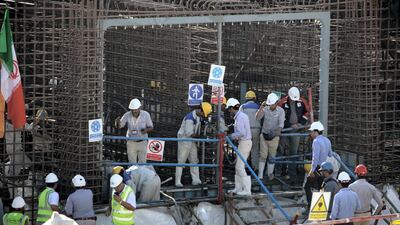
Workers prepare to begin the construction of a second reactor at the Bushehr site. AFP


“But let's create an international fuel bank — a reliable source of spent fuel for all the region — and make sure that everybody has the spent fuel they need but nobody enriches.”
Mr Menendez also said that International Atomic Energy Agency (IAEA) chief Rafael Grossi had told senators during his visit to Washington last month that the window for Iran to bring its enrichment activities back into compliance with the original deal is “on the verge of closing".
“If we cannot get the information that the IAEA has been looking for at several sites, that have been publicly reported that the Iranians have resisted giving them information, then I'm not sure we can fully calibrate where their weaponisation elements are,” said Mr Menendez.
The nuclear deal, a hallmark of former president Barack Obama’s foreign policy agenda, was quickly undone by his successor, Donald Trump.
Under Mr Trump, the US placed heavy sanctions on Iran, and Tehran has subsequently breached many of the terms of the deal, enriching more uranium at higher levels.
President Joe Biden's administration had hoped to revive the deal earlier this year, but initial dialogue stalled after the election of Ebrahim Raisi, Iran's new hard-line president.
Indirect talks between the US and Iran are expected to resume on November 29 in Vienna and will be headed by EU envoy Enrique Mora, who led the previous rounds of negotiations.
US State Department spokesman Ned Price said it was possible that progress will be made quickly during the talks.
“We believe that if the Iranians are serious, we can manage to do that in relatively short order,” Mr Price said.
“But we've also been clear, including, as this pause has dragged on for some time, that this window of opportunity will not be open forever.”

