
Retired general Colin Powell, the former US secretary of state and chairman of the Joint Chiefs of Staff who served under both Bush presidents, has died of complications from Covid-19, his family said on Monday. He was 84.
“He was fully vaccinated. We want to thank the medical staff at Walter Reed National Medical Centre for their caring treatment,” a family message on his Facebook page said.
“We have lost a remarkable and loving husband, father, grandfather and a great American.”
US media reported that Powell had multiple myeloma, a cancer of plasma cells that reduces the body's ability to fight infection.
"Time and again, he put country before self, before party, before all else—in uniform and out—and it earned him the universal respect of the American people," President Joe Biden said as tributes from world leaders poured in.

As a four-star army general, Powell — who leaves behind a widow, Alma Powell — was chairman of the military's Joint Chiefs of Staff under President George HW Bush during the 1991 Gulf War in which US-led forces expelled Iraqi troops from neighbouring Kuwait.
Powell, a moderate Republican and a pragmatist, later served as secretary of state under President George W Bush.
In a statement, Mr Bush said he and former first lady Laura Bush were “deeply saddened” by Powell’s death. Mr Bush said he was “a great public servant” and was “widely respected at home and abroad”.
A decorated soldier who started as a second lieutenant, a rank earned as a Reserve Officer Training Corps student at City College of New York, Powell served in Vietnam, West Germany and South Korea before being put in charge of the Gulf War.
In the allied effort to help Saudi Arabia defend Kuwait against Saddam Hussein’s Iraq, he developed the so-called Powell Doctrine.
It called for using overwhelming force, such as “shock-and-awe” battle tactics, to assure victory and minimise casualties once diplomatic solutions prove unworkable. He styled himself the “reluctant warrior”.
“Many of my generation, the career captains, majors, and lieutenant colonels seasoned in [Vietnam], vowed that when our turn came to call the shots, we would not quietly acquiesce in half-hearted warfare for half-baked reasons that the American people could not understand,” he wrote in My American Journey, published in 1995.
Such idealism proved elusive, however, in the 2003 Iraq War to oust Hussein.
As secretary of state, Powell was given the task of justifying an allied invasion. In a speech to the United Nations that included pictures he said were of mobile arms laboratories, he asserted there was “no doubt” that Hussein had hidden chemical and biological weapons.
But the following year, Powell told Congress that the evidence he had been given was “wrong,” and the speech “a blot” on his record.
“It was painful,” he told interviewer Barbara Walters in 2006. “It is painful now.”
British former prime minister Tony Blair, whose unflinching support of George W Bush provided the Iraq invasion with vital international backing, remembered Powell as a "towering figure in American military and political leadership".
"He was wonderful to work with, he inspired loyalty and respect and was one of those leaders who always treated those under them with kindness and concern," Mr Blair said.
Powell had two other blots on an otherwise lauded record. In the first, he was assigned to investigate the 1968 US massacre at My Lai in Vietnam and found no wrongdoing.
And as former president Ronald Reagan’s national security adviser, he was part of an administration that illegally traded arms for hostages in what became known as the Iran-Contra scandal. He was not personally implicated in either case.
After his retirement, Powell leaned in a more liberal direction, quietly campaigning against the nomination of John Bolton to be ambassador to the UN.
Born in New York in 1937 to Jamaican immigrant parents, Powell was for decades one of America's most prominent black figures.
He supported affirmative action and criticised the Bush administration on its treatment of detainees at the Guantanamo Bay detention facility and its handling of impoverished victims of Hurricane Katrina. In 2008 and 2012, he endorsed Barack Obama, a Democrat, for president.
In 2008, he spoke out against Islamophobia after Republican critics of Mr Obama falsely said he was Muslim.
“Is there something wrong with being a Muslim in this country? The answer is no. That's not America," Powell said.
Illustrating his deep misgivings about the evolution of the Republican Party as it lurched rightward in recent years, Powell endorsed Democrats Hillary Clinton in the 2016 presidential election and Joe Biden last year against Donald Trump.
Powell called Mr Trump a liar who presented a danger to the United States.
Secretary of State Antony Blinken paid tribute to Powell in a televised address, calling him "simply and completely a leader".
"He treated people the way he expected them to treat each other and he made sure they knew he would always have their back. His people would walk through walls for him," Mr Blinken said.
Secretary of defence Lloyd Austin said there will "never be another Colin Powell".
"Generations of young leaders will continue to look to his example and his character as the foundation for their own success," he said in a statement.
-
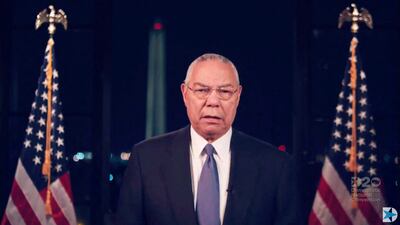
Former US secretary of state Colin Powell speaks during the second day of the Democratic National Convention, held virtually due to the coronavirus pandemic, in August 2020. Powell died on Monday from Covid-19 complications. AFP -
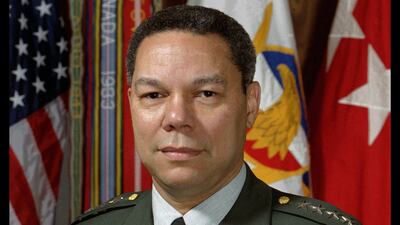
Powell, American statesman and general in the United States Army, in 1990. He also served as secretary of state (2001-2005), national security adviser (1987-1989) and chairman of the joint chiefs of staff (1989-1993). Getty Images -

Powell with former US president George Bush during the former's Presidential Medal of Freedom ceremony in the White House, July 1991. Getty Images -
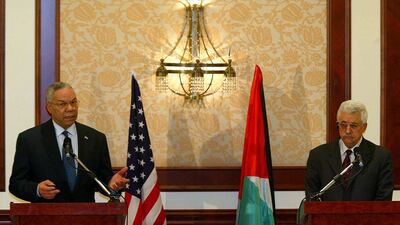
Powell, as US secretary of state, holds a joint press conference with Palestinian prime minister Mahmoud Abbas in May 2003 after their meeting in Jericho. Getty Images -

Powell delivers a powerful speech at the funeral of former US Army General, Norman Schwarzkopf, at West Point, New York, in February 2013. Reuters -

Powell and his wife Alma stand over Barack Obama as the then-president signs America's Promise Summit Declaration at the White House in September 2014. Reuters -

Powell and Hillary Clinton at a ceremony in Washington in September 2014. Reuters -

President Bill Clinton talks to Powell and former housing secretary Jack Kemp in September 1995 in Washington. Reuters -

Diana, Princess of Wales and Powell greet Mariela Baretto and her son Christopher in a receiving line before attending the United Cerebral Palsy annual dinner in New York in December 1995. Reuters -

Powell and his wife display the Honarary Knight Commander, of the Order of Bath, which he received from Britain’s Queen Elizabeth II in December 1993. Reuters -

Powell greets musician Sir Paul McCartney and Heather Mills at the US State Department in Washington in April 2001. McCartney was voicing his concerns about the use of landmines. Reuters -

Powell poses for photographers with Palestinian leader Yasser Arafat as they meet for talks in Ramalllah in February 2001. Reuters -

Powell clasps his hands in traditional Indian greeting as he meets women in Bombay in September 1997. Reuters -

Powell in talks with Jordan's King Abdullah in June 2001 at the Royal Palace in Amman. Reuters -

Powell holds up a vial that he described as one that could contain anthrax, during his presentation on Iraq to the UN Security Council in New York, February 2003. Reuters -

Powell embraces Prince Malika, 6, and Nhlahla Zonke, 7, who are suffering from HIV/AIDS at the Jabavu Clinic in Soweto, South Africa in May 2001. Reuters -

Powell talks to reporters as he embarks on a 26-city tour to promote his book in September 1995. Reuters -

Powell shakes hands with Saudi Arabia's Crown Prince Abdullah before a bilateral meeting in a Paris hotel in June 2001. Reuters -

Powell salutes his former boss, ex-US president Ronald Reagan, at a party February 1996 in honour of Reagan's 85th birthday. Reuters -

Powell with George W. Bush (L) and Dick Cheney in Crawford, Texas, December 2000. Reuters -

George W Bush watches his then-vice president Dick Cheney swearing in Powell as secretary of state designate at the White House, January 2001. Holding the bible is Powell's wife, Alma. Reuters -

Then-Texas governor and Republican presidential candidate George W. Bush waves with Powell after a rally in Pittsburgh, Pennsylvania, in November 2000. Reuters -

Gen Powell, then the chairman of the joint chiefs of staff, with members of the 132nd MP Company in Saudi Arabia, in December 1990. Reuters -

President Clinton chats with Powell as they sit with former presidents George Bush (L) and Jimmy Carter, with his wife Rosalynn Carter, at the start of the Summit for America's Future in Philadelphia, in April 1997. Reuters -

Powell with (L-R) Ronald Reagan, Alma Powell and Nancy Reagan arriving at the Ronald Reagan Presidential Library for award ceremonies in November 1993. Reuters -

Afghan interim leader Hamid Karzai speaks to Powell at the International Conference on Reconstruction Assistance to Afghanistan in Tokyo, in January 2002. Reuters -

Britain's prime minister Tony Blair with Powell during a special remembrance service in Downing Street, London, in December 2001. The event was in memory of the victims of the September 11 attacks on New York and Washington earlier that year. Reuters



