


US President Joe Biden’s special envoy for Iran, Robert Malley, will travel to the UAE, Saudi Arabia and Qatar within the next several days to discuss stalled negotiations aimed at reviving the ailing nuclear deal.
Mr Malley said on Wednesday that his discussions in the Gulf would focus on containing Iran’s nuclear programme and noted that the Biden administration is considering other options to pursue should talks to restore the deal ultimately fail.
“We will be prepared to adjust to a different reality in which we have to deal with all options to address Iran’s nuclear programme if it’s not prepared to come back into the constraints of [the 2016 nuclear deal],” Mr Malley said in a virtual interview with the Carnegie Endowment for International Peace.
US National Security Adviser Jake Sullivan noted last week during a meeting with his Israeli counterpart Eyal Hulata that “if diplomacy fails, the United States is prepared to turn to other options”.
The Biden administration's Iran envoy also said US Secretary of State Antony Blinken would be addressing the same topic with Israeli Foreign Minister Yair Lapid during his visit to Washington on Wednesday.
Mr Blinken and Mr Lapid also met trilaterally on Wednesday with Sheikh Abdullah bin Zayed, UAE Minister of Foreign Affairs and International Co-operation.
After the meeting, a reporter asked if a military path was under consideration for Iran. Mr Blinken said diplomacy is the preferred course but warned: “We are prepared to turn to other options if Iran doesn't change course.”
Mr Lapid echoed the remark, stating that "by saying other options, I think everybody understands in Israel, in the Emirates and Tehran what is it that we mean".
Despite the escalating rhetoric, Mr Malley said that the Gulf states’ increased diplomacy with Iran, coupled with the UAE's and Bahrain’s normalisation agreements with Israel, could help defuse tension in the region.
“One big change from 2016 to today … is that Iran’s neighbours are now engaging with Iran,” said Mr Malley. “Saudi Arabia, the United Arab Emirates, all of the countries on the Gulf Co-operation Council are now having interactions with Iran, which many of them would not have had in 2016.
“You have the normalisation accords between Israel and a number of Arab countries. That’s also a new element. And those can, in fact, create a greater de-escalation if we use them properly and create more incentives to address the nuclear crisis with Iran.”
He said the US and Israel still have differences on “the merits of coming back into the deal” under the new Israeli government led by Prime Minister Naftali Bennett.
However, he noted that Mr Bennett differs from former prime minister Benjamin Netanyahu in that the Israelis now “want to keep those differences behind closed doors as much as possible, while making it clear that they have genuine problems — real problems — with the [nuclear deal]".
“They want to work with us to see how we manage those differences in the scenario where we come back and in the scenario that we do not.”
-
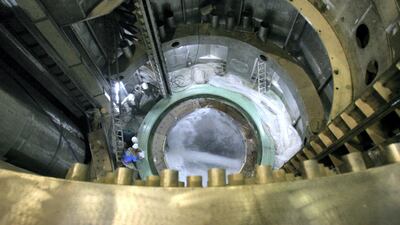
Russian contractors work at the Bushehr nuclear reactor site in 2007. The plant opened four years later. Bloomberg -
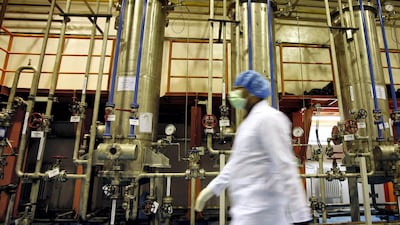
An Iranian technician at the International Atomic Energy Agency inspects the country's Isfahan plant in 2007. Tehran is no longer co-operating with the agency at nuclear sites across the country. EPA -

Workers wait to begin constructing a second reactor at the Bushehr nuclear power plant in 2019. AFP -
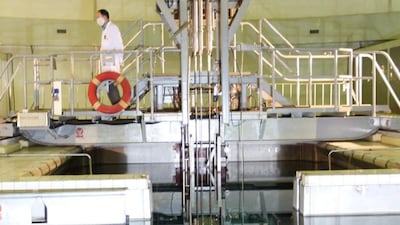
A metal-encased rod with 20 per cent enriched nuclear fuel is inserted into a reactor in Tehran in 2012. AFP -
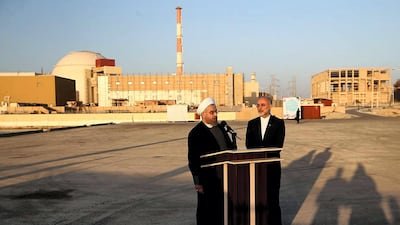
Fomer Iranian President Hassan Rouhani and the country's Atomic Energy Organisation chief Ali Akbar Salehi speak at the Bushehr nuclear site in 2015. AFP -
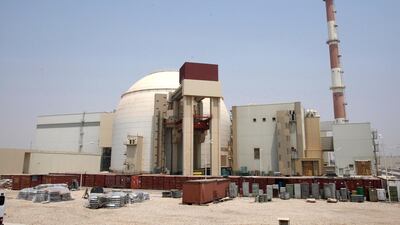
Iran's Bushehr nuclear plant has been restarted. EPA -
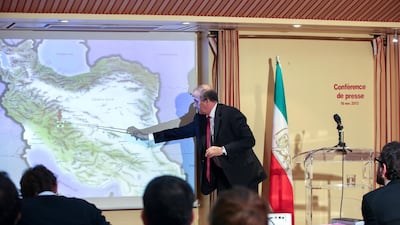
Mehdi Abrichamtchi, chairman of the Peace and Security Committee at the National Council of Resistance of Iran, shows journalists the location of a secret nuclear site in Iran in 2013. AFP -
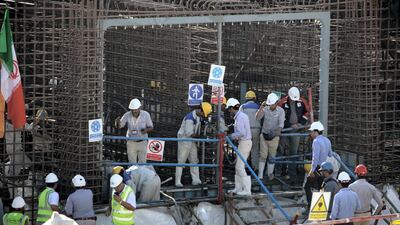
Workers prepare to begin the construction of a second reactor at the Bushehr site. AFP


A senior US official said last week that Iran’s breakout time to build a nuclear weapon had been reduced from a year to a few months after former president Donald Trump withdrew from the deal, prompting Tehran to increase its nuclear activities in breach of the accord.
But negotiations with Iran in Vienna have made little headway since the sixth round of nuclear talks concluded under former president Hassan Rouhani in June.
Under Mr Rouhani, the two sides agreed in principle that the US would scale back its sweeping sectoral sanctions on Iran in exchange for Tehran scaling back its nuclear accord breaches — though differences remained on the status of some additional sanctions instated under Mr Trump.
Iran has not agreed to resume indirect talks since hard-line cleric and nuclear deal sceptic Ebrahim Raisi took office in August.
Iranian Foreign Ministry spokesman Saeed Khatibzadeh hinted this month that Iran could return to the negotiating table by November.
“We now have a different team, different leadership and a president that is clearly stating that it wants to do things differently,” said Mr Malley. “We’re getting a piece of Iran’s answer every day where they are not coming back to the table.
“Every day where they’re making statements about how little was achieved in Vienna, which is what the current team is saying, is telling us this is a team that may not in effect be prepared to come back into what we consider — and what the rest of the [nuclear deal’s signatories] — would consider full mutual compliance with the accord.”
-

Iranian President Hassan Rouhani, right, and the head of Atomic Energy Organization of Iran Ali Akbar Salehi inspect the nuclear technology on the occasion of Iran National Nuclear Technology Day in Tehran in 2019. EPA -
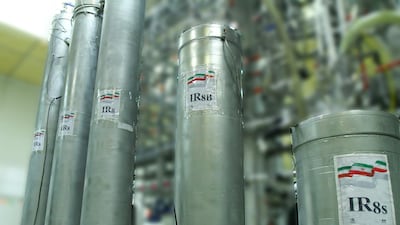
IR-8 centrifuges at Natanz nuclear power plant, some 300 kilometres south of capital Tehran. AFP -
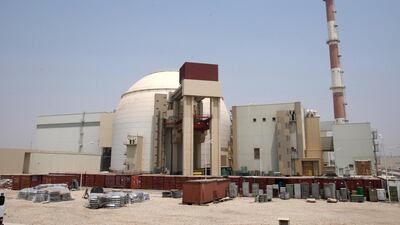
The Iranian nuclear power plant in Bushehr in 2010. EPA -

Salehi speaks with media while visiting Natanz enrichment facility, in central Iran in 2019. Atomic Energy Organization of Iran via AP -
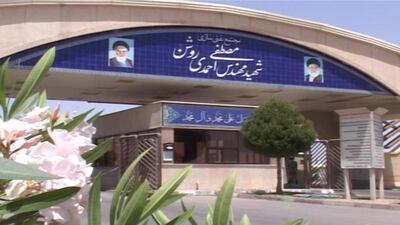
The gate of Natanz nuclear power plant in Natanz , Isfahan province, in 2019. EPA -
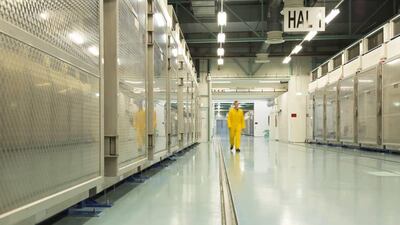
Inside of the Iran's Fordow nuclear facility, in Fordow, Qom province in 2019. EPA -
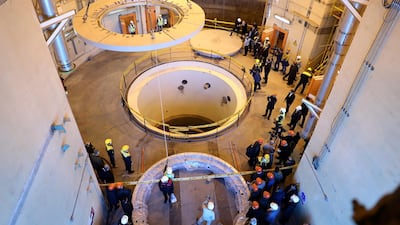
Technicians work at the Arak heavy water reactor's secondary circuit, as officials and media visit the site, near Arak, Iran in 2019. Atomic Energy Organization of Iran via AP -
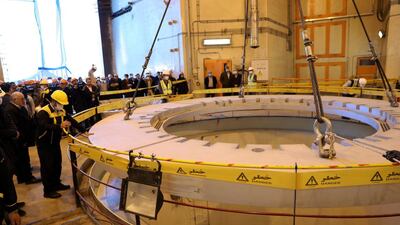
Members of the media and officials tour the water nuclear reactor at Arak in 2019. WANA via Reuters -
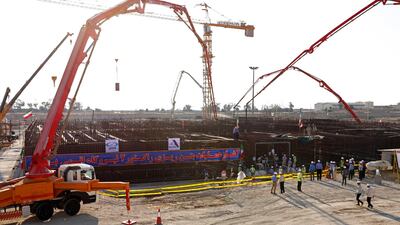
Concrete is poured for the base of the second nuclear power reactor at Bushehr plant in 2019. Atomic Energy Organization of Iran via AP



