Naftali Bennett, who on Sunday replaced Israel's veteran premier Benjamin Netanyahu, is a multi-millionaire former tech entrepreneur who made his name in politics with hardline religious-nationalist rhetoric.
The 49-year-old, who has made pitches to hard-right voters throughout his career, leads the Yamina party, which has called for Israel to annex parts of the occupied West Bank.
A bald politician with a discreet kippa and perfect American English, he is ultra-liberal on the economy and takes a hard line against Israel's arch-enemy, Iran.
He shares this ideology with Mr Netanyahu and has served in several of the Likud leader's governments, but in recent years the two have become increasingly opposed.
In the aftermath of 11 days of deadly fighting with Palestinian militants in the Gaza Strip, Mr Bennett finally agreed to join centrist Yair Lapid in a coalition to oust the prime minister, who has been in power for 12 consecutive years as well as an earlier three-year term.
Mr Lapid and Mr Bennett will share power, letting Mr Bennett serve the first term in a rotating premiership.
Mr Bennett, in a Knesset speech before Sunday's vote, promised the new government, a coalition of ideologically divergent parties, "represents all of Israel".
He said the country, after four inconclusive elections in under two years, had been thrown "into a maelstrom of hatred and in-fighting".
"The time has come for different leaders, from all parts of the population, to stop, to stop this madness", he said, to angry shouts of "liar" and "criminal" from right-wing opponents.

Religious-nationalist Yamina won seven seats in the country's last general elections in March, although one member has refused to join an anti-Netanyahu coalition.
A controversial past
A former special forces commando, Mr Bennett is the son of US-born parents and lives with his wife Galit and four children in the central city of Raanana.
In 1996, he led a commando unit against Hezbollah during fighting in southern Lebanon. He was later blamed by Israeli publication Yedioth Ahronoth for the Qana massacre, in which at least 106 Lebanese civilians were killed by Israeli artillery fire. Four UN peacekeepers were among the wounded.
Over 800 civilians had been taking shelter from fighting in a UN compound. Mr Bennett was accused of setting off a chain of events that led to the deadly artillery strike, a charge he denies.
After leaving the army, he launched tech start-up which he eventually sold for $145 million in 2005, and the next year became chief of staff to Mr Netanyahu, who was then in opposition.
After leaving Mr Netanyahu's office, Mr Bennett in 2010 became head of the Yesha Council, which lobbies for Jewish settlers in the West Bank.
He took politics by storm in 2012 by taking charge of the hard-right Jewish Home party, which was facing annihilation.
He increased its parliamentary presence fourfold, while making headlines with a series of incendiary comments about the Palestinians.
In 2013, he said Palestinian "terrorists should be killed, not released".
He also argued that the West Bank is not under occupation because "there was never a Palestinian state here", and that the Israeli-Palestinian conflict could not be resolved but must be endured, like a piece of "shrapnel in the buttocks".
Beyond holding the defence portfolio, Mr Bennett has served as Mr Netanyahu's economy minister and education minister.
He rebranded Jewish Home as Yamina (Rightward) in 2018, and was part of Mr Netanyahu's coalition that collapsed in the same year.
He was not asked to join a Netanyahu-led unity government in May last year – a move seen as an expression of the premier's personal contempt towards him, despite their shared ideology.
In opposition and with the coronavirus pandemic raging in 2020, Mr Bennett dampened his right-wing rhetoric to focus on the health crisis, moving to broaden his appeal by releasing plans to contain the virus and aid the economy.
"In the next years we need to put aside politics and issues like annexation or a Palestinian state, and focus on gaining control over the coronavirus pandemic, healing the economy and mending internal rifts," he told Israel's widely listened-to Army Radio in November.
-

New Israeli Prime Minister Naftali Bennett, Foreign Minister Yair Lapid and Defence Minister Benny Gantz sit in parliament, in Jerusalem, on June 13, 2021. Mr Bennett was sworn in after winning a confidence vote with a margin of 60 votes to 59. Reuters -

Former prime minister and now head of the opposition Benjamin Netanyahu and Mr Bennett following the vote in the Knesset, Israel's parliament, on June 13. Reuters -

The new government brings together unlikely bedfellows including right-wing nationalist Mr Bennett, pictured, centrist former TV host Mr Lapid and Arab Islamist Mansour Abbas. EPA -

A supporter of the coalition government holds a placard that reads in Hebrew "Hope". Reuters -

Mr Netanyahu speaks before parliament votes. Getty Images -

Mr Gantz, left, and Mr Netanyahu chat with Members of Parliament. AFP -

Mr Bennett will be prime minister for the first two years before handing over to Mr Lapid for the last two years of the parliament's term, under their agreement. AFP -

Mr Bennett named a cross-party Cabinet. AP -

Mr Bennett, 49, is a nationalist tech millionaire known for his aspirations to expand Israel's settlements. AFP -

Mr Netanyahu vowed to not be silenced and said he would do "daily battle against the incoming government". AFP -
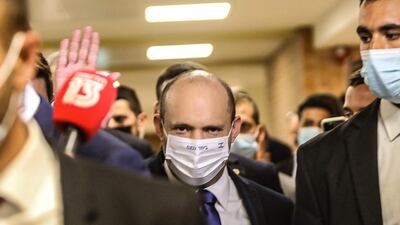
Mr Bennett arrives at the Knesset earlier in the day. AFP -

Leader of the Tikva Hadasha party, Gideon Saar, centre, arrives for the special voting session. EPA -

Mr Lapid's secularist party finished second with 17 seats in the March elections. Reuters -

Mr Abbas has been leader of United Arab List party, Raam, since early 2019 - the year he was first elected to the Knesset. AFP -

Merav Michaeli of the Israeli Labor Party arrives at the Knesset. AFP



