


A large number of US police killings over a period of four decades have gone either unreported or been misclassified, with black Americans most susceptible to being subjected to fatal police violence, a study from The Lancet medical journal reported.
The study's findings “show a system of violent and fatal policing in the US that is unfairly and unevenly applied across race and ethnicity,” The Lancet Editorial notes.
More than 17,000 deaths caused by US police killings from 1980-2018 have gone unreported in official reports, the study said. That figure accounts for about 55.5 per cent of 30,800 deaths caused by police violence in the four-decade period.
-
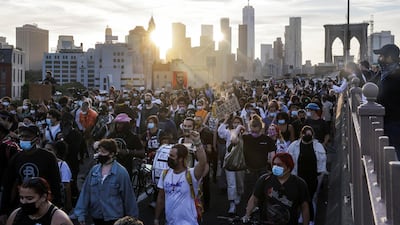
Protesters march on the Brooklyn Bridge during a demonstration on the first anniversary of the death of George Floyd, in New York. Reuters -

Some streets in Manhattan were closed due to the demonstrations on Tuesday evening. AP -

The musician Common performs with the Sounds of Blackness at George Floyd Square in Minneapolis, Minnesota. Floyd's death in May 2020 led to worldwide protests and calls for police reform or abolition. Getty -
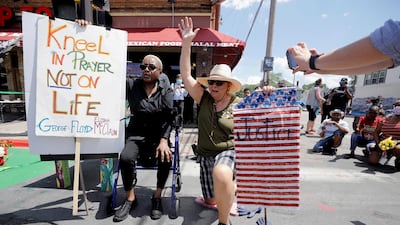
Robin Puttin leads a prayer while kneeling and raising her hand on the first anniversary of George Floyd's death, at George Floyd Square, in Minneapolis, Minnesota. Reuters -
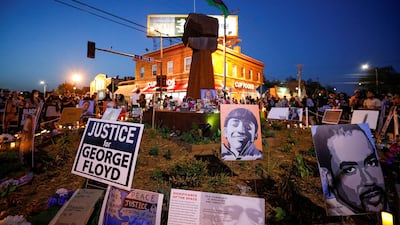
Electric and LED candles bearing the names of people killed by police illuminate the fist sculpture as people gather at the George Floyd Square. Reuters -
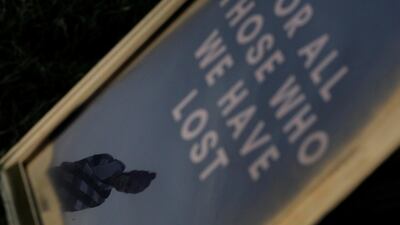
A man is reflected in a sign during a vigil held to remember George Floyd in Lynn, Massachusetts. Reuters -
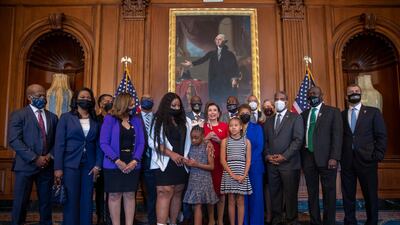
House Speaker Nancy Pelosi meets the family of the late George Floyd at the US Capitol in Washington. The family met President Joe Biden and various US politicians, and participated in a memorial at Black Lives Matter Plaza. EPA -
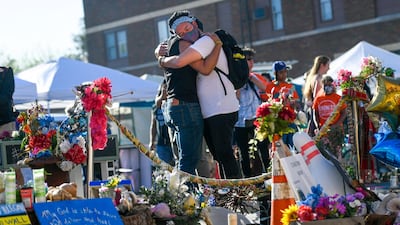
People gather at the sight where George Floyd was killed one year ago, at 38th Street and Chicago Avenue in Minneapolis - an area now called George Floyd Square. EPA -
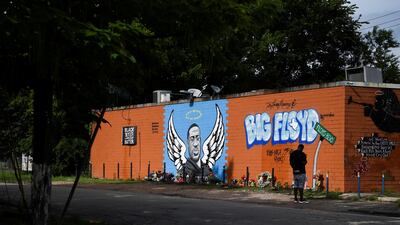
A man stands next to a mural of George Floyd in Houston, Texas. Reuters -
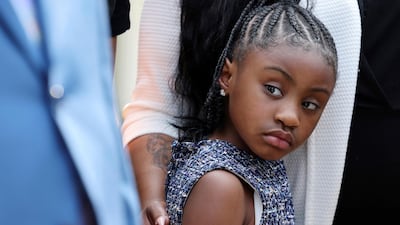
A family member holds onto Gianna Floyd, daughter of George Floyd, at the White House following their meeting with President Biden in Washington. Reuters -
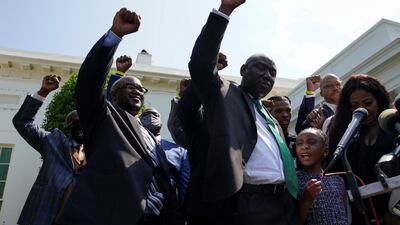
Gianna Floyd and other family members and lawyers, raise fists after meeting President Biden in Washington. Reuters -
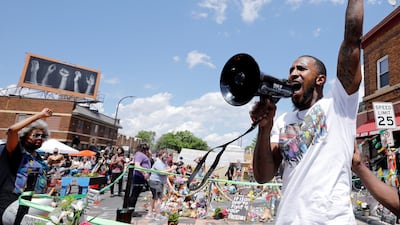
Community organiser Tommy McBrayer leads a chant in solidarity with George Floyd, at George Floyd Square, in Minneapolis. Reuters -
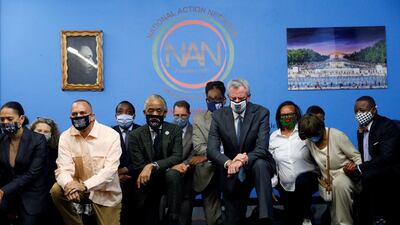
New York City Mayor Bill de Blasio and Reverend Al Sharpton kneel with community leaders for nine minutes and 29 seconds, symbolising Floyd's ordeal at the hands of police. Reuters -
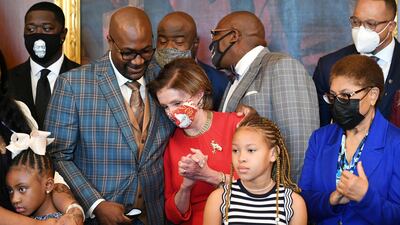
Philonise Floyd, brother to George Floyd, puts his arm around Speaker Nancy Pelosi, near Rep. Karen Bass, as he and other members of the Floyd family meet politicians at the US Capitol. Reuters -
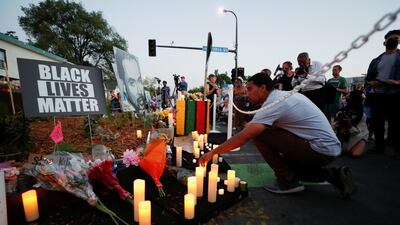
A man places a candle at a memorial in honour of George Floyd, at George Floyd Square in Minneapolis. Reuters -
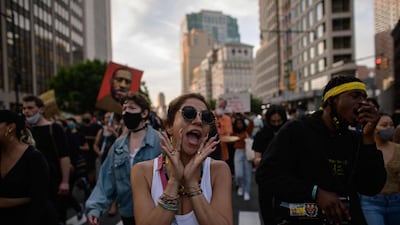
Black Lives Matter protesters hold placards and shout slogans in Brooklyn, New York. AFP -
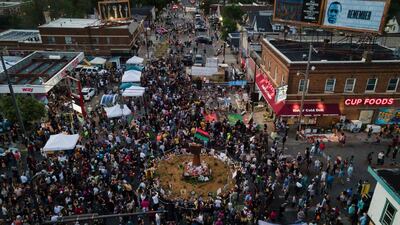
People gather at George Floyd Square in Minneapolis. AP -
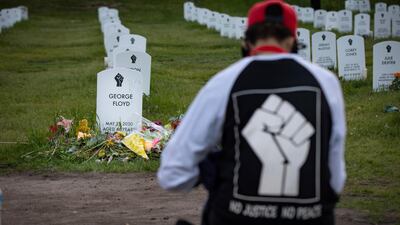
A man sits in front of the Say Their Names cemetery, close to George Floyd Square, in Minneapolis. AP -
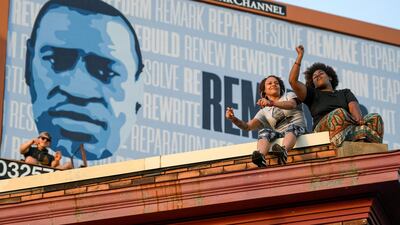
Two women sit on a roof as they listen to a memorial music performance, at George Floyd Square, in Minneapolis. EPA


Rates of police violence increased by 38 per cent for all races from the 1980s to the 2010s, the study found. The US National Vital Statistics System, which collects all death certificates in the US, misclassified 56 per cent of non-Hispanic white deaths and 33 per cent of the deaths of non-Hispanic people of other races.
In addition, 50 per cent of deaths of Hispanics of any race were misclassified.
More than 930 people in the US have been shot and killed by police in the past year, a database compiled by The Washington Post shows.
Black Americans disproportionately killed by police
Police violence has a disproportionate effect on black, Hispanic and indigenous Americans, new estimates from the report show.
Black Americans, who experienced the highest death rate, were more than 3.5 times likelier to experience fatal police violence than white Americans.
About 60 per cent of deaths among black Americans caused by police violence were misclassified. Out of 9,540 deaths, 5,670 went unreported.
The study also found the rate of fatal police violence was higher in every year for black Americans versus white Americans.
The inaccurate reporting and misclassification of deaths of black Americans “further obscures the larger issue of systemic racism that is embedded in many US institutions, including law enforcement,” said co-lead author Fablina Sharara of the Institute for Health Metrics and Evaluation at the Washington University School of Medicine.
Trust in police erodes as reform talks break down
The murder of George Floyd by Derek Chauvin - a white police officer - last year sparked global attention on police brutality, particularly within the US. More than 7,500 demonstrations occurred across the US in the months following Floyd's death, data from the Armed Conflict Location and Event Data Project show.

During these protests, there were 950 instances of police brutality against citizens and journalists, The Guardian reported. There were 200 recorded in Portland alone, where police spent about $118,000 on tear gas and less-lethal ammunition over a six-week period.
Despite widespread media coverage of these protests, a majority of Americans do not believe police violence against black Americans has changed for the better, and that police are more likely to use violence against black Americans than white Americans, a poll conducted by The Associated Press-NORC Center for Public Affairs Research showed.
Seventy-seven per cent of black Americans said police violence is a serious problem.
But recent efforts to limit police violence, such as the use of body cameras and providing de-escalation training, have done little to “meaningfully” mitigate police violence rates, The Lancet study found.
Hopes of comprehensive police reform were dashed this month when Congress failed to reach a deal over the George Floyd Justice in Policing Act, a sweeping bill that would have established a framework to limit racial profiling and demilitarise the police, among other reforms.

