


US President Joe Biden and scores of other world leaders are braving the Covid-19 danger and heading to New York to deliver their speeches at the UN General Assembly in person this year.
The National highlights the key issues to watch for during the toughest week in global diplomacy.
1. South Korea's BTS rally for UN targets
Move over Mr Biden - the real stars of this UN General Assembly have already danced and sang their way through the UN's domed meeting place.
South Korean seven-piece boy band BTS broadcast from UN headquarters on Monday, promoting global goals tackling poverty, inequality, injustice and climate change as world leaders headed to New York.
The group filmed a music video for their song Permission to Dance at the UN at the weekend, dancing through the General Assembly Hall and out into the gardens. It quickly garnered a few million views on social media.
2. Joe Biden tries to salvage America’s battered reputation
President Biden’s first speech as US leader to the UN General Assembly comes only weeks after Washington’s ignominious retreat from Afghanistan as the Taliban swept back to power.
Mr Biden is a multilateralist supporter of UN-style diplomacy. His speech on Tuesday will probably contrast to his predecessor Donald Trump’s go-it-alone “America First” rhetoric and try to reassert US leadership.
Still, US allies were shocked by how sharply Mr Biden pulled the plug on their joint military enterprise in Afghanistan and have big qualms about US leadership. All the while, China grows richer and mightier.
A US-led conference on sharing Covid-19 vaccines on September 22 may burnish Washington’s credentials, but Mr Biden still has a diplomatic mountain to climb in New York.
“Trump took a vicious line towards China and attacked its trade policies,” said Richard Gowan, a UN expert at the International Crisis Group think tank.
“Biden won’t be as nasty towards Beijing. But I think we probably will hear the president … talk about the need to protect a rules-based world order led by the US against Chinese competition.”
3. Embattled UN buoyed by opinion poll findings
UN Secretary General Antonio Guterres is struggling to keep a divided world on track to tackle climate change and the coronavirus pandemic — but a new poll suggests people broadly support his leadership of the world body.
A Pew Research survey found last week that about two thirds of people in wealthier nations in North America, Europe and Asia view the organisation favourably.
UN spokeswoman Melissa Fleming called the results “encouraging".
4. Could the real Afghan and Myanmar envoys please stand up?
The Taliban’s rapid return to power last month in Afghanistan and the military coup in Myanmar in February have far-reaching consequences for those two countries.
They also pose a troubling question at the coming General Assembly: Who is the correct representative for each nation?
Both UN members have ambassadors in place at UN headquarters in New York. But Myanmar’s envoy Kyaw Moe Tun openly defies the junta that seized power back home, and Afghanistan’s envoy Ghulam Isaczai likewise abhors the Taliban.
Myanmar’s new military rulers have tried to replace Mr Kyaw Moe Tun and there has even been a plot to kill him. The Taliban are expected to send their own envoy to New York once they have consolidated a government in Kabul.

A UN committee is in charge of deciding the rightful envoy for a UN member. But time is short, and it may not be clear who speaks for Myanmar and Afghanistan until it is their turn at the podium on September 27.
5. Vaccination frustration
The UNGA was scaled back this year for fear of becoming a Covid-19 superspreader event. Still, dozens of leaders are headed to Manhattan and even with trimmed down entourages, this adds up lots of officials from the world’s four corners crammed into a big hall.
Under UN rules, participants must vouch that they are vaccinated or recently tested and infection-free when they enter the headquarters building. Everyone must wear masks under the General Assembly hall's golden dome.
But, in true UN fashion, divisions have developed in recent days. New York officials, who host the world body, say participants must be vaccinated. Their call for vaccinations was endorsed by the UN’s new General Assembly president, Abdulla Shahid.
-

Demonstrators march through the streets of Paris, protesting against new Covid-19 restrictions announced by French President Emmanuel Macron. -

Thousands took part in demonstrations, claiming that the new measures are an attack on civil liberties. -

Under the new restrictions, from August 1 people will have to show proof of vaccination or a negative Covid-19 test to access bars, cafes, restaurants, shopping centres and hospitals. -

Nurses take part in protests in Paris. The government says the latest measures are to curb rising Covid-19 infections and drive up the vaccinations rate. -

Florian Philippot of the nationalist The Patriots party speaks at a demonstration in Paris. A protester holds a placard with the message 'No to health passport'. -

Protesters hold signs claiming that they are living in a health dictatorship, during a rally in Paris. -

Tens of thousands of people protested across France on Saturday against the government's latest Covid-19 restrictions. -

Anti-vaccine protesters rally in Paris, with the Louvre in the background. Restrictions will also apply on long-distance rail journeys and flights. -

Nicolas Dupont-Aignan, leader of Debout la France, a right-wing party, addresses anti-vaccine protesters near the Louvre in Paris. -

Demonstrators gather around the Louvre to protest against Covid-19 restrictions. -

French President Emmanuel Macron said an extension of a vaccine passport scheme is required due to soaring Covid-19 infection rates. -

Protesters fly the French tricolour as they gather round the by the Louvre pyramid in Paris. They say coronavirus restrictions are contrary to the French tradition of liberty. -

Police confront protesters against the new coronavirus safety measures, in Paris. -

Florian Philippot, fourth right, of French nationalist party The Patriots, and Nicolas Dupont-Aignan, third right, leader of the right-wing Debout la France party, among protesters in Paris.


But naysayers have blasted the vaccine demand. Russian ambassador Vassily Nebenzia said it was a “clearly discriminatory” infringement of nations’ rights at the UN — which is supposed to follow internationally agreed upon rules, not those imposed by US officials.
6. How to keep your foreign minister busy at a scaled-back UNGA
Lana Nusseibeh, the UAE’s Ambassador to the UN, and other New York-based envoys have a problem for this year’s UNGA – keeping their presidents, prime ministers and ministers occupied at the week-long diplomatic jamboree.
On a normal year, UN headquarters and the surrounding streets are bustling with side events, conferences and bilateral sit-downs as huge entourages of officials snake their way through endless security checkpoints.
But the second UNGA during the coronavirus pandemic will have fewer in-person events and fewer officials travelling to New York. For Ms Nusseibeh and others responsible for planning their boss’s itineraries, this is a headache.
UN envoys “are stressing currently about the high-level week that is about to start, and the delegations of heads of states and foreign ministers who are about to arrive, and potentially the lack of meetings they have to send them to,” Ms Nusseibeh said this week.
“We're all going through a little bit of stress thinking about their schedules.”
7. UK's Johnson seeks pledges in run-up to Glasgow climate talks
To put it mildly, global efforts to cut emissions of planet-heating gases are not going well.
-

French glaciologist Pierre Rene makes ice height measurements at the Ossoue glacier on the Vignemale peak in the French Pyrenees last month. The glacier, the highest and the largest in the French Pyrenees, is expected to disappear by 2050 due to climate change. AFP -
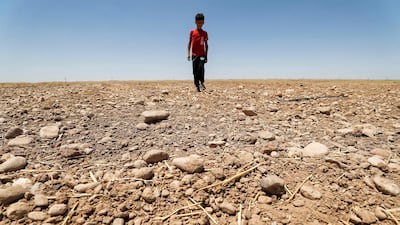
A boy walks through a dry field in eastern Iraq. Reduced agricultural production, water scarcity, rising sea levels and other adverse effects of climate change could force up to 216 million people to migrate within their own countries by 2050, the World Bank has said. AFP -
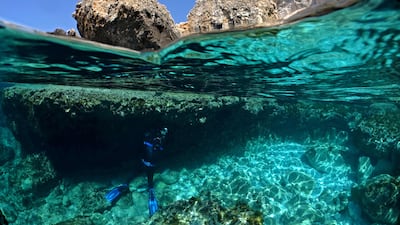
Cypriot marine ecologist Louis Hadjioannou takes pictures of coral as he monitors the effects of climate change in the crystal clear waters off the island's south-eastern shore. AFP -
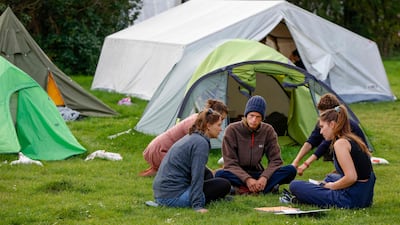
Climate activists at a protest camp in Berlin. The activists were involved in a weeks-long hunger strike as they demanded meetings with German party leaders to discuss the environment. AFP -
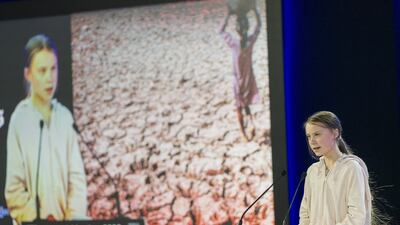
Swedish climate activist Greta Thunberg addresses a panel session during the 50th annual meeting of the World Economic Forum in Davos, Switzerland. EPA -
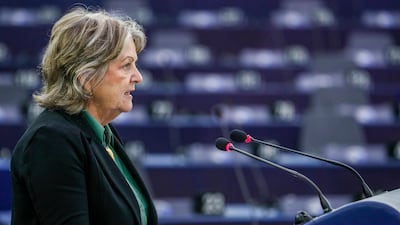
European Commissioner for Cohesion and Reforms Elisa Ferreira discusses the effects of natural disasters in Europe due to climate change, during a plenary session at the European Parliament in Strasbourg, France. AFP


World leaders have agreed to keep temperature rise below 1.5°C against pre-industrial levels, but none of the big world economies has cut back on carbon enough to make this anywhere close to a realistic outcome.
The responsibility for fixing this currently lies with the UK Prime Minister Boris Johnson, who will host a climate summit in Glasgow in November that is, for many activists, the last chance to put global efforts on the right track.
Mr Johnson and Mr Guterres will gather with about three dozen world leaders on Monday, hoping to raise ambitions for scrapping coal and other dirty fuels at the coming talks in Scotland.
Speaking on background with reporters, a UN climate official said it would be a “frank, closed-door discussion” where the UN chief would “raise the alarm” and demand not only long-term pledges but also near-term plans for cutting carbon drastically.

