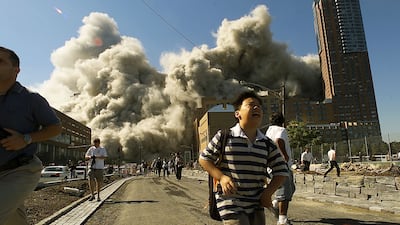
People covered in ash make their way through dust and debris after the South Tower of the World Trade Centre collapsed. Photo: Keystone/Zuma/Shutterstock (1450286a)

9/11 clean-up crews fought for health care for years after attacks


  • English
  • Arabic

John Feal was not at the World Trade Centre when the planes struck, but as a demolition supervisor, he was one of an army of construction workers sent to Ground Zero in the aftermath of the September 11, 2001 attacks.

Days after he began working at the site, several tonnes of steel fell on his left foot after part of the structure collapsed. He spent 11 weeks in hospital and half his foot was amputated after he developed gangrene and sepsis.

But he was denied any money from the original compensation fund, which only helped people injured within 96 hours of the attack.

Mr Feal, from Long Island, has since become a prominent voice in the battle to help those who suffered long-term illnesses following the events of 9/11.

More than 2,600 people died at the World Trade Centre on September 11.

First responders rushed to the scene, followed by construction workers including Mr Feal. For days, they sifted carefully through the debris, searching for human remains.

The structure was unstable, as Mr Feal discovered to his cost. Fires burned on the site for months and people working at Ground Zero picked their way through the wreckage, fearful of sustaining injuries from the jagged steel and iron strewn across the area.

Some first responders even wrote their names and phone numbers on their arms in case they were crushed or fell into a crevice.

In the aftermath of the attack, massive dust clouds rose from the site, enveloping the area in a dark gloom.

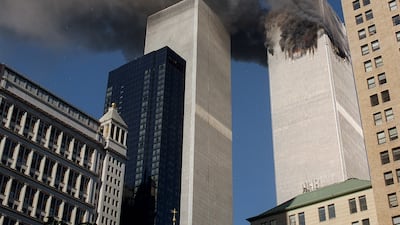
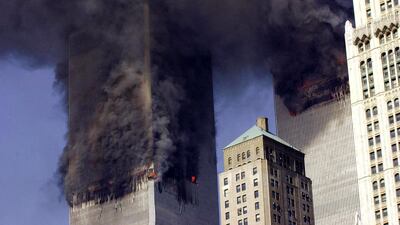
  • Smoke billows from the North Tower of the World Trade Centre in New York City after terrorists crashed a plane into the building on September 11, 2001. AP Photo
    Smoke billows from the North Tower of the World Trade Centre in New York City after terrorists crashed a plane into the building on September 11, 2001. AP Photo
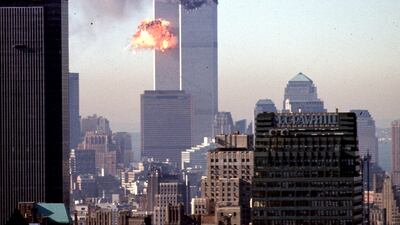
  • The plane was thought to have hit the North Tower between floors 93 and 99 sparking a fierce fire on those storeys from which people desperately tried to escape. Reuters
    The plane was thought to have hit the North Tower between floors 93 and 99 sparking a fierce fire on those storeys from which people desperately tried to escape. Reuters
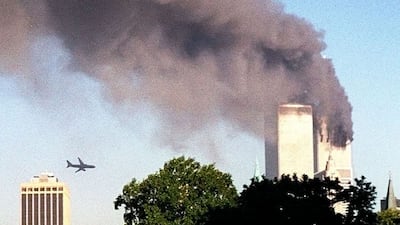
  • American Airlines flight 175 closes in on the south face of the South Tower of the World Trade Centre as the North Tower burns. Shutterstock
    American Airlines flight 175 closes in on the south face of the South Tower of the World Trade Centre as the North Tower burns. Shutterstock
  • The moment of impact. AFP
    The moment of impact. AFP
  • With both towers ablaze, pandemonium ensues in Manhattan in the building and on the ground. AFP
    With both towers ablaze, pandemonium ensues in Manhattan in the building and on the ground. AFP
  • The cloudless, blue sky gave little portent of the dark, history-changing day that was to come but would remain etched on the memory of those involved and beyond. AFP
    The cloudless, blue sky gave little portent of the dark, history-changing day that was to come but would remain etched on the memory of those involved and beyond. AFP
  • People run for their lives as the North Tower of World Trade Centre collapses. The South Tower had come down 29 minutes earlier. Getty Images
    People run for their lives as the North Tower of World Trade Centre collapses. The South Tower had come down 29 minutes earlier. Getty Images
  • Emergency personnel tend to injured people in Liberty Park, New Jersey, as the enormity of the day's events slowly begin to hit home. Reuters
    Emergency personnel tend to injured people in Liberty Park, New Jersey, as the enormity of the day's events slowly begin to hit home. Reuters
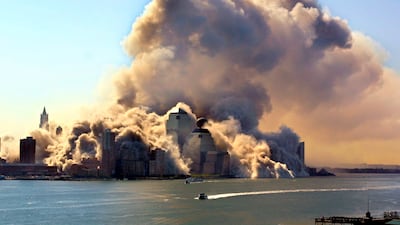
  • The World Trade Centre disappears in a thick cloud of smoke as the second tower implodes. AP Photo
    The World Trade Centre disappears in a thick cloud of smoke as the second tower implodes. AP Photo
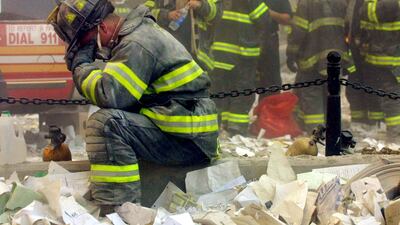
  • Firefighter Gerard McGibbon, of Engine 283 in Brownsville, Brooklyn, prays after the buildings collapse. Getty Images
    Firefighter Gerard McGibbon, of Engine 283 in Brownsville, Brooklyn, prays after the buildings collapse. Getty Images
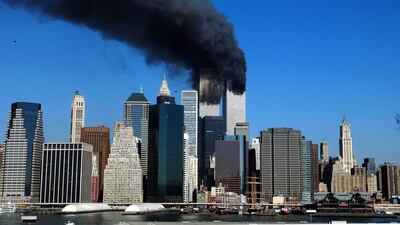
  • Smoke pours from the site and drifts across the New York sky. Reuters
    Smoke pours from the site and drifts across the New York sky. Reuters

The wind carried a lethal cocktail of carcinogens including benzene, dioxins and asbestos that hung over Lower Manhattan for months.

Some 400,000 people were exposed to toxic dust from the collapsed twin towers, sustained physical injuries at the site or suffered emotional damage, official estimates show.

Only last year, a study by the Icahn School of Medicine at Mount Sinai in New York City found that first responders were twice as likely to have contracted thyroid cancer than the general population.

Their risk of leukaemia was 41 per cent higher and the rate of prostate cancer was 25 per cent above average.

There were also long-term victims at the Pentagon and in Shanksville, Pennsylvania, where a United Airlines flight crashed after it was hijacked.

Even today, the toll is rising.

At the last count, 255 New York police officers and 253 members of the city’s fire department had died from World Trade Centre-related illnesses.

Many victims were first responders but the toxic fallout from 9/11 also affected people living and working across Lower Manhattan - and Mr Feal took up the cudgels on their behalf.

“I started fighting for myself and then began helping others,” he told The National.

“When I was going to therapy and survivor groups, I saw everybody was going through the same thing that I was.”

Many were suffering from cancer, respiratory sicknesses and chronic obstructive pulmonary disease.

“The treatment was not good. It took us years to get bills passed to make sure they got free health care and compensation. We had to fight every step of the way.”

Mr Feal joined forces with Carolyn Maloney, a New York congresswoman, and her chief of staff, Ben Chavet, in trying to bring justice to thousands of people who, having contracted serious illnesses, were being left to fend for themselves.

Support was at best patchy after the closure of the original Victim Compensation Fund in 2004.

What aid there was — such as the Medical Monitoring and Treatment Programme — was not especially well funded, receiving only $475 million between 2002 and 2011, a fraction of the $7.4 billion allotted to the original Victim Compensation Fund.

In some cases, survivors had to turn to philanthropic organisations for financial support.

Others were dependent on health insurance.

As early as 2005, Ms Maloney introduced the Remember 9/11 Act to provide health care for those who had contracted diseases such as cancer following the attacks.

The bill went nowhere.

Mr Feal threw his weight behind the campaign. Having finally won a settlement on his own behalf, he spent thousands of dollars bringing other ailing survivors to Washington to lobby for legislation.

He threatened to run primary candidates against any New York congressional Democrats if they failed to vote for a bill providing compensation.

Ms Maloney tried again, introducing the James Zadroga 9/11 Health and Compensation Act, named after a police officer and non-smoker who died of respiratory disease.

He was the first New York police officer whose death was attributed to toxins at the World Trade Centre site.

The measure eventually passed in January 2011, albeit with the funding slashed from $7.4bn to $4.6bn, and the 10-year time limit slashed to five because of Republican opposition.

It established the Word Trade Centre Health programme, which covered at least 68 cancers linked to toxins at Ground Zero.

John Feal at Ground Zero in Manhattan

The act, which re-established the Victim Compensation Fund, was supported by Jon Stewart, an American comedian best known as the host of The Daily Show.

He did the same in 2015, when the fund was renewed.

But within three years the Victim Compensation Fund was running out of cash and with the clock running down, pressure mounted for a lasting solution.

A fresh measure, called the Never Forget the Heroes Act, was introduced. Its key provision was to extend the Victim Compensation Act until 2090, again with the support of Mr Stewart.

Appearing before a subcommittee of the House Judiciary Committee in June 2019, he laid into Congress with astonishing ferocity.

“Behind me, a filled room of 9/11 first responders, and in front of me, a nearly empty Congress,” he said.

The bill passed, albeit with two Republican senators — Mike Lee and former presidential candidate Rand Paul — objecting on grounds of cost.

Care is now in place which should at least provide some financial security for those who have paid dearly over the past two decades.

“These responders and survivors should not have had to drag themselves through the halls of Congress to get action but that is what they had to do,” Mr Chevat said.

“After struggling for so many years, those affected by the toxins are now getting the care they deserve and need, and compensation for their injuries.”

Now 54, Mr Feal regards his suffering as minute compared to other victims of the attack. “My story pales into comparison to those who have died.”

But he takes pride in the success of his campaign. “It is the reason why more than 100,000 people got free health care.

“I don’t want to downplay the significance of others. But if we hadn’t done what we did, there would not have been legislation today.”


Jon Stewart, the former host of 'The Daily Show', speaks before the House on June 11, 2019. EPA


Mercer, the investment consulting arm of US services company Marsh & McLennan, expects its wealth division to at least double its assets under management (AUM) in the Middle East as wealth in the region continues to grow despite economic headwinds, a company official said.

Mercer Wealth, which globally has $160 billion in AUM, plans to boost its AUM in the region to $2-$3bn in the next 2-3 years from the present $1bn, said Yasir AbuShaban, a Dubai-based principal with Mercer Wealth.

Within the next two to three years, we are looking at reaching $2 to $3 billion as a conservative estimate and we do see an opportunity to do so,” said Mr AbuShaban.

Mercer does not directly make investments, but allocates clients’ money they have discretion to, to professional asset managers. They also provide advice to clients.

“We have buying power. We can negotiate on their (client’s) behalf with asset managers to provide them lower fees than they otherwise would have to get on their own,” he added.

Mercer Wealth’s clients include sovereign wealth funds, family offices, and insurance companies among others.

From its office in Dubai, Mercer also looks after Africa, India and Turkey, where they also see opportunity for growth.

Wealth creation in Middle East and Africa (MEA) grew 8.5 per cent to $8.1 trillion last year from $7.5tn in 2015, higher than last year’s global average of 6 per cent and the second-highest growth in a region after Asia-Pacific which grew 9.9 per cent, according to consultancy Boston Consulting Group (BCG). In the region, where wealth grew just 1.9 per cent in 2015 compared with 2014, a pickup in oil prices has helped in wealth generation.

BCG is forecasting MEA wealth will rise to $12tn by 2021, growing at an annual average of 8 per cent.

Drivers of wealth generation in the region will be split evenly between new wealth creation and growth of performance of existing assets, according to BCG.

Another general trend in the region is clients’ looking for a comprehensive approach to investing, according to Mr AbuShaban.

“Institutional investors or some of the families are seeing a slowdown in the available capital they have to invest and in that sense they are looking at optimizing the way they manage their portfolios and making sure they are not investing haphazardly and different parts of their investment are working together,” said Mr AbuShaban.

Some clients also have a higher appetite for risk, given the low interest-rate environment that does not provide enough yield for some institutional investors. These clients are keen to invest in illiquid assets, such as private equity and infrastructure.

“What we have seen is a desire for higher returns in what has been a low-return environment specifically in various fixed income or bonds,” he said.

“In this environment, we have seen a de facto increase in the risk that clients are taking in things like illiquid investments, private equity investments, infrastructure and private debt, those kind of investments were higher illiquidity results in incrementally higher returns.”

The Abu Dhabi Investment Authority, one of the largest sovereign wealth funds, said in its 2016 report that has gradually increased its exposure in direct private equity and private credit transactions, mainly in Asian markets and especially in China and India. The authority’s private equity department focused on structured equities owing to “their defensive characteristics.”

Fixtures

Friday Leganes v Alaves, 10.15pm; Valencia v Las Palmas, 12.15am

Saturday Celta Vigo v Real Sociedad, 8.15pm; Girona v Atletico Madrid, 10.15pm; Sevilla v Espanyol, 12.15am

Sunday Athletic Bilbao v Getafe, 8.15am; Barcelona v Real Betis, 10.15pm; Deportivo v Real Madrid, 12.15am

Monday Levante v Villarreal, 10.15pm; Malaga v Eibar, midnight

Charlotte Gainsbourg

Rest

(Because Music)

JOKE'S%20ON%20YOU
%3Cp%3EGoogle%20wasn't%20new%20to%20busting%20out%20April%20Fool's%20jokes%3A%20before%20the%20Gmail%20%22prank%22%2C%20it%20tricked%20users%20with%20%3Ca%20href%3D%22https%3A%2F%2Farchive.google%2Fmentalplex%2F%22%20target%3D%22_blank%22%3Emind-reading%20MentalPlex%20responses%3C%2Fa%3E%20and%20said%3Ca%20href%3D%22https%3A%2F%2Farchive.google%2Fpigeonrank%2F%22%20target%3D%22_blank%22%3E%20well-fed%20pigeons%20were%20running%20its%20search%20engine%20operations%3C%2Fa%3E%20.%3C%2Fp%3E%0A%3Cp%3EIn%20subsequent%20years%2C%20they%20announced%20home%20internet%20services%20through%20your%20toilet%20with%20its%20%22%3Ca%20href%3D%22https%3A%2F%2Farchive.google%2Ftisp%2Finstall.html%22%20target%3D%22_blank%22%3Epatented%20GFlush%20system%3C%2Fa%3E%22%2C%20made%20us%20believe%20the%20Moon's%20surface%20was%20made%20of%20cheese%20and%20unveiled%20a%20dating%20service%20in%20which%20they%20called%20founders%20Sergey%20Brin%20and%20Larry%20Page%20%22%3Ca%20href%3D%22https%3A%2F%2Farchive.google%2Fromance%2Fpress.html%22%20target%3D%22_blank%22%3EStanford%20PhD%20wannabes%3C%2Fa%3E%20%22.%3C%2Fp%3E%0A%3Cp%3EBut%20Gmail%20was%20all%20too%20real%2C%20purportedly%20inspired%20by%20one%20%E2%80%93%20a%20single%20%E2%80%93%20Google%20user%20complaining%20about%20the%20%22poor%20quality%20of%20existing%20email%20services%22%20and%20born%20%22%3Ca%20href%3D%22https%3A%2F%2Fgooglepress.blogspot.com%2F2004%2F04%2Fgoogle-gets-message-launches-gmail.html%22%20target%3D%22_blank%22%3Emillions%20of%20M%26amp%3BMs%20later%3C%2Fa%3E%22.%3C%2Fp%3E%0A
HWJN
%3Cp%3EDirector%3A%20Yasir%20Alyasiri%3C%2Fp%3E%0A%3Cp%3EStarring%3A%20Baraa%20Alem%2C%20Nour%20Alkhadra%2C%20Alanoud%20Saud%3C%2Fp%3E%0A%3Cp%3ERating%3A%203%2F5%3C%2Fp%3E%0A%3Cp%3E%3C%2Fp%3E%0A
Key facilities
  • Olympic-size swimming pool with a split bulkhead for multi-use configurations, including water polo and 50m/25m training lanes
  • Premier League-standard football pitch
  • 400m Olympic running track
  • NBA-spec basketball court with auditorium
  • 600-seat auditorium
  • Spaces for historical and cultural exploration
  • An elevated football field that doubles as a helipad
  • Specialist robotics and science laboratories
  • AR and VR-enabled learning centres
  • Disruption Lab and Research Centre for developing entrepreneurial skills
Company%20profile
%3Cp%3E%3Cstrong%3EName%3A%3C%2Fstrong%3E%20WallyGPT%3Cbr%3E%3Cstrong%3EStarted%3A%20%3C%2Fstrong%3E2014%3Cbr%3E%3Cstrong%3EFounders%3A%20%3C%2Fstrong%3ESaeid%20and%20Sami%20Hejazi%3Cbr%3E%3Cstrong%3EBased%3A%3C%2Fstrong%3E%20Dubai%3Cbr%3E%3Cstrong%3ESector%3A%20%3C%2Fstrong%3EFinTech%3Cbr%3E%3Cstrong%3EInvestment%20raised%3A%20%3C%2Fstrong%3E%247.1%20million%3Cbr%3E%3Cstrong%3ENumber%20of%20staff%3A%3C%2Fstrong%3E%2020%3Cbr%3E%3Cstrong%3EInvestment%20stage%3A%20%3C%2Fstrong%3EPre-seed%20round%3C%2Fp%3E%0A
Stree

Producer: Maddock Films, Jio Movies
Director: Amar Kaushik
Cast: Rajkummar Rao, Shraddha Kapoor, Pankaj Tripathi, Aparshakti Khurana, Abhishek Banerjee
Rating: 3.5


ENGLAND SQUAD

Goalkeepers Henderson, Johnstone, Pickford, Ramsdale

Defenders Alexander-Arnold, Chilwell, Coady, Godfrey, James, Maguire, Mings, Shaw, Stones, Trippier, Walker, White

Midfielders Bellingham, Henderson, Lingard, Mount, Phillips, Rice, Ward-Prowse

Forwards Calvert-Lewin, Foden, Grealish, Greenwood, Kane, Rashford, Saka, Sancho, Sterling, Watkins 

Updated: September 08, 2021, 3:05 PM