

For many, the horrific events of 9/11 happened out of the blue, with four hijacked planes taking almost 3,000 lives and causing billions of dollars in damage. It is remembered as only one day, though the worst terrorist attack on American soil required years of planning and was a result of bungled intelligence and a clash of egos that proved both deadly and disastrous.
Here are the major US players, what they knew and when they knew it.
The Clinton years
Richard Clarke was national co-ordinator for Security, Infrastructure Protection and Counter-terrorism for the National Security Council, affording him former president Bill Clinton’s ear.
While supervising the investigation of Ramzi Yousef, the 1993 World Trade Centre bombing suspect, Mr Clarke met John O’Neill, the new chief of the FBI’s counter-terrorism section. Together, they worked tirelessly to track Yousef to Pakistan, where he was arrested.
Mr O’Neill would become the FBI’s most committed tracker of Osama bin Laden and Al Qaeda.
Michael Scheuer, the former chief of the bin Laden Unit at the Counterterrorist Centre, nicknamed Alec Station, proved equally as dedicated, but did not believe in sharing information between bureaus.
-
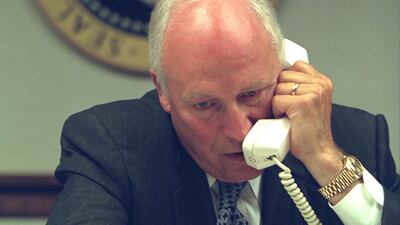
US Vice President Dick Cheney in the President's Emergency Operations Centre at the White House on September 11, 2001, the day of the terrorist attacks. US National Archives -

Secretary of State Colin Powell, right, and National Security Adviser Condoleezza Rice in the President's Emergency Operations Centre on September 11, 2001. US National Archives -
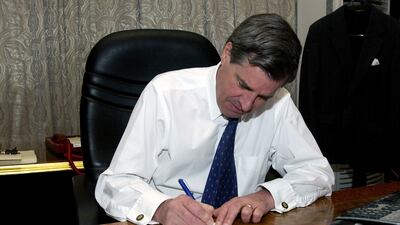
US Ambassador to Iraq Paul Bremer signs the Iraqi Sovereignty document transferring full governmental authority to the Iraqi Interim Government, in Baghdad, on June 28, 2004. Mr Bremer was tapped by the Bush administration to become the top US civilian in Iraq following the invasion. US Air Force -

CIA Director George Tenet listens to President George W Bush's address after the 9/11 terrorist attacks. US National Archives -
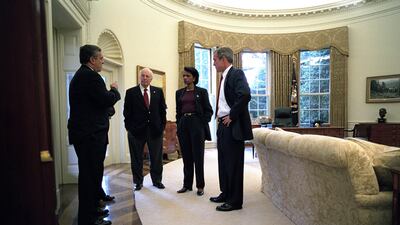
President Bush meets Mr Tenet, Vice President Cheney and Ms Rice on October 7, 2001 at the White House, the day the US invaded Afghanistan as a response to the 9/11 attacks. George W Bush Presidential Library -
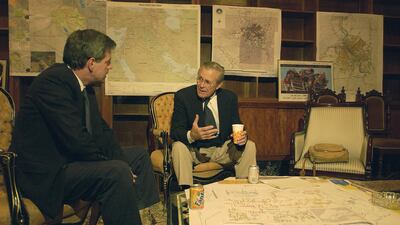
Presidential Envoy Paul Bremer, left, briefs Donald H. Rumsfeld, US Secretary of Defence, in Iraq, in 2003. Department of Defence -
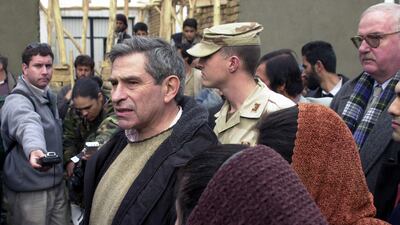
US Deputy Secretary of Defence Paul Wolfowitz addresses the media after touring the Rabia Balkhi Hospital in Kabul, Afghanistan, on January 15, 2003. US Army -
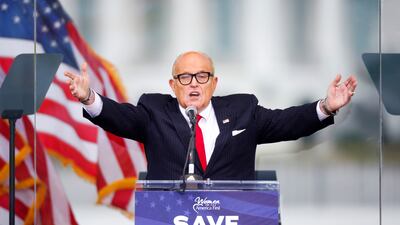
Rudy Giuliani, seen here speaking at a rally, was Mayor of New York when the 9/11 attacks took place. Reuters -
Former Special Agent John O’Neill retired from the FBI in August 2001 to lead security at the World Trade Centre. Although he escaped from his office in the North Tower after it was struck by terrorist hijackers on 9/11, he died helping others escape when the tower collapsed. Photo: FBI -
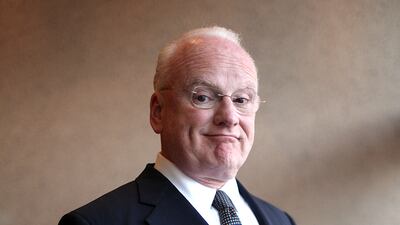
Richard Clarke worked with both the Clinton and Bush administrations to combat Al Qaeda and the Taliban. Speaking before the 9/11 Commission in 2004, Mr Clarke told the families of the victims that their government failed them. The National -
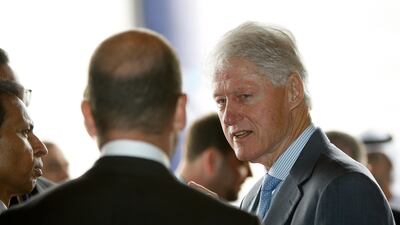
Former President Bill Clinton appeared on Australian TV 10 hours before the 9/11 attacks and said that he was obsessed with Osama bin Laden and that he almost killed him. Jeffrey E Biteng / The National


Clash of egos
Mr O’Neill wanted to hunt bin Laden down and arrest him, something the CIA had no power to do. Mr Scheuer wanted to bomb Kandahar, Afghanistan, where bin Laden was reportedly hiding.
Meanwhile, Paul Bremer had been appointed chairman of the National Commission on Terrorism. In 2000, Mr Bremer delivered a report to Mr Clinton outlining warnings about a new breed of Islamic extremists, the serious threat of Al Qaeda and the Taliban.
Mr Bremer also said that the lack of communication and transparency between government agencies was a serious threat to the homeland.
His report made no mention of Iraq.
Mr O’Neill predicted correctly that Al Qaeda had made it to the US, information the CIA already knew, but didn't share. In fact, when the CIA learnt that Nawaf Al Hazmi and Khalid Al Mihdhar - two of the 19 men who would ultimately hijack the planes on 9/11 - had acquired US visas, they did not alert the FBI.
Intelligence had connected the future hijackers to bin Laden, who was wanted in connection with the deadly bombings of the US embassies in Dar es Salaam, Tanzania, and Nairobi, Kenya. They were not brought in for questioning by any agency.
The Bush White House
George W Bush won the presidency in 2000 with Dick Cheney as his vice president.
Mr Bremer and Mr Clarke were holdovers from the old administration, though Mr Clarke’s position had been downgraded and he was rarely granted access to the new president.
Donald Rumsfeld, whom Mr Bremer had consulted for his Clinton report, was made secretary of defence. Paul Wolfowitz, who was also part of the first Bush administration and a key adviser during Desert Storm, became deputy secretary of defence.
Condoleezza Rice was named Assistant to the President for National Security Affairs, commonly referred to as the National Security Advisor. Mr Clarke urged Ms Rice to call a meeting of the Principals Committee to discuss an imminent attack on US soil.
Dropping the ball
Ms Rice said that the issue would not be addressed until it had been “framed” by the new deputies in the Bush administration.
At a meeting of the deputies in April 2001, Mr Wolfowitz, seemingly always eager to blame Iraq, said that he didn’t understand why they were only talking about bin Laden.
In addition to Mr Clarke, CIA director George Tenet also warned Ms Rice of a major attack.
The president’s daily brief, the intelligence report delivered by the CIA to Mr Bush on Aug 6, 2001, spoke of the same. It was titled, “Bin Laden Determined to Strike in US".
The first meeting of the Principals Committee on Al Qaeda was held on September 4, 2001. A week later, 19 hijackers pulled off the largest terrorist attack in American history, deadlier than Pearl Harbour, an act that many said was preventable.
Postmortem
The events of 9/11 led to the invasion of two countries the US accused of harbouring Al Qaeda: Afghanistan and Iraq.
On November 27, 2002, Mr Bush ordered the establishment of the 9/11 Commission to “examine and report on the facts and causes relating to the September 11 terrorist attacks”. Over the course of 10 months, the commission would hear from survivors, victims' families, first responders and many of the aforementioned officials.
The final report included the failings of several government agencies, particularly the CIA, the FBI, the Pentagon and the National Security Council, and recommended a comprehensive restructuring of US intelligence agencies.
It also advocated increased diplomacy between the US and the Islamic world.
Where are they now?
Bill Clinton is now head of the Clinton Foundation and ironically appeared on Australian television on September 10, 2001. When asked about bin Laden he said: “I nearly got him. And I could have killed him, but I would have to destroy a little town called Kandahar in Afghanistan and kill 300 innocent women and children, and then I would have been no better.”
Richard Clarke is chairman of Good Harbour Consulting and Good Harbour International and is on the advisory board of US facial recognition company Clearview AI. Appearing before the 9/11 Commission, Mr Clarke apologised to the families of the 9/11 victims, saying: “Your government failed you. I failed you.”
Michael Scheuer is now a follower of QAnon and called Kyle Rittenhouse, the 17-year-old gunman who opened fire on a Black Lives Matter protest, a hero.
Paul Bremer was appointed by Mr Bush as presidential envoy to Iraq. He now sells oil paintings on the internet and is a ski instructor.
George W Bush retired to his ranch in Crawford, Texas, and also took up oil painting.
Dick Cheney pushed the narrative that the 9/11 attack was linked to Saddam Hussein. More recently, his daughter, Liz Cheney, has said that he has been “deeply troubled” by the actions of many in his Republican Party who continue to peddle conspiracy theories about the 2020 US election.
Donald Rumsfeld led the post-9/11 wars in Afghanistan and Iraq and faced criticism for the use of torture at Abu Ghraib prison. He died of multiple myeloma in June of this year.
Paul Wolfowitz served as ambassador to Indonesia and is now a visiting scholar at the American Enterprise Institute, a conservative think tank. On 9/11, he suggested to Mr Bush that Saddam Hussein was responsible for the attack.
former US president
Condoleezza Rice is now the director of the Hoover Institution, a think tank at Stanford University, and serves on the board of directors of Dropbox and Makena Capital Management, LLC.
George Tenet assured Mr Bush that there was evidence that Iraq had weapons of mass destruction before resigning from the CIA in 2004.
John O’Neill was forced out of the FBI and took a job as head of security at the World Trade Centre. On 9/11, he was last seen on the 48th floor of the north tower helping people exit the building. His remains were found in the rubble 10 days later.


