


The US House of Representatives has unanimously passed a legislative amendment that would partially cut military aid to Azerbaijan following the country's offensive against Armenia in the Nagorno-Karabakh region last year.
Proposed by Democratic Congressman Frank Pallone for the 2022 budget, the amendment was passed late Wednesday and states that “none of the funds appropriated or otherwise made available by this act under ‘International Military Education and Training’ and ‘Foreign Military Financing Programme’ may be made available for Azerbaijan".
US security aid to Azerbaijan had increased to $100 million per year in 2019 under former president Donald Trump.
The Pallone Amendment blames this assistance for empowering Baku's destabilising policies.
“The more than $120m in military aid the US has recklessly provided Azerbaijan has emboldened the tyrannical regime in Baku, materially empowering their ethnic cleansing in Artsakh last September and encouraging Baku to continue invading and occupying Armenian land today,” the amendment read.
But the amendment does not block the discretionary assistance the US Department of Defence provides to Azerbaijan.
It also includes language that would require Secretary of State Antony Blinken to consider “the military balance between Azerbaijan and Armenia and the diplomatic consequences of such disparity in military assistance” when issuing next year’s waiver allowing for US security assistance to be sent to Baku.
A report accompanying the amendment calls for boosting aid to Armenia “for economic development, private sector productivity, energy independence, democracy and the rule of law, and other purposes".
-
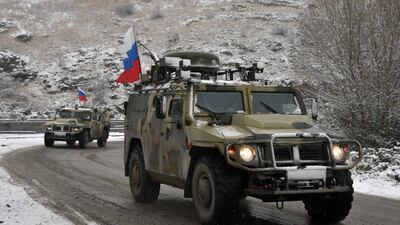
Russian peacekeeping military vehicles outside Lachin after Moscow brokered a truce in the Armenian-majority breakaway region of Nagorno-Karabakh on November 10, 2020. AFP -
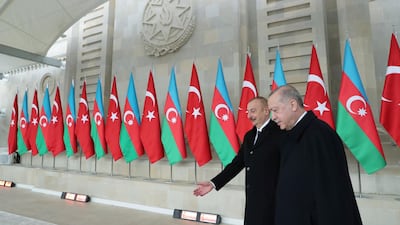
Azerbaijan's President Ilham Aliyev welcomes Turkish President Recep Tayyip Erdogan, right, as they attend a parade in the Azerbaijani capital Baku on December 10, 2020 to celebration the end of fighting in Nagorno-Karabakh. Turkish Presidency via AP -

Azerbaijani troops march during a celebration parade in Baku on December 10, 2020. AP Photo -
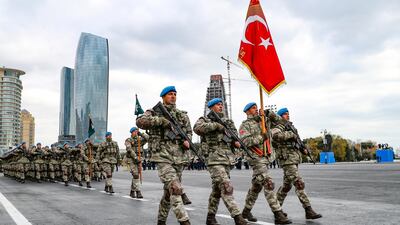
Members of a Turkish forces commando brigade take part in the military parade in Baku, Azerbaijan, on December 10, 2020. AP Photo -
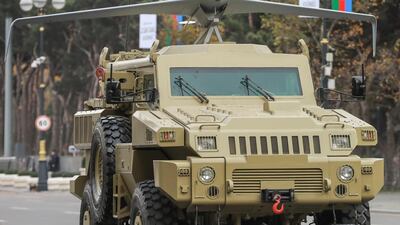
An Azeri army armoured vehicle with mounted with a drone drives during the parade in Baku. Reuters -

Protesters rally in the Armenian capital Yerevan on December 11, 2020 to demand the resignation of Prime Minister Nikol Pashinyan over a peace agreement with Azerbaijan that ended six weeks of war over the disputed region of Nagorno-Karabakh. AFP -
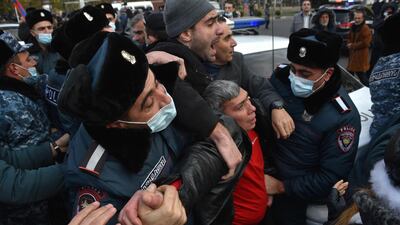
Police arrest a protester during a demonstration against Armenian Prime Minister Nikol Pashinyan in Yerevan. Armenians are upset by the government's agreement to cede three districts of Nagorno-Karabakh to Azerbaijan in addition four others seized by Azerbaijani forces during the fighting that began on September 27, 2020. AFP -

Marine Sargasyan, left, her stepdaughter Anzhelika Astribabayan and her grandchildren children take refuge in a hotel room in Nagorno-Karabakh's main city of Stepanakert after fleeing the nearby town of Shusha. AFP -

Two men repair the roof of a house destroyed by fighting in Stepanakert. AFP -

A vendor sells a traditional bread at a street market in Karabakh's main city of Stepanakert on November 28, 2020. AFP -

Elmira Grigoryan, 70, a refugee from the village of Vazgenashen which is under the control of Azerbaijan, queues to receive a food package in Stepanakert. AFP


Ryan Bohl, a security analyst at the intelligence firm Stratfor, said the bipartisan support for the amendment “reflects rising pro-Armenia sentiment in Congress”, even though the scope of the bill is limited.
“It's symbolic of the return of human rights in American foreign policy under Joe Biden,” he said.
President Joe Biden recognised the Armenian Genocide last April, in a further display of the pro-Armenia mood in the US government. But the White House has been more cautious when it comes to aid to Azerbaijan.
Last April, Mr Biden extended a waiver allowing for US assistance to Azerbaijan under Section 907.
Mr Bohl said that the Biden administration wants to preserve critical interests with Baku.
“Azerbaijan is warm to Israel and warm to the US against Russia and Iran. While it's not a close relationship, Washington sees the geostrategic position of Baku as something they should try to keep in their back pocket and not necessarily fully sacrifice over human rights,” the expert explained.
On Wednesday night, the US State Department issued a statement calling for a halt to the fighting that recently resumed in the Nagorno-Karabakh region.
“We call on Armenia and Azerbaijan to uphold their ceasefire commitments by taking immediate steps to de-escalate the situation,” department spokesman Ned Price said.
He also urged both sides to return to the negotiating table under the auspices of the OSCE Minsk Group to achieve a long-term political settlement to the conflict.
The Pallone Amendment will now go to the Senate for a vote as part of the full foreign aid spending bill before it becomes law.

