Britain has warned that a terrorist attack is now highly likely as it raised the official threat assessment to severe in the middle of ISIS assaults around Europe.
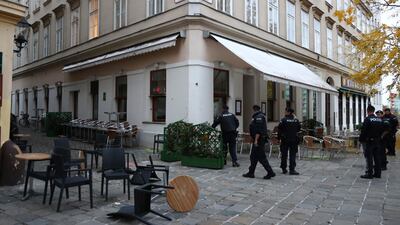
Terrorist incidents in France and Monday night's attack in the Austrian capital Vienna, in which four people were killed, pushed officials into a heightened state of readiness.
Last week, three people died after a knife attack in the French city of Nice, while teacher Samuel Paty was murdered in Paris last month.
The decision to raise the UK's threat level has been taken by the Joint Terrorism Analysis Centre, the government body that assesses the level of risk to the public.
The centre is based at MI5's headquarters in London and is made up of counter-terrorism experts from the police, government and security agencies.
The terror threat level had been at "substantial" since November last year, when it was lowered from "severe" for the first time in five years.
The severe level is the second-highest level, with only "critical" above it.
Critical was reached in May 2017 after the Manchester Arena bombing.
Prime Minister Boris Johnson said he was "deeply shocked" after Monday night's attack in Vienna.
"The UK's thoughts are with the people of Austria," Mr Johnson said. "We stand united with you against terror."
Neil Basu, the head of counter-terrorism for the Metropolitan Police, said the UK had made its own assessment of the risk without any indication of a direct link.
“Our thoughts are with all of the victims, their families and loved ones of the recent attacks both in Austria and France, as well as all of the emergency service personnel who continue to respond to and investigate these atrocities," Mr Basu said.
“At this time, there is no intelligence to link any of these attacks to the UK, and officers from Counter Terrorism Policing continue to work closely with our international partners and will, of course, provide any assistance where we can.
"Today, the threat level from terrorism has changed from substantial to severe as a precautionary measure in response to the events in France and Austria.
"This ... means it is highly likely that a terrorist attack could happen in the UK, but I want to stress that the change is not based on a specific threat.
"However I do urge the public to remain vigilant and to report any suspicious activity to police.
"Now, more than ever, we need communities to stand together and reject those who seek to sow division and hatred between us."
Britain maintains a five-tier system of security alert:
Low – an attack is highly unlikely;
Moderate – an attack is possible but not likely;
Substantial – an attack is likely;
Severe – an attack is highly likely; and
Critical – an attack is highly likely in the near future.

EA Sports FC 24
The specs
Engine: 3.0-litre six-cylinder turbo
Power: 398hp from 5,250rpm
Torque: 580Nm at 1,900-4,800rpm
Transmission: Eight-speed auto
Fuel economy, combined: 6.5L/100km
On sale: December
Price: From Dh330,000 (estimate)
The specs
Engine: four-litre V6 and 3.5-litre V6 twin-turbo
Transmission: six-speed and 10-speed
Power: 271 and 409 horsepower
Torque: 385 and 650Nm
Price: from Dh229,900 to Dh355,000
The biog
Name: Salvador Toriano Jr
Age: 59
From: Laguna, The Philippines
Favourite dish: Seabass or Fish and Chips
Hobbies: When he’s not in the restaurant, he still likes to cook, along with walking and meeting up with friends.
Mercer, the investment consulting arm of US services company Marsh & McLennan, expects its wealth division to at least double its assets under management (AUM) in the Middle East as wealth in the region continues to grow despite economic headwinds, a company official said.
Mercer Wealth, which globally has $160 billion in AUM, plans to boost its AUM in the region to $2-$3bn in the next 2-3 years from the present $1bn, said Yasir AbuShaban, a Dubai-based principal with Mercer Wealth.
“Within the next two to three years, we are looking at reaching $2 to $3 billion as a conservative estimate and we do see an opportunity to do so,” said Mr AbuShaban.
Mercer does not directly make investments, but allocates clients’ money they have discretion to, to professional asset managers. They also provide advice to clients.
“We have buying power. We can negotiate on their (client’s) behalf with asset managers to provide them lower fees than they otherwise would have to get on their own,” he added.
Mercer Wealth’s clients include sovereign wealth funds, family offices, and insurance companies among others.
From its office in Dubai, Mercer also looks after Africa, India and Turkey, where they also see opportunity for growth.
Wealth creation in Middle East and Africa (MEA) grew 8.5 per cent to $8.1 trillion last year from $7.5tn in 2015, higher than last year’s global average of 6 per cent and the second-highest growth in a region after Asia-Pacific which grew 9.9 per cent, according to consultancy Boston Consulting Group (BCG). In the region, where wealth grew just 1.9 per cent in 2015 compared with 2014, a pickup in oil prices has helped in wealth generation.
BCG is forecasting MEA wealth will rise to $12tn by 2021, growing at an annual average of 8 per cent.
Drivers of wealth generation in the region will be split evenly between new wealth creation and growth of performance of existing assets, according to BCG.
Another general trend in the region is clients’ looking for a comprehensive approach to investing, according to Mr AbuShaban.
“Institutional investors or some of the families are seeing a slowdown in the available capital they have to invest and in that sense they are looking at optimizing the way they manage their portfolios and making sure they are not investing haphazardly and different parts of their investment are working together,” said Mr AbuShaban.
Some clients also have a higher appetite for risk, given the low interest-rate environment that does not provide enough yield for some institutional investors. These clients are keen to invest in illiquid assets, such as private equity and infrastructure.
“What we have seen is a desire for higher returns in what has been a low-return environment specifically in various fixed income or bonds,” he said.
“In this environment, we have seen a de facto increase in the risk that clients are taking in things like illiquid investments, private equity investments, infrastructure and private debt, those kind of investments were higher illiquidity results in incrementally higher returns.”
The Abu Dhabi Investment Authority, one of the largest sovereign wealth funds, said in its 2016 report that has gradually increased its exposure in direct private equity and private credit transactions, mainly in Asian markets and especially in China and India. The authority’s private equity department focused on structured equities owing to “their defensive characteristics.”
