

The photo of the Patek Philippe Nautilus that popped up on Salem Belckacem’s phone was the signal the Algerian leader of a watch-robber gang needed.
Leaping on his moped, with an accomplice on the back, he raced to the Cube, a Japanese restaurant in Mayfair, an upmarket area of central London, where his unsuspecting victim was dining alfresco.
Diner Alexandre Boudoin’s £65,000 ($82,000) watch was in plain sight as he stretched out his arm on the sunlit open-air restaurant patio.
Belckacem had been alerted by his spotter, Mehdi Zouhri, who with another gang member had been discreetly taking photos as they staked out the area for a glimpse of a watch the gang knew could net them thousands.
Arriving at speed, Belckacem's passenger jumped off the back of the moped and grabbed Mr Boudoin’s right wrist, ripping the watch “clean off”.
With Zouhri and another gang member "running interference" so no one could give chase, the watch was spirited through the backstreets of London and has not been seen since. The chances are that it is in the hands of an unwitting new owner.
A shaken Mr Boudoin told the trial of the gang members who robbed that him: "This experience has made me feel extremely unlucky. I don't feel differently about London but I will have to be a lot more careful going forward. The way I feel about the people who did this? I have a lot of resentment."
Using background details provided by London's Met Police about the Algerian-led gang, court documents and coverage of their trial, as well as speaking to experts, The National has been able to piece together how they went about their work and how the booming market in stolen watches drew them to the streets of London.

Route to riches
That robbery last April followed the same modus operandi as a string of crimes that 30-year-old Belckacem and his gang of two fellow Algerians and a Libyan pulled off before their luck ran out.
The Met finally caught up with them and in doing so shed light on the organised gang of international thieves who travelled from north Africa, through France and into the UK where there are plentiful targets on the streets of Knightsbridge, Mayfair and Soho.
There have been so many robberies that some international business executives have voiced concerns about visiting even the most high-end parts of London for fear their expensive watches will be stolen.
The "Rolex Ripper" crime wave has seen the number of stolen watches nearly double in England and Wales between 2015 and 2022, to 11,035, according to figures from Watchfinder UK.
London is the epicentre. The stolen watch database shows that last year there was a 56 per cent surge in thefts in the UK capital, with 6,000 watches stolen.
The Met Police has been dedicating resources to fighting watch crime and this year revealed details of an operation in which undercover officers wearing luxury watches late at night in central London were used as bait to lure robbers before their colleagues moved in to make arrests.
London is not the only city that has experienced watch robberies carried about by gangs, led by Algerians and other North Africans who have travelled for the purpose.
A European law enforcement source told The National that police were “aware of the phenomenon” but were wary of ascribing crimes to a particular nationality, as many criminals acquired local identities and European gangs are also involved in such crimes.
The gang ... and the victims
Belckacem is serving a seven-year prison sentence for robbery along with Nassem Naele, 31, while Mohamed Amir, 32, and 29-year-old Libyan Mehdi Zouhri were both jailed for six years. Also part of the gang was Oussama Kanouni, 27, who was jailed for a year and four months for possessing fake identity documents.
The Met Police says the robberies were the “work of a highly organised and professional gang of robbery suspects and the offences were incredibly traumatic for the victims”.
Another victim was James Dreyfous, who was robbed after he left Bonds restaurant in Mayfair with three women. A moped, again ridden by Belckacem, pulled up and his £65,000 watch was taken by an unidentified male riding pillion.
Weiyu Wang was shopping with his wife and daughter on Bond Street on May 14 when he was robbed of his £100,000 Patek Philippe watch. Amir followed Mr Wang, taking photos of his watch, before Naele pushed Mr Wang's wife.

The tourist was trying to help his wife up with his right hand when Naele took the opportunity of that distraction to grab hold of Mr Wang's left wrist and pulled hard enough to break the bracelet to snatch the watch.
Maria Malysheva was robbed of her watch worth tens of thousands of pounds near Canary Wharf station when Belckacem grabbed her in a bear hug which allowed Zouhri to forcibly take the watch off her wrist. Belckacem then threw his victim to the ground.
The Met Police say the gang’s crime spree began to unravel when officers found CCTV footage that showed Belckacem and another other man arriving on a moped shortly after a robbery before parking it and running to a taxi stopped nearby.
The moped was recovered and Belckacem's fingerprints were identified from a crash helmet found under the locked seat. He later had the nerve to report the moped as stolen, for which he was convicted for perverting the course of justice.

While the police would not be drawn on where Belckacem’s learnt his trade, it is clear he was an experienced and audacious criminal.
As part of their investigation, police raided a property in west London, where officers found both Naele and Kanouni, who were arrested on suspicion of conspiring to commit robbery. The team then tracked down Amir and Zouhri, who were also identified then arrested and charged.
When they were in the UK’s capital, despite the high value of the watches they were caught with, they lived at low-key addresses.
When The National visited the small social housing apartment where Belckacem lived, his neighbour said she had seen him “maybe two or three times” before one day “the place was full of police vans with flashing lights”.
French connection
According to the Met Police, some of the suspects had attempted to evade the authorities through the use of fake names and fraudulent documents. Extensive work was needed to establish their real names.
Mohammed Amir originally claimed to be Mohamed Bougherraf before his true identity was revealed.
Court papers reveal Naele had a French driving licence in the name of Nassim Naili, while Kanouni had French ID cards in the name of Oussama Nafaa and Mathieu Arenas.
The use of fake French IDs suggests at least some members of the gang moved across Europe to make their way to the rich pickings of London.
It is not known when the gang arrived in the UK, but moving across borders to carry out violent robberies is a pattern that has been established by Algerian watch robbers in France.
Kouba neighbourhood
Police in Paris recently dismantled a gang of watch Algerian watch robbers, who went after timepieces worth €60,000 to €80,000 ($65,000 to $86,000) in upmarket areas of the French capital, which has also been experiencing a surge in robberies.
Investigators found the thieves came from the Kouba neighbourhood in Algiers, and came in waves using fake ID, lured by the chance of making several thousand euros in a few minutes. During their three-week stay in Paris, they used apartments or squats in the suburbs as their base, police believe.
Operating in teams of two or three, spotters would often first lurk near the exits of high-end restaurants waiting for a victim wearing a luxury watch to emerge, then signal for the rest of the gang to arrive and take the watch with extreme violence.
In other instances, they would roam the streets on mopeds looking for victims. One trick was to knock a car's wing mirror out of place and when the driver leaned a hand out to fix it, their watch would be whipped off.

After staying for a few weeks at a time and making enough money from their robberies, once a job was done they would leave the next day. London was reportedly one destination, as well as Barcelona, Austria and Switzerland, with Kouba used as a safe haven for them to return.
It appears they also shared the same detailed knowledge of watches possessed by their countrymen who operated in London. Police believe they were able to spot luxury brands such Patek Philippe, Hublot or Audemars Piguet and knew the value of the items they stole "to the nearest euro".
Mirroring the tactics of their Met counterparts, Paris police also set up a dedicated team to tackle the gangs of young men, whose tactics have been described "refined".
The gang's spree came to an end when they targeted a restaurant owner for his €250,000 Patek Philippe but police, who had them under surveillance, pounced.
Lured to work for crime gangs
In Kouba itself, it comes as no surprise that young men have been caught up in crime after leaving the area.
More and more of them, many of whom lack technical qualifications, have become a prime target for organised crime networks, who exploit them for activities such as drug trading, street robberies and even human trafficking, according to one retired police officer. It is a problem not only in Algeria but also neighbouring Tunisia, which also has historic ties to France.
"How can we explain how young people with no history, no criminal record and whose parents are well-off and respected, take the path of exile and a few months later we learn that they are in prison?” he told The National.
“For me, it is the mafia networks that use them, taking advantage of their precariousness. You just have to break them and then ask them to do anything.”
The theft of luxury items, such as watches, is more prevalent among the diaspora established in France, often orchestrated by well-organised crime groups, the officer said.

“Mafias formed by third-generation immigrants in France are very well-organised and can easily enter and leave England or any European country.
“They often use young immigrants from Algeria who find themselves in a desperate situation as battering rams to commit their crimes, especially those who have left in the last two years. They are willing to do anything, as long as they are promised money in return.”
In Smain, a neighbourhood cafe, friends of two waiters who recently left for London say they chat and discuss details of their trip over the phone with them and hope to join them soon.
“Here, going to England is a culture – a kind of spell cast on young people,” says Merouane Kadach, who immigrated with two brothers to England but had to return to take care of his elderly parents.
“After all, there is not a family in the neighbourhood that does not have among its own at least one or two immigrants in England.”
The time lord
Paul Thorpe is a retired watch dealer and an authority on watch crime, who has observed at first hand the work done by the Met Police by travelling out with officers on patrol. He runs a popular YouTube channel dedicated to all things luxury watches.
“I would say 90 per cent of watch crime is committed by people who don’t live here [in London] on a permanent basis or have come to the country very recently," he told The National.
Far from being simple thugs who will target anyone who looks rich, they know what they’re looking for.
“They are well-armed knowledge-wise and can tell the difference between a watch that is semi-valuable and highly valuable,” he said.
“They know about the desirable models, their approximate value on the genuine market and black market. So they know what they’re looking at. They’re not stupid.”
Mr Thorpe explained that gangs are between 10 or 20 strong and many will have females who interact with victims to distract them.

“They will certainly be out spotting and they’ve infiltrated security firms so they have doormen looking out for victims.”
Waiting staff in restaurants have also been recruited by watch-robbing gangs and if they are from outside the UK, they will often be of the same nationality.
“So, she is serving people and then going out the back and WhatsApp-ing her friends saying ‘there’s a guy with a yellow shirt on and he’s wearing a Rolex, I’ll let you know when he’s leaving’ and they will be waiting for him.”
Mr Thorpe said the beginning of the era of stolen watches can be traced back to the 2011, when Rolex ceased its lost and stolen register.
He said if the authorities took away “the ability for the police to tell if a car was stolen, would car crime go up or would it go down?”
The watch hunter
The market in pre-owned luxury watches is booming, as collectors are seduced by their beauty and fine craftsmanship and with prices seemingly always heading up, they are of course a sound investment.
According to consultants Deloitte, the watch market is likely to grow to $40 billion by 2030, by which time it will comprise more than half of the primary market. The market is being driven by buyers from the Millennial and Gen Z generations, who are more comfortable with buying second-hand items online and are looking for cheaper price, its report says.
Christopher Marinello, who hunts stolen luxury watches on behalf of wealthy clients, explains that the waiting list for new timepieces is also fuelling theft, as many buyers are prepared to look the other way to get their hands on one.
“I came across a celebrity in Los Angeles recently who bought a $400,000 watch from a guy named Vinnie,” he told The National.
The 10 most expensive watches stolen in the UK in 2023 - in pictures
-
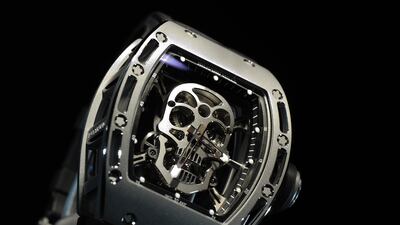
1. Richard Mille Rm 52-01. Value: £1,000,000. Getty Images -
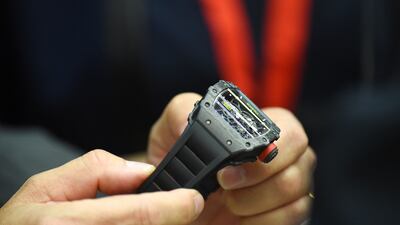
2. Richard Mille Rm 035-2. Value: £400,000. AFP -
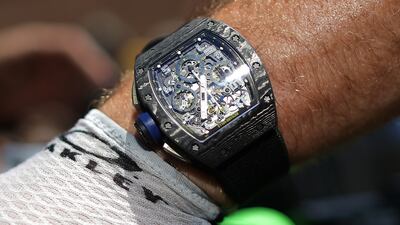
3. Richard Mille Rm 011. Value: £250,000. Getty Images -
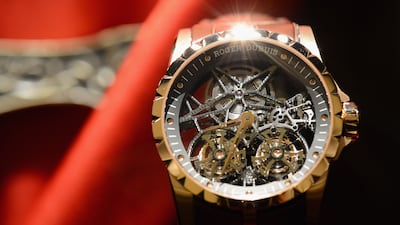
4. Roger Dubuis Excalibur. Value: £200,000. Getty Images -

5. Patek Phillipe 5980/1R-001. Value: £140,000. Photo: Sotheby's -

6. Richard Mille Rm005, 18ct rose gold. Value: £130,000. Alamy -
7. FP Joune Octa Zodiaque. Value: £125,000. Photo: Christie's -
8. Patek Phillipe 5130p 014 World Time Dubai edition. Value: £110,000. Photo: Christie's -
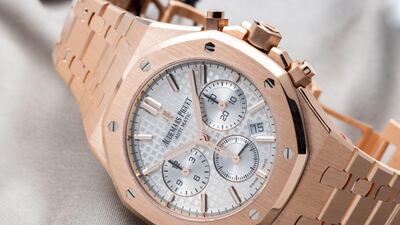
9. Audemars Piguet Royal Oak chronograph full 18ct rose gold. Value:£75,000. Alamy -
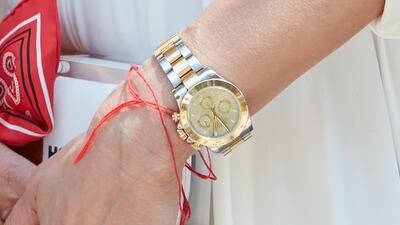
10. Rolex Daytona. Value: £65,000. Alamy


“You shouldn't be buying anything from a guy named Vinnie, let alone a $400,000 watch without papers.”
He said luxury-watch shops in big cities such as London and Paris are there for marketing rather than for actually selling products.
“There's a backlog of couple of years before you get your watch,” said Mr Marinello, the founder and chief executive of Art Recovery International.
“Wealthy people from all around the world, including the Middle East, like to jump into a shop and drive away with a Ferrari or walk away with their wristwatch. That just can't happen and because of that waiting time, that's why the secondary market is so ubiquitous right now.”
Simple crime
When it comes to the business end of robbery and getting stolen goods out of the country, watches offer a simple commodity for thieves.
“They just put them on their wrists. Try to get through Heathrow with a couple of kilos of cocaine. It’s not going to happen," said Mr Thorpe.
“But you can put £2 million worth of watches on your wrist or in your bag and no one will pay a blind bit of notice.
“You can literally put it in your hand baggage and it will go through X-ray and nobody is going to ask you about it.”

He explains that it is "very possible for watches to be stolen and out of the country within hours", to places such as Dubai, where there is a flourishing second-hand market.
Ben Russell, the Met Police’s commander for intelligence, told The National that watches appeal to robbers in a way that expensive jewellery does not.
"They're more visible, they're easier to value," he said. "There's also something about looking for someone who's on their own, maybe at 2am, that's more appealing."
He also made the point that they can be taken out of the country because "they're small items that can hidden easily".
Spain in the frame
It is not only the police in the UK who have been dealing with groups of North African watch robbers.
Another gang which included an Algerian and a Moroccan, stole luxury watches worth €170,000, after travelling to the holiday island of Majorca from Barcelona.
Each of the gang's six members had specific functions such as monitoring and selecting targets and then carrying out the thefts in Palma last year.
Also in Palma, police arrested two Moroccan members of a gang that was engaged in the violent robbery of luxury watches the year before, again having travelled there to seek out victims.

According to Spain's national police, gangs based in Italy often recruit young men of North African origin to carry out watch robberies in areas popular with holidaymakers. In the winter they travel to the Canary Islands to commit crimes, taking advantage of the good weather and tourism,
Staying safe
Despite being the target of criminals, there's no indication the lure of the luxury watch is going to fade and predictions for the coming decade are for a the booming market to continue to flourish.
In the meantime, the Met Police advise owners of luxury watches to photograph and insure them, and register them on the several specialist databases that have sprung up in response to the spate of robberies.
When out and about, it is important that anyone wearing an expensive watch remains vigilant and aware of their surroundings, says the force.
Detective Inspector Tom Rogerson, who led the investigation into the Algerian-led gang, told The National he was “pleased in this case that the sentences reflect the seriousness of the offences”.
"Officers from the Met continue to work tirelessly to identify and locate robbery suspects and bring them to justice.”
This story was published in collaboration with Egab.

