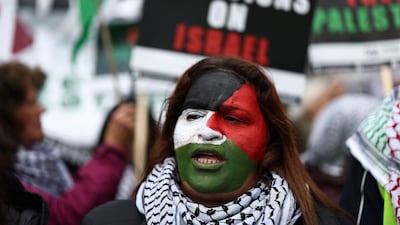
• Banned: A protester with their face covered during the Pro-Palestinian march in London on November 11. EPA
    Banned: A protester with their face covered during the Pro-Palestinian march in London on November 11. EPA
  • A supporter of WikiLeaks founder Julian Assange wears a mask at a protest against his extradition to the US, outside the High Court in London in January 2022. AFP
    A supporter of WikiLeaks founder Julian Assange wears a mask at a protest against his extradition to the US, outside the High Court in London in January 2022. AFP
  • A campaigner from We Own It poses in a Margaret Thatcher mask to protest against the privatisation of Channel 4 in London, in April 2022. AP
    A campaigner from We Own It poses in a Margaret Thatcher mask to protest against the privatisation of Channel 4 in London, in April 2022. AP
  • Extinction Rebellion protesters wear masks depicting Prime Minister Boris Johnson and a rat on Exhibition Road, London, in April 2022. Getty Images
    Extinction Rebellion protesters wear masks depicting Prime Minister Boris Johnson and a rat on Exhibition Road, London, in April 2022. Getty Images
  • An Extinction Rebellion protester wears a mask resembling Rishi Sunak, then chancellor of the Exchequer, in London in April 2022. Getty Images
    An Extinction Rebellion protester wears a mask resembling Rishi Sunak, then chancellor of the Exchequer, in London in April 2022. Getty Images
  • Extinction Rebellion protesters dress up as Mr Sunak, Mr Johnson, then-home secretary Priti Patel, and Jacob Rees-Mogg MP in April 2022 in London. Getty Images
    Extinction Rebellion protesters dress up as Mr Sunak, Mr Johnson, then-home secretary Priti Patel, and Jacob Rees-Mogg MP in April 2022 in London. Getty Images
  • A protester with a face mask of WikiLeaks founder Julian Assange in October 2021. AFP
    A protester with a face mask of WikiLeaks founder Julian Assange in October 2021. AFP
  • Protesters wave flags and hold flares during a pro-Palestinian protest in London on November 11. AP
    Protesters wave flags and hold flares during a pro-Palestinian protest in London on November 11. AP
  • A demonstrator holds a flare as Extinction Rebellion members stage a protest on Earth Day in London in April 2022. Reuters
    A demonstrator holds a flare as Extinction Rebellion members stage a protest on Earth Day in London in April 2022. Reuters
  • An activist holds a flare in a protest against factory farming, outside the High Court in London in January 2022. AP
    An activist holds a flare in a protest against factory farming, outside the High Court in London in January 2022. AP
  • A flare burns as National Health Service staff march against Covid-19 vaccine rules in London, in January 2022. Reuters
    A flare burns as National Health Service staff march against Covid-19 vaccine rules in London, in January 2022. Reuters
  • Police officers surrounded by orange flare smoke and NHS uniforms after the march against Covid-19 vaccine rules, at the entrance to Downing Street, London, in January 2022. Reuters
    Police officers surrounded by orange flare smoke and NHS uniforms after the march against Covid-19 vaccine rules, at the entrance to Downing Street, London, in January 2022. Reuters
  • A demonstrator holds a flare in a march to protest against the Police, Crime, Sentencing and Courts Bill, outside the entrance to Downing Street, in London in January 2022. AFP
    A demonstrator holds a flare in a march to protest against the Police, Crime, Sentencing and Courts Bill, outside the entrance to Downing Street, in London in January 2022. AFP
  • A pro-Palestinian demonstrator in London wears a mask and holds a lit flare in May 2021. Reuters
    A pro-Palestinian demonstrator in London wears a mask and holds a lit flare in May 2021. Reuters

New UK laws to prohibit face coverings and pyrotechnics at protests


Soraya Ebrahimi
  • English
  • Arabic

People who wear face coverings and use pyrotechnics at protests in the UK face police arrest under new laws to crack down on disorder.

The move follows warnings from police chiefs that some protesters are using face coverings to conceal their identities, intimidate law-abiding citizens and avoid criminal convictions.

Police already have powers to ask people to remove face coverings where they believe a crime is likely to occur.

But this new order allows officers to arrest those who disregard their orders, with people who flout the rules facing a month in prison and a £1,000 [£1,262] fine.

Flares and others pyrotechnics will also be banned from protests, and protesters will no longer be able to use the right to demonstrate as a reasonable excuse to get away with disruptive offences, such as blocking roads.

Flares and fireworks have been used during recent large-scale protests. They have been fired at police officers.

The measures, which will be introduced in the Criminal Justice Bill, will also make climbing on war memorials a specific public order offence, carrying a three-month prison sentence and a £1,000 fine.

Pro-Palestinian protests in London - in pictures

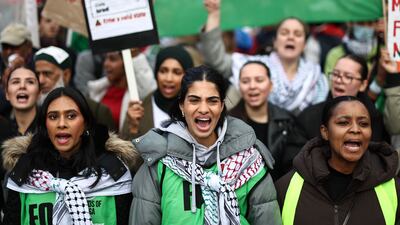
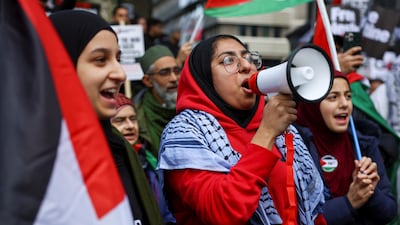
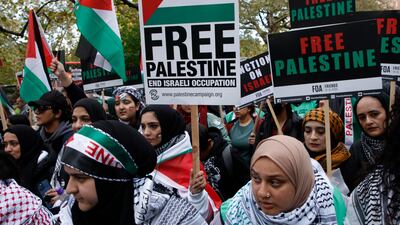
  • People take part in a 'March For Palestine' in London, to demand an end to the war on Gaza. AFP
    People take part in a 'March For Palestine' in London, to demand an end to the war on Gaza. AFP
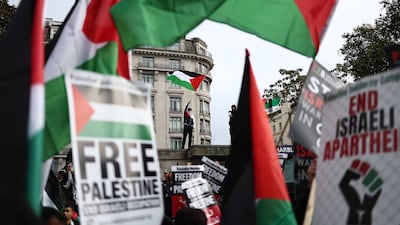
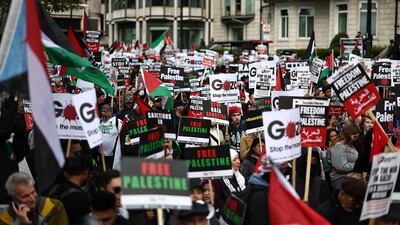
  • Hundreds of people took to the streets of the British capital at the weekend. AFP
    Hundreds of people took to the streets of the British capital at the weekend. AFP
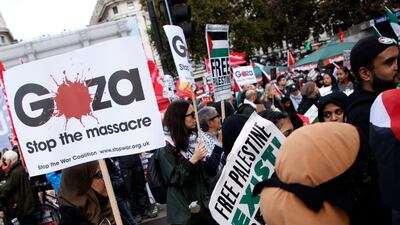
  • It came as protesters worldwide on Friday demanded an end to Israel's bombardment of Gaza. AP
    It came as protesters worldwide on Friday demanded an end to Israel's bombardment of Gaza. AP
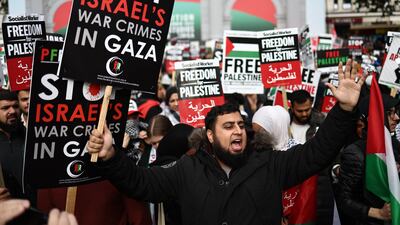
  • People take part in a 'March For Palestine' in London, to demand an end to the war on Gaza. AFP
    People take part in a 'March For Palestine' in London, to demand an end to the war on Gaza. AFP
  • People take part in a 'March For Palestine' in London, to demand an end to the war on Gaza. Reuters
    People take part in a 'March For Palestine' in London, to demand an end to the war on Gaza. Reuters
  • People take part in a 'March For Palestine' in London, to demand an end to the war on Gaza. AP
    People take part in a 'March For Palestine' in London, to demand an end to the war on Gaza. AP
  • People take part in a 'March For Palestine' in London, to demand an end to the war on Gaza. AFP
    People take part in a 'March For Palestine' in London, to demand an end to the war on Gaza. AFP
  • People take part in a 'March For Palestine' in London, to demand an end to the war on Gaza. AFP
    People take part in a 'March For Palestine' in London, to demand an end to the war on Gaza. AFP

“Recent protests have seen a small minority dedicated to causing damage and intimidating the law-abiding majority," Home Secretary James Cleverly said.

“The right to protest is paramount in our country, but taking flares to marches to cause damage and disruption is not protest, it is dangerous.

“That is why we are we giving police the powers to prevent any of this criminality on our streets.”

Thousands of pro-Palestinian protesters march in London - video

The National Police Chiefs’ Council lead for public order, Chief Constable BJ Harrington, said: “We welcome the proposal to create new offences relating to war memorials and flares, as well as making it clear that covering your face at a protest to conceal identity is not acceptable.

“These changes are in line with conversations that we have had with the Home Office to ensure that we have the powers that we need to get balance right between the rights of those who wish to protest, and those impacted by them.

“Safety is our number one concern when policing these events, and the effective banning of these items during protests can only help in our mission to ensure that they take place without anyone coming to any harm.

“As with all policing powers, these new powers will be used when appropriate, proportionate and necessary to achieve policing objectives.

“Policing is not anti-protest, but there is a difference between protest and criminal activism, and we are committed to responding quickly and effectively to activists who deliberately disrupt people’s lives with reckless and criminal acts.”

Since October 7, there have been more than 1,000 protests and vigils, with more than 26,000 police officer shifts between October 7 and December 17 alone, and 600 arrests.

The measures are part of a government crackdown on disruptive protests.

They follow legislation passed last year that criminalises actions such as "locking on" and give police the ability to stop and search protesters for items such as padlocks and superglue, if they suspect the demonstrators are setting out to cause chaos.

The Police, Crime, Sentencing and Courts Act 2022 also made it easier to tackle public nuisance caused by protesters.


Updated: February 08, 2024, 12:15 AM