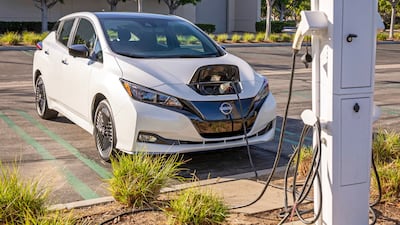
The battery of an electric car is recharged at a roadside charging station on January 09, 2024 in London, England. Getty Images

Electric vehicle use could outpace need for new oil and gas licences


Soraya Ebrahimi
  • English
  • Arabic

The growing use of electric vehicles could cut the need for imports of petrol and diesel as much as granting new licences for UK oil production would and outpace it after 2030, according to energy analysts.

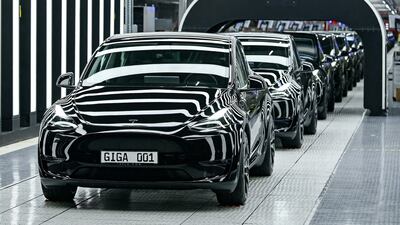
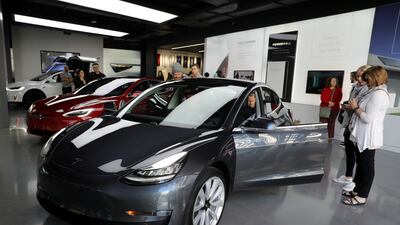
There are already about one million electric cars on British roads and a further 5.3 million are expected by 2030, the Energy and Climate Intelligence Unit (ECIU) said.

Coming into force from this month, the government’s Zero Emission Vehicle policy requires carmakers to sell an increasing number of electric vehicles (EVs), a measure intended to speed up the process of people switching away from the combustion engine.

Those 6.3 million electric cars in 2030 would reduce demand for oil so much that it could have the same effect in cutting the amount of fossil fuels imported into the UK as the government’s policy of allowing more drilling in the North Sea, according to the ECIU analysis.

The Offshore Petroleum Licensing Bill, currently passing through the Commons, would compel the North Sea regulator to invite applications for new projects each year, instead of when it feels it is appropriate, as it does currently.

Ministers argue that this will improve the country’s energy security by reducing the need to ship oil in from abroad from countries that could be hostile to the UK.

“The licensing debate only distracts from a more permanent solution to securing the UK’s energy independence which means building out British renewables more quickly to power homes and EVs as well as cutting energy waste by insulating roofs," Dr Simon Cran-McGreehin, head of analysis at ECIU, said.

“The government’s recent track record on some of these policy areas is less than stellar.”

In September, Prime Minister Rishi Sunak announced a delay for when new petrol and diesel cars will no longer be sold, from 2030 to 2035, with the Office for Budget Responsibility (OBR) saying this could mean a delay in some consumers making the switch.

He has been criticised as sidelining climate issues, not including them in his top five priorities, and for abandoning the UK’s position as a global leader in cutting emissions.

The government maintains that the UK has cut its emissions more than any other major economy since 1990 but these cuts happened before the current government and mostly because coal is no longer generally used for electricity.

Previous ECIU analysis found that only 20 per cent of oil from UK fields is refined in the UK to produce petrol and other fuels, with this figure shrinking to 1 per cent by 2030 because of reduced demand.

About 80 per cent of all the oil from the North Sea is sold abroad and the government has said it is “not desirable” for it to make companies allocate oil for the UK.

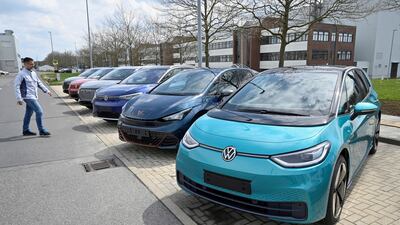
Best selling electric cars in the UK in 2022 – in pictures

It also said that most oil exports are to Europe where the fuel is refined into products that are then used in the UK.

“The government’s electric vehicle mandate policy is, in effect, an energy security policy weaning us off foreign oil imports as the North Sea’s output inevitably declines," Dr Cran-McGreehin said.

“But as the OBR has noted, last year’s government U-turn on the phase-out of sales of new petrol cars will likely reduce the number of EVs that might have been on the UK’s roads, weakening our energy security, leaving us more dependent on foreign oil.”

A Department for Energy Security and Net Zero spokesperson said: “We still rely on oil and gas for most of our energy needs and backing domestic supply bolsters energy security by reducing the reliance on imports, supporting 200,000 jobs and bringing in tens of billions of tax which we can invest in helping people with cost of living.

“At the same time we are powering our transition to more renewables and low carbon alternatives with an expected £100 billion ($1.27bn) investment by 2030 in technologies such as offshore wind, solar and carbon capture.”


Our family matters legal consultant

Name: Hassan Mohsen Elhais

Position: legal consultant with Al Rowaad Advocates and Legal Consultants.

Our legal consultant

Name: Dr Hassan Mohsen Elhais

Position: legal consultant with Al Rowaad Advocates and Legal Consultants.

The past Palme d'Or winners

2018 Shoplifters, Hirokazu Kore-eda

2017 The Square, Ruben Ostlund

2016 I, Daniel Blake, Ken Loach

2015 DheepanJacques Audiard

2014 Winter Sleep (Kış Uykusu), Nuri Bilge Ceylan

2013 Blue is the Warmest Colour (La Vie d'Adèle: Chapitres 1 et 2), Abdellatif Kechiche, Adele Exarchopoulos and Lea Seydoux

2012 Amour, Michael Haneke

2011 The Tree of LifeTerrence Malick

2010 Uncle Boonmee Who Can Recall His Past Lives (Lung Bunmi Raluek Chat), Apichatpong Weerasethakul

2009 The White Ribbon (Eine deutsche Kindergeschichte), Michael Haneke

2008 The Class (Entre les murs), Laurent Cantet

WORLD CUP SQUAD

Dimuth Karunaratne (Captain), Angelo Mathews, Avishka Fernando, Lahiru Thirimanne, Kusal Mendis (wk), Kusal Perera (wk), Dhananjaya de Silva, Thisara Perera, Isuru Udana, Jeffrey Vandersay, Jeevan Mendis, Milinda Siriwardana, Lasith Malinga, Suranga Lakmal, Nuwan Pradeep

How to tell if your child is being bullied at school

Sudden change in behaviour or displays higher levels of stress or anxiety

Shows signs of depression or isolation

Ability to sleep well diminishes

Academic performance begins to deteriorate

Changes in eating habits

Struggles to concentrate

Refuses to go to school

Behaviour changes and is aggressive towards siblings

Begins to use language they do not normally use

The Bio

Amal likes watching Japanese animation movies and Manga - her favourite is The Ancient Magus Bride

She is the eldest of 11 children, and has four brothers and six sisters.

Her dream is to meet with all of her friends online from around the world who supported her work throughout the years

Her favourite meal is pizza and stuffed vine leaves

She ams to improve her English and learn Japanese, which many animated programmes originate in

Virtual banks explained

What is a virtual bank?

The Hong Kong Monetary Authority defines it as a bank that delivers services through the internet or other electronic channels instead of physical branches. That means not only facilitating payments but accepting deposits and making loans, just like traditional ones. Other terms used interchangeably include digital or digital-only banks or neobanks. By contrast, so-called digital wallets or e-wallets such as Apple Pay, PayPal or Google Pay usually serve as intermediaries between a consumer’s traditional account or credit card and a merchant, usually via a smartphone or computer.

What’s the draw in Asia?

Hundreds of millions of people under-served by traditional institutions, for one thing. In China, India and elsewhere, digital wallets such as Alipay, WeChat Pay and Paytm have already become ubiquitous, offering millions of people an easy way to store and spend their money via mobile phone. Indonesia, Vietnam and the Philippines are also among the world’s biggest under-banked countries; together they have almost half a billion people.

Is Hong Kong short of banks?

No, but the city is among the most cash-reliant major economies, leaving room for newcomers to disrupt the entrenched industry. Ant Financial, an Alibaba Group Holding affiliate that runs Alipay and MYBank, and Tencent Holdings, the company behind WeBank and WeChat Pay, are among the owners of the eight ventures licensed to create virtual banks in Hong Kong, with operations expected to start as early as the end of the year. 

NO OTHER LAND

Director: Basel Adra, Yuval Abraham, Rachel Szor, Hamdan Ballal

Stars: Basel Adra, Yuval Abraham

Rating: 3.5/5

Global state-owned investor ranking by size

1.

United States

2.

China

3.

UAE

4.

Japan

5

Norway

6.

Canada

7.

Singapore

8.

Australia

9.

Saudi Arabia

10.

South Korea

What is graphene?

Graphene is extracted from graphite and is made up of pure carbon.

It is 200 times more resistant than steel and five times lighter than aluminum.

It conducts electricity better than any other material at room temperature.

It is thought that graphene could boost the useful life of batteries by 10 per cent.

Graphene can also detect cancer cells in the early stages of the disease.

The material was first discovered when Andre Geim and Konstantin Novoselov were 'playing' with graphite at the University of Manchester in 2004.

SERIES SCHEDULE

First Test, Galle International Stadium
July 26-30
Second Test, Sinhalese Sports Club Ground
August 3-7
Third Test, Pallekele International Cricket Stadium
August 12-16
First ODI, Rangiri Dambulla International Stadium
August 20
Second ODI, Pallekele International Cricket Stadium
August 24
Third ODI, Pallekele International Cricket Stadium
August 27
Fourth ODI, R Premadasa Stadium
August 31
Fifth ODI, R Premadasa Stadium
September 3
T20, R Premadasa Stadium
September 6

Drivers’ championship standings after Singapore:

1. Lewis Hamilton, Mercedes - 263
2. Sebastian Vettel, Ferrari - 235
3. Valtteri Bottas, Mercedes - 212
4. Daniel Ricciardo, Red Bull - 162
5. Kimi Raikkonen, Ferrari - 138
6. Sergio Perez, Force India - 68

Islamophobia definition

A widely accepted definition was made by the All Party Parliamentary Group on British Muslims in 2019: “Islamophobia is rooted in racism and is a type of racism that targets expressions of Muslimness or perceived Muslimness.” It further defines it as “inciting hatred or violence against Muslims”.

Hili 2: Unesco World Heritage site

The site is part of the Hili archaeological park in Al Ain. Excavations there have proved the existence of the earliest known agricultural communities in modern-day UAE. Some date to the Bronze Age but Hili 2 is an Iron Age site. The Iron Age witnessed the development of the falaj, a network of channels that funnelled water from natural springs in the area. Wells allowed settlements to be established, but falaj meant they could grow and thrive. Unesco, the UN's cultural body, awarded Al Ain's sites - including Hili 2 - world heritage status in 2011. Now the most recent dig at the site has revealed even more about the skilled people that lived and worked there.

Updated: January 22, 2024, 12:01 AM