


British Prime Minister Rishi Sunak’s Rwanda legislation was dealt a new blow on Sunday by a legal assessment for the Tory right, with Robert Jenrick saying he will not support the “weak Bill that will not work”.
Mr Jenrick, who resigned as immigration minister over the policy, did say “we can fix this”, raising the possibility he could abstain with other opponents before trying to amend the legislation later.
Meanwhile, sacked home secretary Suella Braverman echoed Mr Jenrick by raising concerns that the legislation does not tackle the issue of temporary Rule 39 injunctions from the European Court of Human Rights, which stopped last year’s flight.
“I know that our Attorney General [Victoria Prentis] has advised that to ignore a Rule 39 injunction would be a breach of international law, so therefore as it stands Rule 39s will block flights,” Ms Braverman told the Sunday Telegraph.
However, Levelling Up Minister Michael Gove came out in support of Mr Sunak, saying he is confident of Conservative support for the plans, insisting they are “tough and robust” and “legally sound”.
He said ministers will “listen” to critics after Sir Bill Cash signalled his legal assessment for the Tory right concludes the proposed law is not fit for purpose.
Conservative veteran criticises legislation
The veteran Conservative, who has chaired a legal examination being eagerly awaited by many hardliners, suggested the legislation is not “sufficiently watertight”.
Sir Bill wrote in the Sunday Telegraph that they had been considering whether the “wording is sufficiently watertight to meet the government’s policy objectives”.
“At present it does not,” he said.
“Our report, I hope, will be helpful to the government in deciding whether the Bill in its current form is fit for purpose or will require further amendment, even by the government itself.”
Mr Sunak could face a damaging defeat this week, as he is relying on the law to revive his asylum plans that were deemed unlawful by the Supreme Court over concerns for refugees’ safety.
Senior Conservative Damian Green and his band of moderate One Nation Conservatives will meet on Monday to decide whether to oppose the legislation over concerns about breaking international law and ruling Rwanda “safe”.
The former de facto deputy prime minister played down the “very, very small number” of his colleagues who are agitating for a new leader.
“It’s a vanishingly small number and anyone who thinks that what the Conservative Party or the country needs is a change in Prime Minister is either mad or malicious or both,” he told the BBC.
Miriam Cates and Danny Kruger, co-founders of the right-wing New Conservatives group, said there are “big question marks” over the legislation.
“There’s no point uniting around a policy that doesn’t work. That way we’ll just unite and die,” they wrote in the Sun on Sunday.
Rwanda's migration centre facilities - in pictures
-

The Hope Hostel in Kigali, Rwanda, was due to house asylum seekers under the British government's plan. PA -
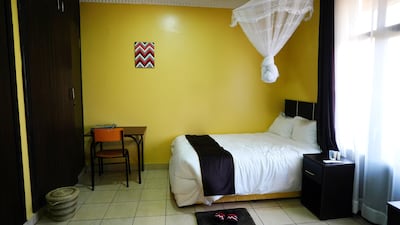
Bedroom accommodation at the Hope Hostel in Kigali. PA -

Inside the Hope Hostel in Kigali. Reuters -

A computer room in the accommodation block at the Hope Hostel. PA -

Then home secretary Suella Braverman visits a newly built house earmarked for asylum seekers with Rwanda's Minister for Information, Communication and Technology, Claudette Irere, on the outskirts of Kigali in March. PA -

The accommodation block at Gashora Refugee Camp Transit Centre, south of Kigali. PA -
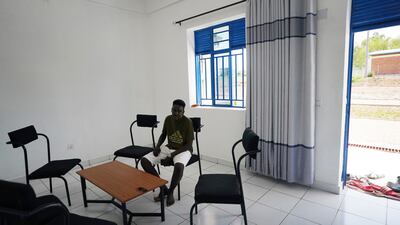
A resident sits in a communal room in the Gashora Refugee Camp Transit Centre. The camp is designed to provide short-term accommodation for people evacuated from Libya after fleeing persecution from a number of countries. PA


Labour will whip to vote against the Bill, meaning a rebellion by just 28 Tories could defeat the legislation central to Mr Sunak’s £290 million ($364 million) scheme to send people who arrive on small boats to East Africa.
Mr Sunak urged opposition leader Keir Starmer to “rise above political games” and “act in the national interest” by supporting the Bill.
But the Labour leader has increased his attacks and will use a speech on Tuesday to accuse the Tories of being unable to govern while their warring factions are “fighting like rats in a sack”.
Sunak to defend his decision-making during Covid pandemic
Rishi Sunak will face allegations that his Eat Out to Help Out scheme fuelled the spread of coronavirus, when he appears at the Covid inquiry on Monday.
He is expected to be grilled on whether he believed scientists were handed too much power and if insufficient consideration was given to the effect of lockdowns.
Messages have revealed that government scientists referred to him as “Dr Death, the Chancellor” over concerns about his push to keep economic activity going while leading the Treasury during the pandemic.
Mr Gove defended Mr Sunak on Sunday, arguing there was no “public critique” of the Eat Out to Help Out scheme before its launch in August 2020.
But Prof Chris Whitty, England’s chief medical officer, is said to have privately referred to the scheme to boost the restaurant industry as “eat out to help out the virus”.
Sir Patrick Vallance, who was chief scientific adviser, said he and Prof Whitty could not recall being consulted in advance about the scheme that cost hundreds of millions of pounds.
Giving evidence to Baroness Heather Hallett’s inquiry, Sir Patrick said the scheme was “highly likely” to have caused deaths.
Mr Gove said the policy was announced a month before it was implemented and during this time it was “not the case that there was a public critique”.
“It was an effective way of ensuring that the hospitality industry was supported through a very difficult period, and it was entirely within the broad outlines of rules about social mixing that prevailed at the time,” he told Sky.
The plan was part of Mr Sunak’s summer economic update on July 8, 2020, and provided 50 per cent off the cost of food and/or non-alcoholic drinks.
Former deputy chief medical officer Prof Jonathan Van-Tam said the scheme “didn’t feel sensible” because it was encouraging exactly what officials had been trying to stop in previous months.
One of Sir Patrick’s diary entries recorded Dominic Cummings, who was Boris Johnson’s chief adviser in Downing Street at the time, saying Mr Sunak “thinks just let people die and that’s OK”.
It is understood that the inquiry has shared with its core participants an interview Mr Sunak did with the Spectator magazine in August last year.
In it, Mr Sunak claimed he “wasn’t allowed to talk about the trade-off” between the economic and social effects of lockdowns and their benefits to suppressing the virus.
He discussed the “problem” of handing power to scientists, adding: “If you empower all these independent people, you’re screwed.”
Mr Sunak may also face questions over his WhatsApp messages, or lack of them.
He has reportedly told the inquiry that “having changed my phone a number of times over the last three years” he no longer has access.
Lawyers representing bereaved families from the four UK nations will also question Mr Sunak, as will long Covid groups and the Trades Union Congress.

