


The number of artefacts missing from the British Museum is close to 2,000, with the value running into the “millions”.
The institution, one of the world's most famous museums, revealed last week that it was taking legal action against an unnamed member of staff – who was subsequently sacked – after items from its collection were discovered to be missing, stolen or damaged earlier this year.
The museum has not revealed how many items were stolen, saying only that they were “small pieces” including “gold jewellery and gems of semi-precious stones and glass dating from the 15th century BC to the 19th century AD.”
But the number of the stolen items is now believed to be “well over 1,000” and “closer to 2,000”, with a value running into “millions of pounds”, according to The Telegraph.
The artefacts have not recently been on public display and were kept in a storeroom, mainly used for research and academic work, the museum said.
The museum may never know exactly what has been stolen because of “gaps in its inventory,” the paper said.
An independent inquiry has been launched and the matter is also under investigation by the Metropolitan Police's economic crime unit.
A museum source said the directorate's handling of the case has been “negligent and incompetent” and that evidence presented to them was ignored.
An antiquities expert reportedly told the museum three years ago that items from its collection were being offered for sale on eBay, with one Roman object, valued between £25,000 (about $32,000) and £50,000 by dealers, offered for just £40.
The independent review will be led by former museum trustee Sir Nigel Boardman and Lucy D'Orsi, chief constable of the British Transport Police, who will “kick-start” efforts to recover the stolen items.
The British Museum declined to comment while the police investigation continues.
The British Museum opened in 1759 and houses a number of contested artefacts, including the Elgin Marbles, which British diplomat Lord Elgin removed from the Parthenon temple in Athens in the early 19th century, when Greece was under Ottoman rule.
Another controversial exhibit is the Rosetta Stone, which was discovered in Egypt, and dates back to about 200BC. It was discovered by French troops in 1799 but acquired by Britain under a treaty in 1802.
The only time the stone is known to have left the British Museum was in 1917, during the First World War, when it was moved to a railway tunnel to keep it safe.
The 1963 British Museum Act prevents the institution from giving away objects from its collection except in very limited circumstances.
The Elgin Marbles – in pictures
-
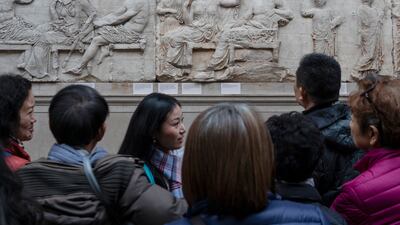
Sections of the Elgin Marbles, also known as the Parthenon Marbles, are displayed at The British Museum in London. Getty Images -

Greece has repeatedly called for the permanent return from the British Museum of the 2,500-year-old sculptures. AP -
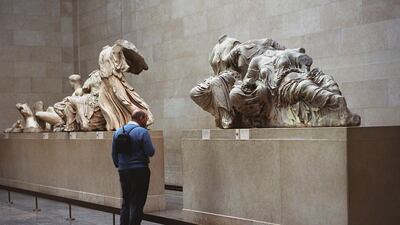
The British Museum has ruled out returning the marbles, which include about half of the 160-metre frieze that adorned the Parthenon, insisting that they were legally acquired. Getty Images -
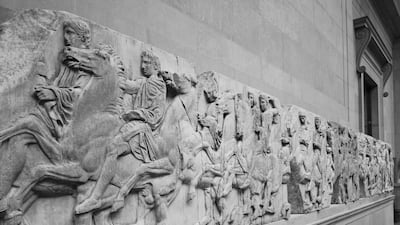
The Elgin Marbles on display in the Duveen Gallery at the British Museum in 1971. Getty Images -

Archaeologist Sir Mortimer Wheeler listens to the newly available audio guide in the Duveen Gallery of the British Museum in 1964. Getty Images -
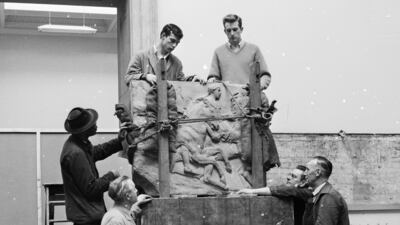
Workmen unload a portion of the Parthenon frieze before affixing it to the wall in the new Elgin Marbles room of the British Museum in 1961. Getty Images



