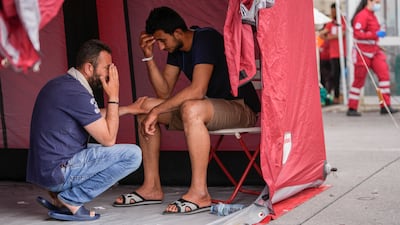
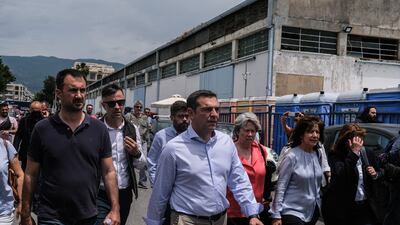
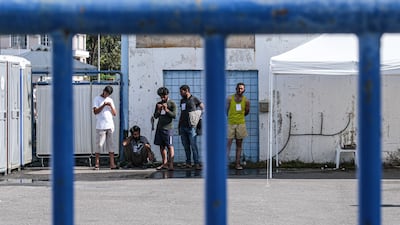
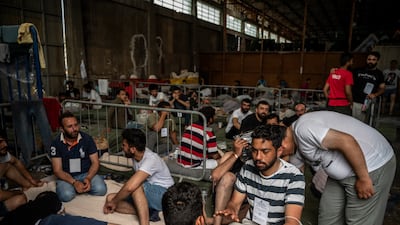
Police in Pakistan have arrested 14 people in connection with the alleged trafficking of migrants who were killed last week after an overcrowded fishing boat capsized off Greece.
Hundreds were aboard the boat, which is believed to have sailed from Libya, carrying Egyptians, Syrians, Pakistanis, Afghans and Palestinians.
The Pakistani government has ordered an inquiry into a network thought to be involved in the trafficking of citizens, a statement from Prime Minister Shehbaz Sharif's office said.
“My thoughts and prayers are with the bereaved families who lost their loved ones,” Mr Sharif said.
Twenty-one of those who died came from the Kotli district in Pakistan's part of the Himalayan Kashmir region, police official Riaz Mughal said.
Two of the 12 Pakistanis who survived the sinking also came from the same area.
“We have already arrested 10 suspects who are part of a human trafficking network that sent these people to Europe,” senior regional police officer Tahir Mahmood Qureshi said.
“We are hunting for more suspects.”
Some had already been traced and arrests planned, while others had gone into hiding, he said.
A further four people were arrested in the eastern Punjab province, a senior official at Pakistan's Federal Investigation Agency said.
Witness accounts suggest that between 400 and 750 people were packed on the fishing boat that sank about 80km from the southern Greek town of Pylos.
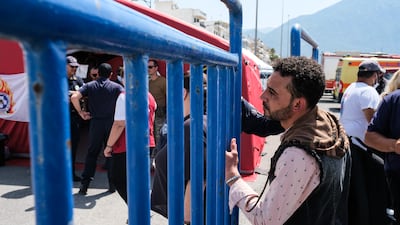
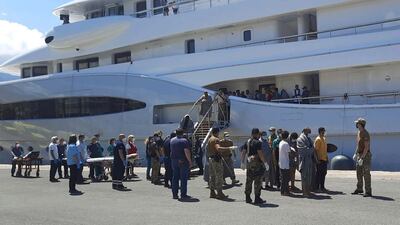
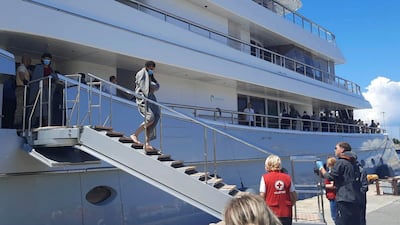
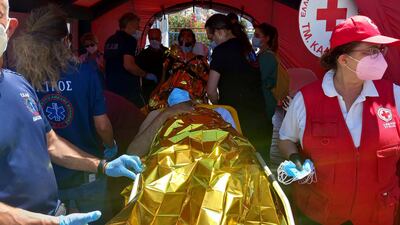
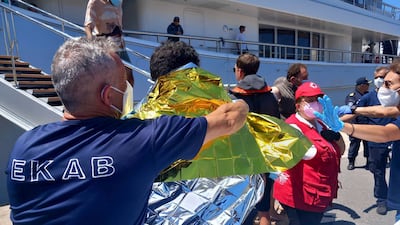
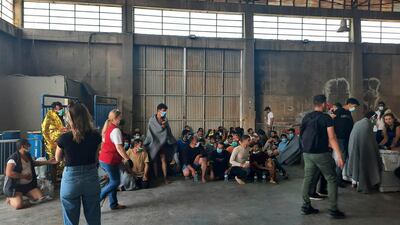
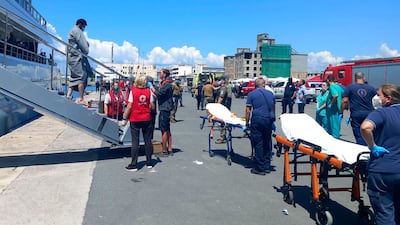
Around 100 migrants rescued after Greece shipwreck – in pictures
Greek authorities said 104 survivors and 78 bodies were brought ashore in the immediate aftermath.
Hopes were fading of finding any more people alive.
Meanwhile, a court in southern Greece on Monday postponed a hearing for nine Egyptian men accused of being migrant smugglers in a case involving the sinking of the fishing trawler.
The court in Kalamata postponed the hearing until Tuesday to provide them and their lawyers with time to review the testimonies of nine Syrian and Pakistani survivors, given over the weekend.
The Egyptians, who were reportedly identified as members of a smuggling ring by some of the survivors, face charges of participating in a criminal organisation.
Relatives of the passengers who had been on board gathered outside the courthouse, shouting the names of their loved ones, Greek media reported.
Other relatives arrived at a migrant holding centre in Malakasa, north of Athens, trying to find relatives who they knew were on the boat.
Zohaib Shamraiz, a Pakistani living in Barcelona, does not know if his 40-year-old uncle, Nadeem Muhamm, survived.
“I spoke to him five minutes before he got on the boat. I told him not to go. I was afraid. He said he had no choice," Mr Shamraiz said.
When he last spoke to his uncle, Mr Muhamm described being herded onto the ship with others by smugglers carrying swords, Mr Shamraiz said.
“He told me there were too many people but if the [passengers] didn’t get on the ship, they would kill them.”
Mr Shamraiz travelled to Greece on Monday attempting to track his uncle and to provide a DNA sample to crossmatch those retrieved from recovered bodies.
His uncle, who was travelling alone, is married and has three young children in Pakistan.
In a separate incident on Monday, Greece's coastguard said 68 people were rescued in the eastern Aegean Sea after their sailing boat go into distress while off the coast of the island of Leros.
The sailing boat, which is believed to have left Turkey carrying migrants hoping to reach Greece, issued a distress call early on Monday, and the passengers were picked up by a merchant ship before being transferred to a coastguard vessel, the agency said.
All were safely transported to Leros, and there were no reports of any injuries or people missing.

Hydrogen: Market potential
Hydrogen has an estimated $11 trillion market potential, according to Bank of America Securities and is expected to generate $2.5tn in direct revenues and $11tn of indirect infrastructure by 2050 as its production increases six-fold.
"We believe we are reaching the point of harnessing the element that comprises 90 per cent of the universe, effectively and economically,” the bank said in a recent report.
Falling costs of renewable energy and electrolysers used in green hydrogen production is one of the main catalysts for the increasingly bullish sentiment over the element.
The cost of electrolysers used in green hydrogen production has halved over the last five years and will fall to 60 to 90 per cent by the end of the decade, acceding to Haim Israel, equity strategist at Merrill Lynch. A global focus on decarbonisation and sustainability is also a big driver in its development.
Various Artists
Habibi Funk: An Eclectic Selection Of Music From The Arab World (Habibi Funk)
Who has lived at The Bishops Avenue?
- George Sainsbury of the supermarket dynasty, sugar magnate William Park Lyle and actress Dame Gracie Fields were residents in the 1930s when the street was only known as ‘Millionaires’ Row’.
- Then came the international super rich, including the last king of Greece, Constantine II, the Sultan of Brunei and Indian steel magnate Lakshmi Mittal who was at one point ranked the third richest person in the world.
- Turkish tycoon Halis Torprak sold his mansion for £50m in 2008 after spending just two days there. The House of Saud sold 10 properties on the road in 2013 for almost £80m.
- Other residents have included Iraqi businessman Nemir Kirdar, singer Ariana Grande, holiday camp impresario Sir Billy Butlin, businessman Asil Nadir, Paul McCartney’s former wife Heather Mills.
Hunting park to luxury living
- Land was originally the Bishop of London's hunting park, hence the name
- The road was laid out in the mid 19th Century, meandering through woodland and farmland
- Its earliest houses at the turn of the 20th Century were substantial detached properties with extensive grounds
RESULTS
6.30pm: Longines Conquest Classic Dh150,000 Maiden 1,200m.
Winner: Halima Hatun, Antonio Fresu (jockey), Ismail Mohammed (trainer).
7.05pm: Longines Gents La Grande Classique Dh155,000 Handicap 1,200m.
Winner: Moosir, Dane O’Neill, Doug Watson.
7.40pm: Longines Equestrian Collection Dh150,000 Maiden 1,600m.
Winner: Mazeed, Richard Mullen, Satish Seemar.
8.15pm: Longines Gents Master Collection Dh175,000 Handicap.
Winner: Thegreatcollection, Pat Dobbs, Doug Watson.
8.50pm: Longines Ladies Master Collection Dh225,000 Conditions 1,600m.
Winner: Cosmo Charlie, Pat Dobbs, Doug Watson.
9.25pm: Longines Ladies La Grande Classique Dh155,000 Handicap 1,600m.
Winner: Secret Trade, Tadhg O’Shea, Ali Rashid Al Raihe.
10pm: Longines Moon Phase Master Collection Dh170,000 Handicap 2,000m.
Winner:
RESULT
Kolkata Knight Riders 169-7 (20 ovs)
Rajasthan Royals 144-4 (20 ovs)
Kolkata win by 25 runs
Next match
Sunrisers Hyderabad v Kolkata Knight Riders, Friday, 5.30pm
Start-up hopes to end Japan's love affair with cash
Across most of Asia, people pay for taxi rides, restaurant meals and merchandise with smartphone-readable barcodes — except in Japan, where cash still rules. Now, as the country’s biggest web companies race to dominate the payments market, one Tokyo-based startup says it has a fighting chance to win with its QR app.
Origami had a head start when it introduced a QR-code payment service in late 2015 and has since signed up fast-food chain KFC, Tokyo’s largest cab company Nihon Kotsu and convenience store operator Lawson. The company raised $66 million in September to expand nationwide and plans to more than double its staff of about 100 employees, says founder Yoshiki Yasui.
Origami is betting that stores, which until now relied on direct mail and email newsletters, will pay for the ability to reach customers on their smartphones. For example, a hair salon using Origami’s payment app would be able to send a message to past customers with a coupon for their next haircut.
Quick Response codes, the dotted squares that can be read by smartphone cameras, were invented in the 1990s by a unit of Toyota Motor to track automotive parts. But when the Japanese pioneered digital payments almost two decades ago with contactless cards for train fares, they chose the so-called near-field communications technology. The high cost of rolling out NFC payments, convenient ATMs and a culture where lost wallets are often returned have all been cited as reasons why cash remains king in the archipelago. In China, however, QR codes dominate.
Cashless payments, which includes credit cards, accounted for just 20 per cent of total consumer spending in Japan during 2016, compared with 60 per cent in China and 89 per cent in South Korea, according to a report by the Bank of Japan.
England XI for second Test
Rory Burns, Keaton Jennings, Ben Stokes, Joe Root (c), Jos Buttler, Moeen Ali, Ben Foakes (wk), Sam Curran, Adil Rashid, Jack Leach, James Anderson
MATCH INFO
Champions League quarter-final, first leg
Manchester United v Barcelona, Wednesday, 11pm (UAE)
Match on BeIN Sports
Where%20the%20Crawdads%20Sing
%3Cp%3E%3Cstrong%3EDirector%3A%20%3C%2Fstrong%3EOlivia%20Newman%3Cbr%3E%3Cstrong%3EStars%3A%3C%2Fstrong%3E%20Daisy%20Edgar-Jones%2C%20Taylor%20John%20Smith%2C%20Harris%20Dickinson%2C%20David%20Strathairn%3Cbr%3E%3Cstrong%3ERating%3A%3C%2Fstrong%3E%202%2F5%3C%2Fp%3E%0A
The five pillars of Islam
Islamophobia definition
A widely accepted definition was made by the All Party Parliamentary Group on British Muslims in 2019: “Islamophobia is rooted in racism and is a type of racism that targets expressions of Muslimness or perceived Muslimness.” It further defines it as “inciting hatred or violence against Muslims”.