


The Co-op has announced a three-year partnership with the Royal Society for Protection of Birds in a project covering the restoration and long-term management of peatland.
The initial focus will be on areas of RSPB-owned upland peatland in Scotland and Wales, which are equivalent in size to about 400 football pitches, bringing vital peatland back into good condition to reduce carbon loss and help tackle the climate and environment crisis.
The Co-op said an estimated 3.2 billion tonnes of carbon are stored in peatlands, and it is believed that without any intervention to repair and preserve them, their greenhouse gas emissions could exceed the equivalent of 20 million tonnes of carbon dioxide each year.
The projects will deliver additional environmental benefits including the protection of natural habitats for wildlife, and potentially improving water quality and reducing flood risk by regulating water flow.
The partnership will initially focus on two areas of peatland which will undergo a large-scale and complex programme of restoration and long-term management, supported by the National Peatland Action Programme in Wales and Peatland Action in Scotland.
They are Cerniau at Lake Vyrnwy in Powys, Wales, at the southern end of the Berwyn and South Clwyd mountains, and Lumbister at Yell, which is situated on one of Shetland’s most northern isles.
Guy Stuart, director of sustainability, technical and agriculture at the Co-op, said that the climate crisis shows that “decarbonisation needs to speed up and through co-operation of the global community”.
“Our pioneering partnership with the RSPB will play a part in helping to avoid carbon emissions through repairing vital peatlands to increase carbon stores and support our work to prioritise action where we are able to make the most impact,” he said.
The Co-op through the years – in pictures
-

Shoppers outside the Co-Operative Society Ltd in East Ham, London, in 1929. All photos: Getty Images -

Tea tasting and inspection at Co-Op Society warehouse in 1931 -

Due to two weeks’ delay in the delivery of tinned food, 'not for sale' signs are placed on items in this Co-op shop in St John's Wood Terrace, London, in 1941 -
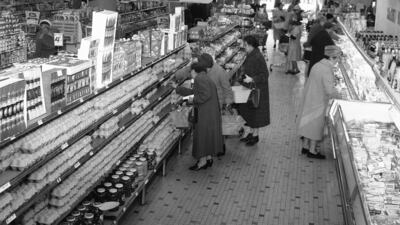
Customers doing their weekly shop at Bexley Heath Co-Op supermarket in 1961 -

A manager and two assistants outside a Co-Op in 1963 -
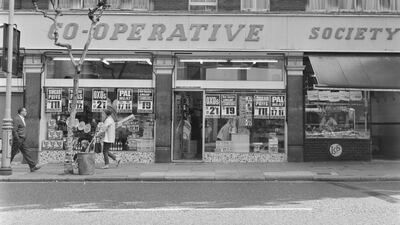
A Co-Operative Society supermarket in 1967 -

The new logo of the Co-operative Society shops and bank in 1974 -
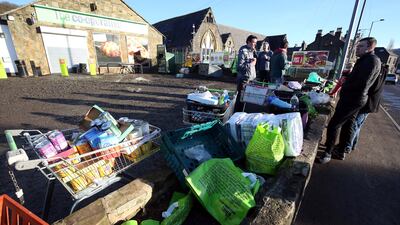
A Co-op provide essentials for residents after flooding in Mytholmroyd, West Yorkshire in December 2015 -

A Co-op supermarket worker loads a Starship delivery robot with groceries in Milton Keynes in 2020



