


English universities are at financial risk due to their overreliance on tuition from overseas students, such as China, the UK's higher education watchdog has warned.
The English higher education regulator has said any event that “reduces the flow” of international students to universities – such as a changing geopolitical environment – could have a “significant impact” on the income of institutions that rely heavily on international recruitment.
The sector is “highly reliant” on the tuition income from overseas students – and particularly on the income from Chinese students, the Office for Students' annual report on financial sustainability suggests.
It adds that an “overreliance” on overseas fees is a “vulnerability” for some higher education providers in England.
The OfS has written to 23 institutions with high levels of recruitment, particularly from China, to ensure they have contingency plans to protect them from any possible drop in income from overseas students.
Chinese students currently make up the largest group of international students at English universities, followed by students from India and Nigeria.
Higher Education Statistics Agency data released in January shows that there were 124,370 Chinese students at English institutions in 2021-22. The figure includes postgraduate and part-time students.
Top 10 UK Universities – in pictures
-

1. University of Oxford. Getty -

2. University of Cambridge. Getty -

3.London School of Economics and Political Science. Getty -

4. University of St Andrews. Getty -
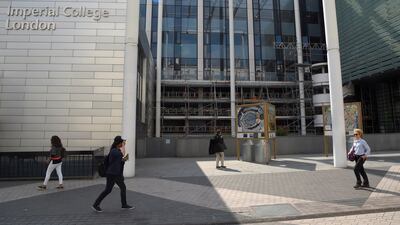
5. Imperial College London. Reuters -

6. Durham University. Alamy -

7. Loughborough University. Getty -

8. UCL (University College London). Alamy -

9. University of Warwick. Alamy -

10. University of Bath. Getty


The English institutions with the largest number of Chinese students in 2021-22 were University College London (10,785), the University of Manchester (9,065), King’s College London (6,360) and the University of Sheffield (6,340).
The data also shows there were 107,270 Indian students at English institutions during 2021-22, and 34,010 students from Nigeria.
The OfS analysis, which does not name individual universities, says that, at an aggregate level, non-EU fee income as a proportion of total income is forecast to increase from 19.3 per cent in 2021-22 to 24 per cent in 2025-26 across the sector.
Overall, the report concludes that the financial position of institutions “remains sound”, but there is significant variation between providers.
It highlights a number of financial risks that institutions face – including the impact of inflation and the reliance on international student recruitment.
But the analysis, which is based on data submitted to the OfS by 254 higher education providers, concludes that the likelihood of a large number of providers having to close due to financial failure “remains low”.
“For a small number of institutions, the financial picture is of particular concern and we will continue to focus our attention on those cases,” said Susan Lapworth, chief executive of the OfS.
“But all institutions will continue to face financial challenges, with a number of risks present at the same time for many.
“International students bring enormous economic, cultural and educational benefits to higher education in England.
“But we continue to have concerns that some universities have become too reliant on fee income from international students, with students from one country sometimes a significant part of the financial model.
“Universities must know what they would do if international recruitment fails to meet expectations. We have written to a number of institutions today to ensure they are alert to this risk, and have credible contingency plans in place to protect them from the consequences of a sudden reduction in their income.”
World's best universities for key subjects – in pictures
-
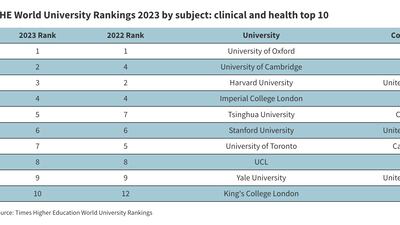
The top ten institutions for clinical and health studies. All photos: Times Higher Education -

The top ten institutions for business and economics studies. -
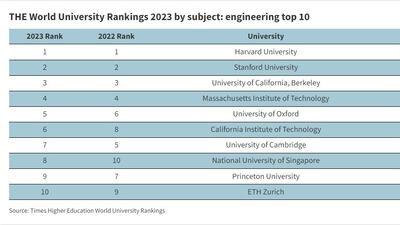
The United States is home to the top four universities for engineering, according to a global education league table. -
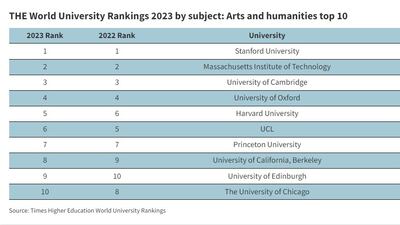
Stanford University leads the way for arts and humanities. -
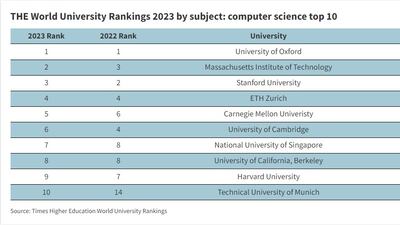
The top ten universities for studying computer science.


During a meeting of the Industry and Regulators Committee in the House of Lords, Robert Halfon, the skills, apprenticeships and higher education minister, said he was concerned about the financial dependency of universities on international students from only one or two countries and he added that “more work needs to be done”.
Speaking on Tuesday, Mr Halfon said: “It is dangerous to rely on one or two countries, and we’re doing a lot of work on diversification of that.”
Nick Hillman, director of the Higher Education Policy Institute, said: “Universities are often stuck between a rock and a hard place – if they take on more home students, they lose more money.
“If they recruit a lot of students from China to make up the shortfall, they get admonished by the OfS and if they recruit more students from India and Nigeria instead, they get told off by the Home Office.
He added that the positive averages should not mask the deep financial problems at certain institutions, particularly those serving British students from underrepresented groups.
A Universities UK representative said: “Universities are well aware of the risks of overreliance on narrow streams of student applications, both at home and abroad, and have been working hard to diversify their student base to protect the financial health of institutions both now and in the future.
“However, this report does highlight the significant financial risks many universities are now facing due to fee freezes and increased costs.
“Universities need a clear, well-thought-out and consistent funding model in order to safeguard their work both now and in the future.”

