


Former Formula One Russian racing driver Nikita Mazepin has taken a fight with the UK government to the High Court over sanctions imposed on him following Russia‘s invasion of Ukraine.
The former driver in the Haas Formula One Team has also taken legal action against Foreign Secretary James Cleverly.
During a High Court hearing in London on Wednesday, a judge considered the preliminary issues.
Mr Justice Chamberlain heard that Mazepin and his father Dmitry Mazepin — a Russian businessman — were made subject to sanctions in mid-March 2022. Neither Mazepin nor his father were at the hearing.
In September 2022, Mazepin had requested “revocation of his designation” but ministers had decided to “take no action”.
A judge is due to oversee a further hearing in London in June.
Mazepin is involved in a similar bid to have sanctions lifted in Canada.
Oligarchs sanctioned by the UK — in pictures
-
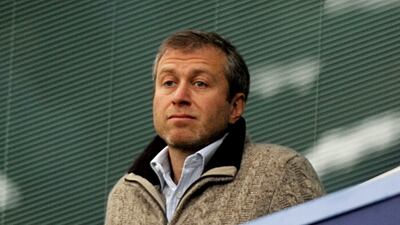
The UK has sanctioned more than 1,400 individuals and businesses, including 100 oligarchs and their relatives, since Russia invaded Ukraine in February. The list of oligarchs includes: Roman Abramovich, 55. PA -

Katerina Tikhonova, left, and Maria Vorontsova, unseen, also known as Maria Putina, daughters of Russia President Vladimir Putin. Reuters -
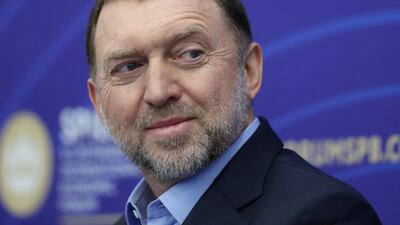
Oleg Deripaska, 54. The industrialist is worth £2 billion and has had close links with the British political establishment. He has a multimillion pound property portfolio in the UK. Reuters -

Igor Sechin, 61. Officials described Mr Sechin as Mr Putin's right-hand man and the second most important person in the country. Reuters -
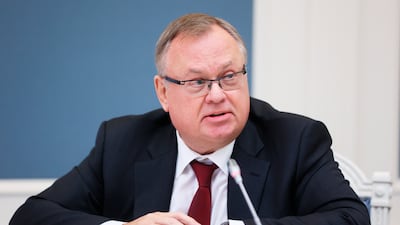
Andrey Kostin, 65. The chairman of VTB, a Russian state-owned bank. Mr Kostin is also a member of the supreme council of the United Russia political party and deemed a close associate of Mr Putin. AP Photo -
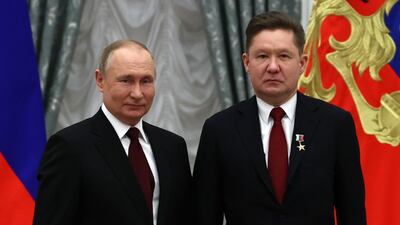
Alexei Miller, 60. The chief executive of energy company Gazprom, Russia's largest company and the world's biggest public energy supplier. AFP -
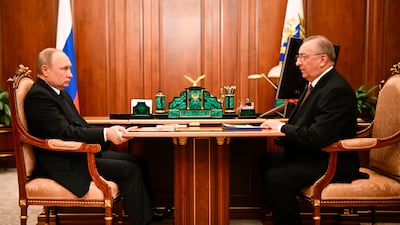
Nikolai Tokarev, 71, president of the Russia state-owned pipeline company Transneft. Mr Tokarev is a former KGB officer who served with Mr Putin in East Germany towards the end of the Cold War. AP Photo -

Kirill Shamalov, 39. He is Russia's youngest billionaire and the ex-husband of Mr Putin's daughter Katerina Tikhonova. Reuters -

Pyotr Fradkov, 43. He is head of the sanctioned Promsvyazbank, which finances Russian defence industries, and the son of Mikhail Fradkov, a former prime minister of Russia and chief of its foreign intelligence service. Reuters -
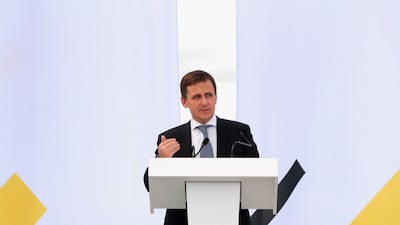
Denis Bortnikov, 47. The deputy president of government-affiliated VTB bank. His father, Alexander Bortnikov, is head of the Federal Security Service. Getty Images -
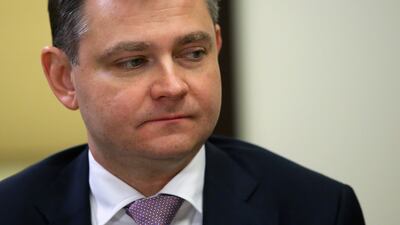
Yury Slyusar, 47. The director of United Aircraft Corporation, one of the major defence organisations that has also been sanctioned. Getty Images


Barrister Tom Leary, who represented Mr Cleverly, told the judge that Haas had “terminated its relationship” with Mazepin in early March 2022, following the outbreak of war.
He said Mazepin had not driven for a Formula One team since.
Mazepin and his father were “subject to an asset freeze and travel ban”, the judge was told.
Mr Leary indicated that one of the reasons Mazepin wanted sanctions lifted was so that he could travel to Britain to negotiate with race teams for the 2024 season.
Mr Justice Chamberlain suggested that a trial judge might have to stage part of the proceedings in private to consider any “closed” material presented by ministers.
Barrister Rachel Scott, who represented Mazepin, told Mr Justice Chamberlain in a written case outline: “The UK sanctions to which he has been made subject, alongside the imposition of restrictive measures at EU level, effectively ended his racing career.
“He missed the 2022 season and, almost certainly, the 2023 season and, whilst those sanctions are in place, no Formula One team will take him on as a test, reserve or full driver.
“The claimant will, in effect, be unable to negotiate a place on a Formula One team for 2024 unless he is free to travel to and from the UK to attend negotiations at teams’ bases in the UK, bearing in mind that seven of the 10 teams are based in the UK.
“Negotiations to join a Formula One team usually begin in May or June of the previous year. Thereafter he must be able to enter the UK, not just for the British Formula One race, but for briefings, ergonomics design work, training and attending the team’s base.”

