

Follow the latest news from the coronation of King Charles here
King Charles III's balanced approach to world religions including Islam has been praised by the grandson of one of Britain’s most prominent faith leaders.
The late theologian Sheikh Zaki Badawi was a leading spokesman on Muslim issues in the UK. He also sparked an unexpected friendship with the king, who was Prince of Wales at the time.
“Charles converted my grandfather from a solid republican to a supporter of the current constitutional monarch,” his grandson Kareem Ahmed told The National.
The Egyptian-born cleric became known as the voice of moderate Islam and advocated Muslims' integration into British society.
"He wasn’t keen on empire, he was the defender of a beleaguered minority," said Mr Ahmed.
Yet Mr Badawi’s meetings with King Charles led him to support the British system of an established church, which is headed by the monarch.
“Both monarch and established church defended minorities, whereas disestablishment would lead to free competition and increase jeopardy, according to my grandfather,” said Mr Ahmed, who is a civil servant and aid worker currently living in Washington.
King Charles met Dr Badawi after he founded the Muslim College in London to train religious leaders in the UK.
But their mutual interest in religion soon evolved into friendship, as the king himself has publicly said.
“They were both involved in interfaith dialogue and working towards more tolerance,” said Mr Ahmed, who often went to see his grandfather speak at mosques and the House of Lords.
Dr Badawi co-founded the Three Faiths Forum in 1997, which became one of the most prominent interfaith groups in the UK.
-
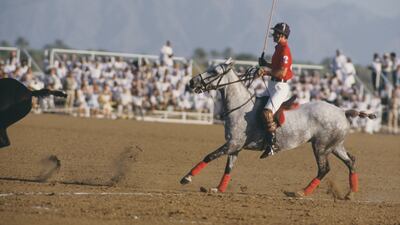
The UK's Prince Charles, now King Charles III, plays polo near Muscat, Oman, in 1986. Getty -

Prince Charles and Princess Diana at a picnic near Riyadh, Saudi Arabia, in 1986. Getty -
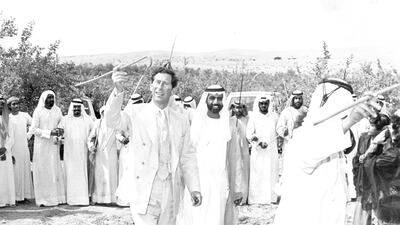
Sheikh Nahyan bin Mubarak with Prince Charles during a visit to the UAE in 1988. Photo: Al Ittihad -

Prince Charles and Diana, Princess of Wales, attend a camel race in Al Ain in March 1989. Getty -
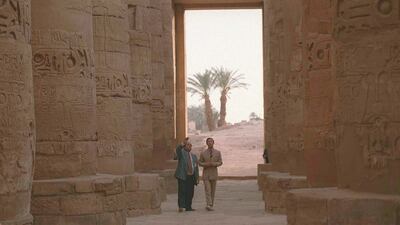
Prince Charles visits the Karnak Temple Complex during a visit to Egypt in 1995. Getty -

Prince Charles tours the Hassan II Mosque in Casablanca during a three-day official visit to Morocco in 1995. Reuters -

The British royal is served Arabic coffee during a visit to Bait Al Zubair in Muscat in 2003. Reuters -

Prince Charles with Maj Gen Andrew Stewart, right, at a British military base in Basra, Iraq, in 2004. Reuters -

The UK royal is shown a map of Arg-e-Bam during a 2004 visit to the ruins in Bam, southern Iran. Reuters -
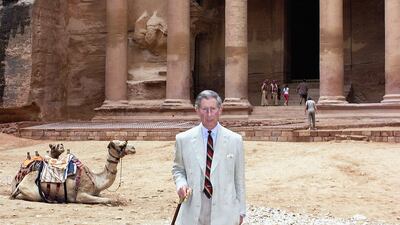
Prince Charles in Petra, Jordan, in 2004. Getty -
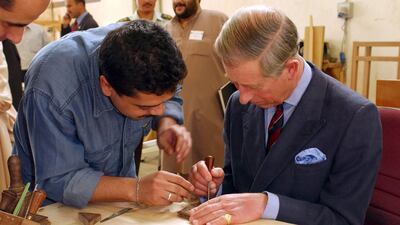
Charles, Prince of Wales at the time, visits the College of Islamic Art at Salt University in Amman, Jordan, in 2004. Getty -

Prince Charles wears a bisht during a 2007 visit to a traditional handicraft centre in Kuwait with Camilla, now Queen Consort. Reuters -

The royal visits Al Safwa farm in Doha in 2013. Reuters -

Prince Charles with former Saudi tourism minister Prince Sultan bin Salman at Al Diriyah in 2014. Reuters -

Prince Charles wears a traditional Saudi uniform to perform a sword dance, known as ardah, in Riyadh in 2014. Reuters -
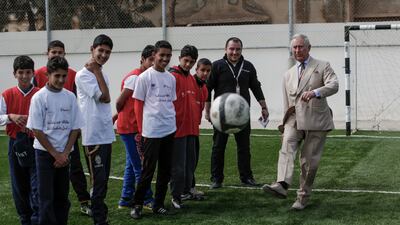
Prince Charles visits Jordanian children and Syrian refugees at a sports ground in Zaatari, Jordan, in 2015. Getty -
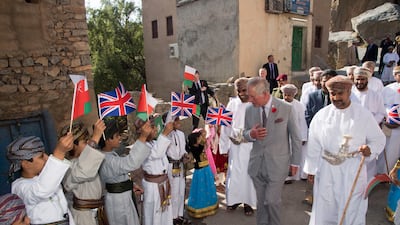
The royal is greeted by children during a walking tour in Muscat in 2016. Getty -
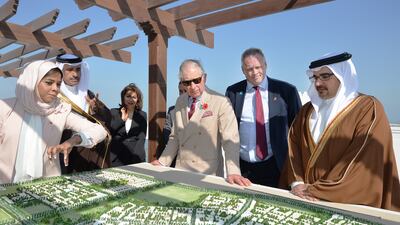
Prince Charles during a visit to the Tubil Bay regeneration project in Bahrain, in 2016. Getty -

Prince Charles visits Manama Souq, Bahrain, in 2016. Getty -
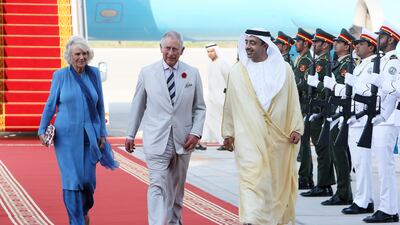
Sheikh Abdullah bin Zayed, Minister of Foreign Affairs and International Co-operation, receives Prince Charles and Camilla in Abu Dhabi in 2016. Photo: Abu Dhabi Crown Prince Court -
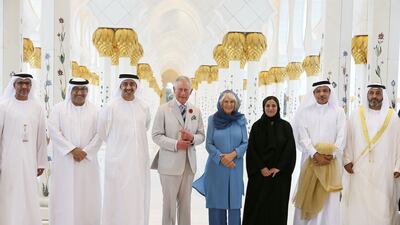
Sheikh Abdullah with Prince Charles and Camilla after a meeting at the Sheikh Zayed Grand Mosque in 2016. Photo: Abu Dhabi Crown Prince Court -
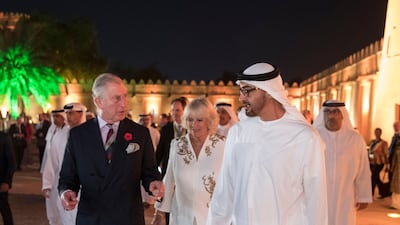
President Sheikh Mohamed, who at the time was Crown Prince of Abu Dhabi and Deputy Supreme Commander of the Armed Forces, receives Charles and Camilla, at Al Jahili Fort in Al Ain in 2016. Photo: Abu Dhabi Crown Prince Court -
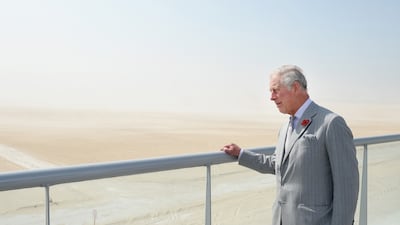
Prince Charles visits the site of Expo 2020 Dubai in 2016. Getty -

Prince Charles visits Bu Tinah island on the second day of his tour of the UAE, in November 2016. Getty -
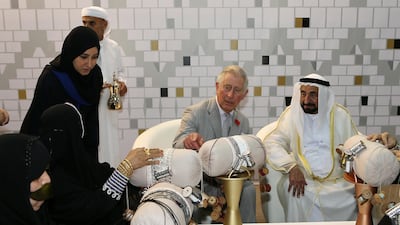
Sheikh Dr Sultan bin Muhammad Al Qasimi, Ruler of Sharjah, with Prince Charles during his visit to the Regional Conservation Centre in Sharjah, in November 2016. Photo: Ab Dhabi Crown Prince Court -

Prince Charles lays a wreath during the Fifth World Holocaust Forum in Jerusalem in 2020. Reuters -

Prince Charles with Roman Krassovsky, right, Archimandrite of the Russian Orthodox Church Outside Russia and chief of its Russian Ecclesiastical Mission in Jerusalem, during a visit in Russian Orthodox Church of Mary Magdalene in 2020. Reuters -
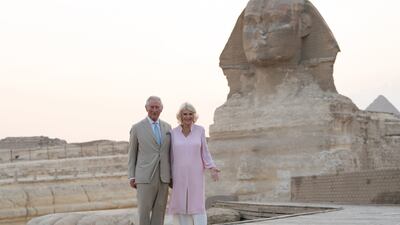
Prince Charles and Camilla visit the Great Sphinx of Giza during a regional tour in 2021. Getty -
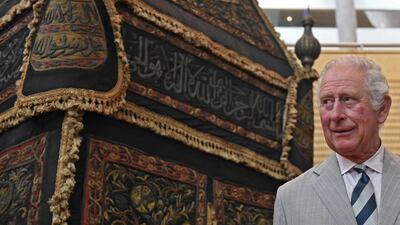
Prince Charles stands next to the mahmal, the palanquin used to transport the kiswah that covers the Kaaba in Makkah, during a visit to Alexandria, Egypt, in 2021. AFP


Though Dr Badawi's family knew of his visits to the then-prince’s residence in Highgrove, they were never involved.
“My grandfather was incredibly discreet about his meetings with Charles,” said Mr Ahmed.
His guess is that Dr Badawi’s wit and charm contributed to their friendship.
“He was extremely funny. He could also be undiplomatic, or outright rude,” said Mr Ahmed.
But the prince may also have found common ground with Dr Badawi’s undogmatic and learned approach to religion. He was a critic of more literalist schools of thought in Islam.
"There is one fundamental system of beliefs, certain accepted rules of conduct, but there are many different cultural manifestations," he once told a journalist.
"These manifestations must always be capable of being changed through adapting to new cultures."
He publicly defended author Salman Rushdie after a fatwa was issued against him by Iran's supreme leader, even when other British Muslim leaders did not.
Dr Badawi and his wife were guests at the prince's wedding in 2005. After his death in 2006, King Charles sent a long, handwritten letter of condolence to the family and issued a public statement describing his “greatest possible admiration” for the cleric “whose advice and friendship [he] valued greatly".
The king has long been an advocate of interfaith dialogue, recognising the growing diversity of faith communities in the UK.
“I have always thought of Britain as a ‘community of communities'," King Charles told faith leaders in September 2022, when he pledged to “protect the space for faith itself” in the UK.
This commitment to diversity will be on display at his coronation, when religious leaders representing the Buddhist, Hindu, Jewish, Muslim and Sikh traditions will play an active role in the ceremonies for the first time.
In the 1990s, he said that he would want to be remembered as the “Defender of Faith” as opposed to the monarch’s official title as the “Defender of the Faith”, meaning Christianity.
He also took a personal interest in Islam, and he has spoken about his attempts to learn Arabic and study the Quran.
In a 1993 speech at the Oxford Institute of Islamic studies – which he has supported for more than 30 years – he highlighted the need for better understanding of Islam in the western world.
"If there is much misunderstanding in the West about the nature of Islam, there is also much ignorance about the debt our own culture and civilisation owe to the Islamic world,” he said.
He first visited Al Azhar, the oldest university for Islamic studies, in Cairo in 2006 and was awarded an honorary doctorate there in 2021.
But there are signs that King Charles’s attempts to involve more faiths in the coronation has upset the establishment.
Last week, The Mail On Sunday reported that King Charles had been “at loggerheads” with the Church of England over the role other faiths should play in the coronation service.
Though the king is said to have requested a multifaith service, he was barred by centuries-old canon law, which prevents leaders of other faiths from reading out prayers during the service.
Catherine Pepinster, a conservative religious commentator, warned against the ancient rituals of the coronation being “diluted in the name of diversity”.
For Mr Ahmed, the inclusion of different faiths at the coronation is a positive sign of changing times.
"Western Europe is steeped in its Christian traditions, but we’re growing as a multicultural and multifaith society," he said.
"The coronation can evolve in a diplomatic and peaceful way to include [different communities].
"There are always going to be outspoken critics from people within a community who chose to focus on rigid interpretations of their religion or way of life."

