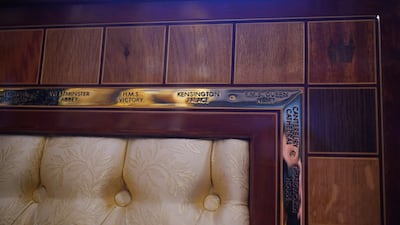
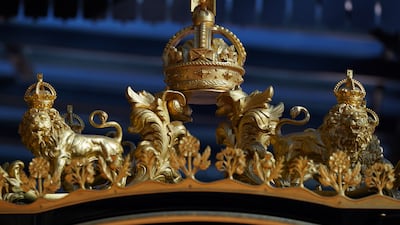
Some of the regalia to be used at the coronation of King Charles III. Photo: The Royal Household

What are the Crown Jewels? A guide to the regalia used in King Charles's coronation


Marwa Hassan
  • English
  • Arabic

As the coronation of King Charles III fast approaches, an array of regalia is being prepared to take centre stage, encapsulating the history and significance of the occasion.

Nestled within the Tower of London, the Coronation Regalia's sacred and secular artefacts symbolise the monarch's devotion and duty to the country. These treasures have graced coronation ceremonies for centuries, and on May 6 they will once again find their place at Westminster Abbey.

St Edward's Crown

St Edward's Crown weighs 2.23kg. Photo: Royal Collection Trust

St Edward's Crown will be placed on the head of King Charles III at Westminster Abbey on coronation day.

It was created for Charles II in 1661 after a previous medieval version was melted down in 1649. The original crown held a connection with the 11th-century royal saint Edward the Confessor, the last Anglo-Saxon king of England.

St Edward's Crown may not be an exact replica of its predecessor but still carries much of its resemblance.

Topped with an orb and a cross, the crown symbolises the Christian world. Its solid gold frame is adorned with jewels and finished with a velvet cap and ermine band.

Last worn by Queen Elizabeth II at her coronation in 1953, St Edward's Crown has been temporarily removed from the Tower of London to be modified for the coming event.

Imperial State Crown

King Charles III will change from St Edward's Crown into the lighter Imperial Crown near the end of the coronation service. Photo: Royal Collection Trust

The Imperial State Crown, steeped in centuries of history, plays a pivotal role in the coronation service.

It will be exchanged for St Edward's Crown at the service's conclusion and is also worn by the monarch during ceremonial events, such as the State Opening of Parliament.

The term "Imperial State Crown" traces its origins back to the 15th century when English monarchs adopted a design with enclosing arches to symbolise England's independence.

The current version was crafted for George VI's coronation in 1937.

However, its design draws inspiration from a crown created for Queen Victoria in 1838 by Rundell, Bridge & Rundell, the crown jewellers of that era.

Ceremonial Maces

Two maces were made between 1660 and 1695, crafted from silver gilt and oak. These ceremonial emblems of authority take centre stage at events such as the State Opening of Parliament.

Based on medieval weapons, the maces will provide an eye-catching symbol of royalty to accompany the sovereign’s procession to Westminster Abbey.

Sword of State

The Sword of Spiritual Justice will feature at the coronation on May 6. Photo: Royal Collection Trust

The Sword of State has an intriguing history, too. Back in the days of King Charles II, two such swords were crafted in 1660 and 1678.

Only one survives, and it has been a part of many coronations, including the 1969 investiture of the prince of Wales, the man who is now king.

It features William III's coat of arms on its scabbard.

Swords of Temporal Justice, Spiritual Justice and Mercy

During a coronation, three more swords feature: the Sword of Temporal Justice (for the monarch's role as head of armed forces), the Sword of Spiritual Justice (representing the monarch as defender of the faith), and the Sword of Mercy, a blunt-tipped blade said to symbolise the sovereign's mercy.

These swords have been in use since Charles I's coronation in 1626 and feature 16th-century steel blades and 17th-century hilts.

St Edward's Staff

(Top to bottom) St Edward's Staff, the Sceptre with Dove and the Sceptre with Cross. Photo: Crown Copyright

This artefact, known as St Edward's Staff, has a history rooted in the tales of royal saints.

Originating from an earlier staff called the Long Sceptre, St Edward's Staff was carried during 15th and 16th-century coronation processions.

It symbolised a powerful connection to Edward the Confessor. Just think of the centuries of awe and reverence this stunning staff has inspired, as it continues to evoke the grandeur of royal heritage today.

Charles Farris, public historian at Historic Royal Palaces, said because its former use was unknown, there had been doubt over whether a new one would be produced.

“But Charles II said ‘no, I want the full set’, and it was made even though no one quite knew what it was for,” Mr Farris said.

Ampulla holding the Chrism oil

The gold Ampulla is shaped in the form of an eagle with outspread wings and is used to hold the consecrated oil. Photo: Royal Collection Trust

The sacred Chrism oil, used to anoint King Charles III and Queen Consort Camilla, has come all the way from the Church of the Holy Sepulchre in the Old City of Jerusalem.

This special oil is held within the Ampulla, a golden vessel shaped like an eagle with outspread wings. When the time comes, the oil will flow through an opening in the bird's beak.

The Ampulla was made in 1661 by the crown jeweller Sir Robert Vyner for Charles II's coronation.

Its design was inspired by a smaller, earlier vessel, which itself was rooted in a mystical 14th-century legend.

The Virgin Mary appeared to St Thomas a Becket, presenting him with a golden eagle and a vial of oil to anoint future monarchs of England, according to the legend.

Coronation Spoon

The 12th-century spoon is considered the "most humble" but the oldest object in the Crown Jewels.

The silver-gilt Coronation Spoon holds a unique place in history, as the oldest object still in use at coronations.

First recorded in 1349 among St Edward's Regalia in Westminster Abbey, it is the only surviving example of royal goldsmiths' work from the 12th century. It may have been created for King Henry II or King Richard I.

The spoon was first used in King James I's ceremony in 1603 and has been used in every subsequent coronation.

After being sold in 1649, it was returned in 1661 for Charles II's coronation, adorned with delicate seed pearls on its handle as a symbol of renewal.

Spurs

The gold, leather and velvet spurs were altered in 1820 for King George IV. Photo: The Royal Household

The golden spurs, intricately crafted with leather and velvet, were created in 1661 for Charles II, but previous versions can be traced all the way back to Richard I, the Lionheart, in 1189.

These regal spurs are said to symbolise knighthood and chivalrous ideals.

Over time, the spurs have been adapted to reflect the changing needs of each ceremony.

In 1820, for example, they were altered for George IV's coronation.

Sword of Offering

The Sword of Offering, crafted in 1820, is a fusion of artistry and symbolism.

Its steel blade is mounted in gold and adorned with jewels that depict a rose, thistle, shamrock, oak leaves, acorns and lion's heads, each representing a different aspect of the United Kingdom.

The sword rests in a lavish gold-covered leather scabbard.

First used at the coronation of King George IV, the Sword of Offering serves as an enduring symbol of the monarch's commitment to their people and the realm.

Armills

The two Armills. Photo: The Royal Household

The two Armills are bracelets made from gold, champleve and basse-taille enamel, lined in velvet, and are thought to relate to ancient symbols of knighthood and military leadership.

They have been referred to during previous coronations as the "bracelets of sincerity and wisdom". The Armills date back to 1661 and have been used at every coronation from Charles II’s to George VI’s in 1937.

Sovereign's Orb

The Sovereign's Orb will feature on May 6. Photo: Royal Collection Trust

The Sovereign's Orb, a majestic golden sphere crafted in the 17th century, serves as a striking representation of the monarch's power and connection to the Christian world.

It is divided into three sections, each adorned with bands of jewels, symbolising the three continents known during medieval times.

As an emblem of the sovereign's authority and spiritual role, the Sovereign's Orb continues to hold a prominent place in royal ceremonies.

Sovereign's Ring

The Sovereign’s Ring is composed of a sapphire with a ruby cross set in diamonds. Photo: The Royal Household

The Sovereign's Ring features a sapphire with a ruby cross set in diamonds.

It was created for the coronation of William IV in 1831 and has since graced the fingers of monarchs from Edward VII onwards during their coronations.

Sovereign's Sceptres

At the coronation, two Sovereign's Sceptres will symbolise aspects of the monarch's responsibilities.

The Sovereign's Sceptre with Cross, representing temporal power and good governance, consists of a gold rod topped by a heart-shaped structure adorned with enamel and the Cullinan I diamond. This sceptre was made for Charles II, with the Cullinan added in 1901.

Meanwhile, the Sovereign's Sceptre with Dove, also known as the Rod of Equity and Mercy, highlights the sovereign's spiritual role. The enamelled dove with outspread wings signifies the Holy Ghost and was created by Sir Robert Vyner in 1661.

Queen Mary's Crown

Queen Consort Camilla has chosen the crown made for King Charles III's great-grandmother Queen Mary for George V's coronation in 1911. Photo: Royal Collection Trust

In a break from modern tradition, Camilla, the Queen Consort has chosen to wear Queen Mary's Crown for the coronation.

It will be the first time in recent history that an existing crown will be used for the Coronation of the Consort.

Minor alterations are being made to Queen Mary's Crown, including the incorporation of the Cullinan III, IV and V diamonds, which were part of Queen Elizabeth II's personal jewellery collection.

The design was inspired by Queen Alexandra's Crown from 1902.

Similar to its predecessor, it can be worn without the arches as a circlet, a style that Queen Mary herself chose for the coronation of her son George VI in 1937.

Queen Consort's Ring

The Queen Consort's Ring, an exquisite ruby set in gold, has a history that begins with the coronation of William IV and Queen Adelaide in 1831.

Since then, it has graced the hands of three more queen consorts – Alexandra, Mary and the Queen Mother.

Queen Consort’s Rod

The Queen Consort's Rod with Dove, echoing the design of the Sovereign's Sceptre, carries powerful symbolism.

Representing "equity and mercy", this stunning piece features a dove with folded wings, embodying the Holy Ghost and said to highlight the queen consort's spiritual role in the monarchy.

The Queen Consort's Sceptre with Cross dates back to 1685 when it was supplied by Sir Robert Vyner for the coronation of Mary of Modena, Queen Consort of James II.

This exquisite sceptre is inlaid with rock crystals.

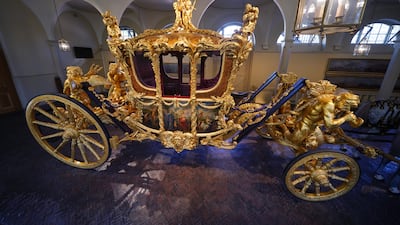
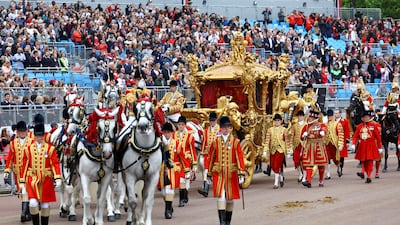
  • King Charles III and Queen Consort Camilla will return from the coronation ceremony in the Gold State Coach. PA
    King Charles III and Queen Consort Camilla will return from the coronation ceremony in the Gold State Coach. PA
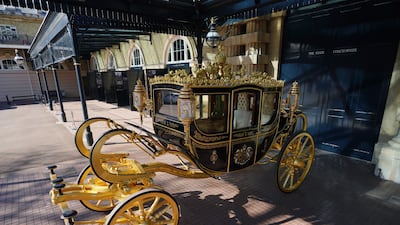
  • The Diamond Jubilee State Coach will take the royal couple to the coronation. PA
    The Diamond Jubilee State Coach will take the royal couple to the coronation. PA
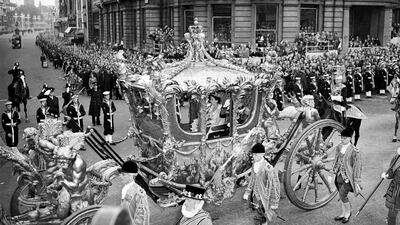
  • Queen Elizabeth II in the Gold State Coach in Trafalgar Square on the way from Buckingham Palace to Westminster Abbey for her coronation in 1953. PA
    Queen Elizabeth II in the Gold State Coach in Trafalgar Square on the way from Buckingham Palace to Westminster Abbey for her coronation in 1953. PA
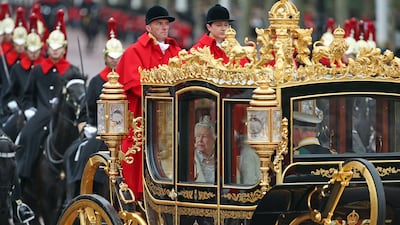
  • Queen Elizabeth returns to Buckingham Palace in the Diamond Jubilee State Coach after delivering the queen's speech in 2019. PA
    Queen Elizabeth returns to Buckingham Palace in the Diamond Jubilee State Coach after delivering the queen's speech in 2019. PA
  • The Gold State Coach passes Buckingham Palace during the Platinum Jubilee Pageant in June 2022. PA
    The Gold State Coach passes Buckingham Palace during the Platinum Jubilee Pageant in June 2022. PA
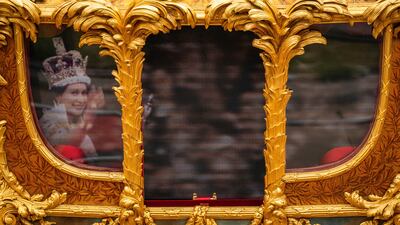
  • A hologram of Queen Elizabeth on the windows of the Gold State Coach during the Platinum Jubilee Pageant in June 2022. AP
    A hologram of Queen Elizabeth on the windows of the Gold State Coach during the Platinum Jubilee Pageant in June 2022. AP
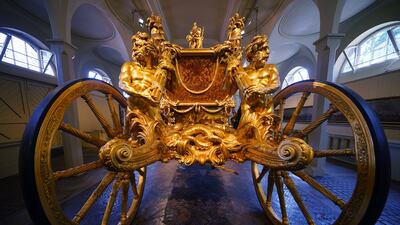
  • The Gold State Coach on display at the Royal Mews in Buckingham Palace. PA
    The Gold State Coach on display at the Royal Mews in Buckingham Palace. PA
  • A painting on the side of the Gold State Coach. PA
    A painting on the side of the Gold State Coach. PA
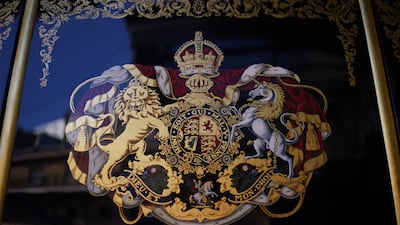
  • A coat of arms on the Diamond Jubilee State Coach. PA
    A coat of arms on the Diamond Jubilee State Coach. PA
  • Detail from a door panel in the Diamond Jubilee State Coach. PA
    Detail from a door panel in the Diamond Jubilee State Coach. PA
  • Detail from the Diamond Jubilee State Coach. PA
    Detail from the Diamond Jubilee State Coach. PA
U19 WORLD CUP, WEST INDIES

UAE group fixtures (all in St Kitts)

  • Saturday 15 January: UAE beat Canada by 49 runs 
  • Thursday 20 January: v England 
  • Saturday 22 January: v Bangladesh 

UAE squad:

Alishan Sharafu (captain), Shival Bawa, Jash Giyanani, Sailles
Jaishankar, Nilansh Keswani, Aayan Khan, Punya Mehra, Ali Naseer, Ronak Panoly,
Dhruv Parashar, Vinayak Raghavan, Soorya Sathish, Aryansh Sharma, Adithya
Shetty, Kai Smith  

Timeline

2012-2015

The company offers payments/bribes to win key contracts in the Middle East

May 2017

The UK SFO officially opens investigation into Petrofac’s use of agents, corruption, and potential bribery to secure contracts

September 2021

Petrofac pleads guilty to seven counts of failing to prevent bribery under the UK Bribery Act

October 2021

Court fines Petrofac £77 million for bribery. Former executive receives a two-year suspended sentence 

December 2024

Petrofac enters into comprehensive restructuring to strengthen the financial position of the group

May 2025

The High Court of England and Wales approves the company’s restructuring plan

July 2025

The Court of Appeal issues a judgment challenging parts of the restructuring plan

August 2025

Petrofac issues a business update to execute the restructuring and confirms it will appeal the Court of Appeal decision

October 2025

Petrofac loses a major TenneT offshore wind contract worth €13 billion. Holding company files for administration in the UK. Petrofac delisted from the London Stock Exchange

November 2025

180 Petrofac employees laid off in the UAE

If you go…

Emirates launched a new daily service to Mexico City this week, flying via Barcelona from Dh3,995.

Emirati citizens are among 67 nationalities who do not require a visa to Mexico. Entry is granted on arrival for stays of up to 180 days. 

Groom and Two Brides

Director: Elie Semaan

Starring: Abdullah Boushehri, Laila Abdallah, Lulwa Almulla

Rating: 3/5

Most%20polluted%20cities%20in%20the%20Middle%20East
%3Cp%3E1.%20Baghdad%2C%20Iraq%3Cbr%3E2.%20Manama%2C%20Bahrain%3Cbr%3E3.%20Dhahran%2C%20Saudi%20Arabia%3Cbr%3E4.%20Kuwait%20City%2C%20Kuwait%3Cbr%3E5.%20Ras%20Al%20Khaimah%2C%20UAE%3Cbr%3E6.%20Ash%20Shihaniyah%2C%20Qatar%3Cbr%3E7.%20Abu%20Dhabi%2C%20UAE%3Cbr%3E8.%20Cairo%2C%20Egypt%3Cbr%3E9.%20Riyadh%2C%20Saudi%20Arabia%3Cbr%3E10.%20Dubai%2C%20UAE%3C%2Fp%3E%0A%3Cp%3E%3Cem%3ESource%3A%202022%20World%20Air%20Quality%20Report%3C%2Fem%3E%3C%2Fp%3E%0A
MOST%20POLLUTED%20COUNTRIES%20IN%20THE%20WORLD
%3Cp%3E1.%20Chad%3Cbr%3E2.%20Iraq%3Cbr%3E3.%20Pakistan%3Cbr%3E4.%20Bahrain%3Cbr%3E5.%20Bangladesh%3Cbr%3E6.%20Burkina%20Faso%3Cbr%3E7.%20Kuwait%3Cbr%3E8.%20India%3Cbr%3E9.%20Egypt%3Cbr%3E10.%20Tajikistan%3Cbr%3E%3Cbr%3E%3Cem%3ESource%3A%202022%20World%20Air%20Quality%20Report%3C%2Fem%3E%3C%2Fp%3E%0A
2017%20RESULTS%3A%20FRENCH%20VOTERS%20IN%20UK
%3Cp%3E%3Cstrong%3EFirst%20round%3C%2Fstrong%3E%3Cbr%3EEmmanuel%20Macron%3A%2051.1%25%3Cbr%3EFrancois%20Fillon%3A%2024.2%25%3Cbr%3EJean-Luc%20Melenchon%3A%2011.8%25%3Cbr%3EBenoit%20Hamon%3A%207.0%25%3Cbr%3EMarine%20Le%20Pen%3A%202.9%25%3Cbr%3E%3Cbr%3E%3Cstrong%3ESecond%20round%3C%2Fstrong%3E%3Cbr%3EEmmanuel%20Macron%3A%2095.1%25%3Cbr%3EMarine%20Le%20Pen%3A%204.9%25%26nbsp%3B%3C%2Fp%3E%0A
The biog

Favourite book: Animal Farm by George Orwell

Favourite music: Classical

Hobbies: Reading and writing


Results

Men's finals

45kg:Duc Le Hoang (VIE) beat Zolfi Amirhossein (IRI) points 29-28. 48kg: Naruephon Chittra (THA) beat Joseph Vanlalhruaia (IND) TKO round 2.

51kg: Sakchai Chamchit (THA) beat Salam Al Suwaid (IRQ) TKO round 1. ​​​​​​​54kg: Veerasak Senanue (THA) beat Huynh Hoang Phi (VIE) 30-25.

57kg: Almaz Sarsembekov (KAZ) beat Tak Chuen Suen (MAC) RSC round 3. 60kg: Yerkanat Ospan (KAZ) beat Ibrahim Bilal (UAE) 30-27.

63.5kg: Abil Galiyev (KAZ) beat Nouredine Samir (UAE) 29-28. 67kg: Narin Wonglakhon (THA) beat Mohammed Mardi (UAE) 29-28.

71kg: Amine El Moatassime (UAE) w/o Shaker Al Tekreeti (IRQ). 75kg:​​​​​​​ Youssef Abboud (LBN) w/o Ayoob Saki (IRI).

81kg: Ilyass Habibali (UAE) beat Khaled Tarraf (LBN) 29-28. 86kg: Ali Takaloo (IRI) beat Emil Umayev (KAZ) 30-27.

91kg: Hamid Reza Kordabadi (IRI) beat Mohamad Osaily (LBN) RSC round 1. 91-plus kg: Mohammadrezapoor Shirmohammad (IRI) beat Abdulla Hasan (IRQ) 30-27.

Women's finals

45kg: Somruethai Siripathum (THA) beat Ha Huu Huynh (VIE) 30-27. 48kg: Thanawan Thongduang (THA) beat Colleen Saddi (PHI) 30-27.

51kg: Wansawang Srila Or (THA) beat Thuy Phuong Trieu (VIE) 29-28. 54kg: Ruchira Wongsriwo (THA) beat Zeinab Khatoun (LBN) 30-26.

57kg: Sara Idriss (LBN) beat Zahra Nasiri Bargh (IRI) 30-27. 60kg: Kaewrudee Kamtakrapoom (THA) beat Sedigheh Hajivand (IRI) TKO round 2.

63.5kg: Nadiya Moghaddam (IRI) w/o Reem Al Issa (JOR).

WHY%20AAYAN%20IS%20'PERFECT%20EXAMPLE'
%3Cp%3EDavid%20White%20might%20be%20new%20to%20the%20country%2C%20but%20he%20has%20clearly%20already%20built%20up%20an%20affinity%20with%20the%20place.%3Cbr%3E%3Cbr%3EAfter%20the%20UAE%20shocked%20Pakistan%20in%20the%20semi-final%20of%20the%20Under%2019%20Asia%20Cup%20last%20month%2C%20White%20was%20hugged%20on%20the%20field%20by%20Aayan%20Khan%2C%20the%20team%E2%80%99s%20captain.%3Cbr%3E%3Cbr%3EWhite%20suggests%20that%20was%20more%20a%20sign%20of%20Aayan%E2%80%99s%20amiability%20than%20anything%20else.%20But%20he%20believes%20the%20young%20all-rounder%2C%20who%20was%20part%20of%20the%20winning%20Gulf%20Giants%20team%20last%20year%2C%20is%20just%20the%20sort%20of%20player%20the%20country%20should%20be%20seeking%20to%20produce%20via%20the%20ILT20.%3Cbr%3E%3Cbr%3E%E2%80%9CHe%20is%20a%20delightful%20young%20man%2C%E2%80%9D%20White%20said.%20%E2%80%9CHe%20played%20in%20the%20competition%20last%20year%20at%2017%2C%20and%20look%20at%20his%20development%20from%20there%20till%20now%2C%20and%20where%20he%20is%20representing%20the%20UAE.%3Cbr%3E%3Cbr%3E%E2%80%9CHe%20was%20influential%20in%20the%20U19%20team%20which%20beat%20Pakistan.%20He%20is%20the%20perfect%20example%20of%20what%20we%20are%20all%20trying%20to%20achieve%20here.%3Cbr%3E%3Cbr%3E%E2%80%9CIt%20is%20about%20the%20development%20of%20players%20who%20are%20going%20to%20represent%20the%20UAE%20and%20go%20on%20to%20help%20make%20UAE%20a%20force%20in%20world%20cricket.%E2%80%9D%C2%A0%3C%2Fp%3E%0A
Ferrari 12Cilindri specs

Engine: naturally aspirated 6.5-liter V12

Power: 819hp

Torque: 678Nm at 7,250rpm

Price: From Dh1,700,000

Available: Now

The specs

Engine: 4.0-litre V8 twin-turbocharged and three electric motors

Power: Combined output 920hp

Torque: 730Nm at 4,000-7,000rpm

Transmission: 8-speed dual-clutch automatic

Fuel consumption: 11.2L/100km

On sale: Now, deliveries expected later in 2025

Price: expected to start at Dh1,432,000

White hydrogen: Naturally occurring hydrogenChromite: Hard, metallic mineral containing iron oxide and chromium oxideUltramafic rocks: Dark-coloured rocks rich in magnesium or iron with very low silica contentOphiolite: A section of the earth’s crust, which is oceanic in nature that has since been uplifted and exposed on landOlivine: A commonly occurring magnesium iron silicate mineral that derives its name for its olive-green yellow-green colour

Updated: May 04, 2023, 11:40 AM