


A station master on duty during Greece’s worst train accident in history will appear before a prosecutor on Thursday to explain how a passenger train was allowed to run on the same line as a freight train for several kilometres.
The two trains collided near a tunnel outside Larissa before midnight on Tuesday. Two carriages were crushed and a third caught fire, trapping people inside, with temperatures in one carriage reaching 1,300°C.
At least 43 people have died and several are still believed to be missing ― including two citizens of Cyprus ― although authorities have not released an official estimate.
Many of the victims were thought to be university students returning after a long holiday weekend. Officials said the death toll was expected to rise.
Seventeen biological samples have been collected from remains, and from 23 relatives seeking a match, the police said.
Protests were held on Wednesday evening at the Thessaloniki train station, the city of Larissa and outside the Athens offices of the railway's Italian-owned operating company, Hellenic Train, where protesters threw rocks at the building and at police.
In Larissa, demonstrators held a silent vigil and brought white roses to form the word Tempe, the name of the valley where the accident took place.
The 59-year-old station master will give evidence on Thursday in the central city of Larissa.
He will be charged with negligent homicide and faces a life sentence if convicted.
Prime Minister Kyriakos Mitsotakis ― who will seek re-election this year with ballots expected in April ― said it was a “terrible train accident without precedent” in Greece, promising that the tragedy would be fully investigated.
“Everything shows that the drama was, sadly, mainly due to a tragic human error,” Mr Mitsotakis said on Wednesday after visiting the disaster site.
US President Joe Biden on Thursday was among the world leaders who offered their condolences following the tragedy.
“On behalf of the American people, [first lady] Jill [Biden] and I send our deepest condolences to the families of the victims who lost their lives in the tragic train accident in Greece,” Mr Biden said on Twitter. “We wish those injured a quick and full recovery.”
Britain's King Charles III also expressed his sadness over the “appalling tragedy”.
Authorities have declared three days of national mourning.
Greece's transport minister submitted his resignation just hours after the accident.
Train crash in Greece — in pictures
-
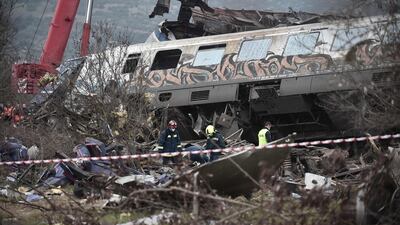
Police and emergency crew search for trapped passengers inside the wreackage. AFP -
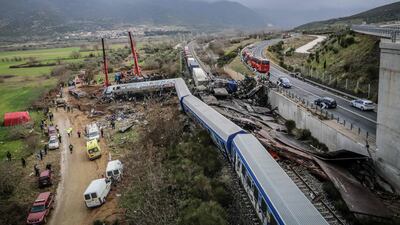
Multiple carriages derailed and a few burst into flames. AFP -
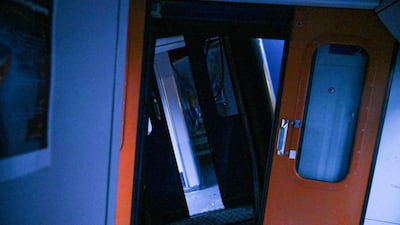
A derailed carriage. AFP -
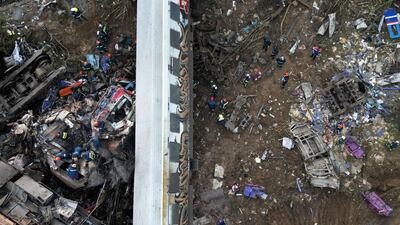
Rescuers and firefighters search the wreckage. AP -
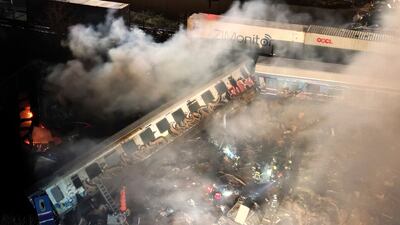
The accident occurred when a passenger train collided with an oncoming freight train. AP -
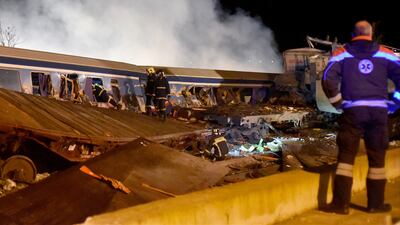
Firefighters work to extricate passengers from derailed train carriages in Greece. EPA -

Smoke rises from derailed carriages. AP -
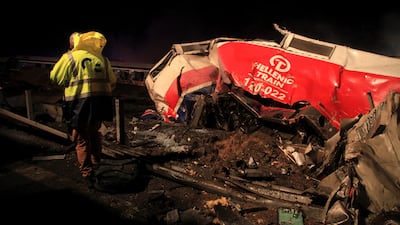
Several carriages were derailed and at least three burst into flames after the trains collided near Tempe. Reuters -
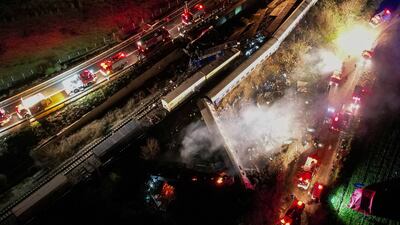
Survivors said several passengers were thrown through the windows of the train carriages due to the impact. Reuters -
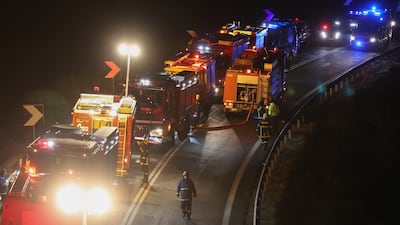
Firefighters and rescuers at the site of the crash. Reuters -

An injured passenger arrives in Thessaloniki, Greece. Reuters -
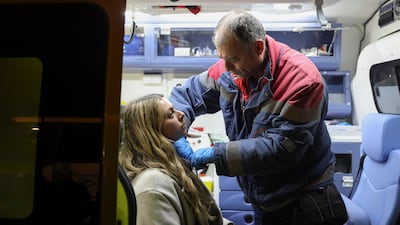
A medic treats a passenger who survived the crash, in Thessaloniki. Reuters -
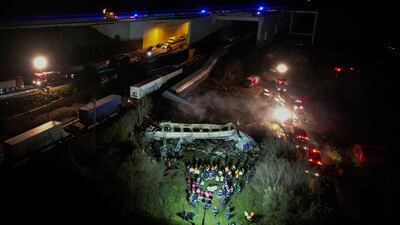
An aerial view of the site of the crash. Reuters -
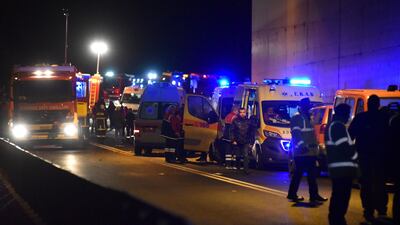
Ambulances line up near the accident scene. EPA


“When something so tragic happens, we cannot continue as if nothing had happened,” Kostas Karamanlis said in a public statement.
But train unionists said the safety shortcomings of the Athens-Thessaloniki railway line had been known for years.
In an open letter last month, train staff said track safety systems were incomplete and poorly maintained.
A safety supervisor resigned last year, warning that infrastructure upgrades pending since 2016 were incomplete and that train speeds of up to 200kph were unsafe.
Five years after Greek rail operator Trainose was sold to Ferrovie Dello Stato Italiane and became Hellenic Train, safety systems on the Athens-Thessaloniki line are still not fully automated.
“It was a student train, full of kids … in their 20s,” Costas Bargiotas, a senior orthopaedic doctor at Larissa General Hospital, told Skai TV.
“It was truly shocking … the carriages crumpled like paper,” he said.
Passengers described scenes of horror and chaos, dodging smashed glass and debris as the train keeled over, and forced to break windows to climb out.
“It was a nightmare. I'm still shaking,” 22-year-old passenger Angelos told AFP. He added that the collision felt “like a strong earthquake”.
Rescuers at the scene said they had never dealt with a disaster of this magnitude before.
Many bodies were charred beyond recognition and some passengers were being identified from body parts.
“Unfortunately, some of these people will only be able to be identified” via DNA, Larissa mayor Apostolos Kalogiannis told Skai TV.

“I've never seen anything like this in my entire life,” said one rescue worker, emerging from the wreckage.
Pavlos Aslanidis, whose son and a friend are among the missing, said “it was the train of terror”.
Rescuers were forced to call off the search late on Wednesday to give exhausted crews and crane operators a respite.

