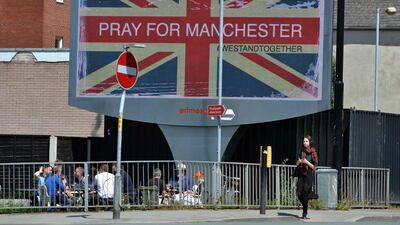
An electronic advertising board close to Manchester Arena on May 23, 2017, a day after the attack. PA

Manchester Bombing inquiry: MI5 missed 'significant' opportunity to prevent attack


Gillian Duncan
  • English
  • Arabic

Britain's MI5 security service missed “significant” opportunities which may have prevented a deadly suicide bombing at the end of a concert in Manchester, an inquiry into the attack concluded on Thursday.

That included a “failure” by an officer of the domestic counter-intelligence and security agency to act fast enough once information came in that could have led to bomber Salman Abedi being interrogated days before he carried out the attack, or led to the discovery of explosives hidden in his car. The nature of that intelligence was not disclosed.

Chairman Sir John Saunders said it was “risky” for the security services to focus on the terrorism threat from ISIS in Syria at the time and ignore the danger posed by groups in Libya in 2017.

Abedi, who had connections to ISIS and Al Qaeda terrorists and fought alongside extremists in Libya, frequently come on the radar of security services and counter-terrorism police.

Sir John also found that Abedi, who was from Manchester but of Libyan descent, probably received help to plot the attack from someone in Libya and said his family bore “significant responsibility” for his extreme views. His radicalisation was driven by “noxious absences and malign presences”, he said.

Inspired by ISIS group, Abedi blew himself up amid crowds of mostly young people who had been attending the concert by American pop star Ariana Grande.

Twenty-two people were killed — the youngest aged only eight — and hundreds were injured in the explosion on May 22, 2017, as parents collected their children at the Manchester Arena.

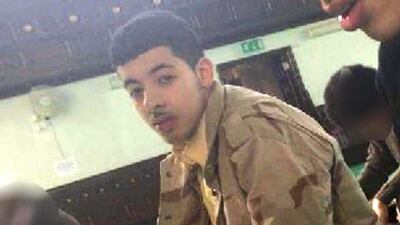
Police photo of Salman Abedi on the night he carried out the attack. PA

“There was a significant missed opportunity to take action that might have prevented the attack,” Sir John said in his third and final report on the bombing, the deadliest in Britain since the 2005 London transport attacks.

“It is not possible to reach any conclusion on the balance of probabilities or to any other evidential standard as to whether the attack would have been prevented.”

Summarising his findings before bereaved families gathered at Manchester Hall, and referring to the failure of an officer to immediately write up a report on one of the pieces of intelligence, he said: “Based on everything the [MI5] Security Service knew or should have known, I am satisfied that such an investigative action would have been a proportionate and justified step to take.

“There was a realistic possibility that actionable intelligence could have been obtained which might have led to actions preventing the attack.”

MI5 Director General Ken McCallum said he was “profoundly sorry that MI5 did not prevent the attack” and added: “I deeply regret that such intelligence was not obtained.”

Abedi’s brother, Hashem Abedi, 25, was jailed for life after he was convicted of assisting in the plot. His older brother, Ismail Abedi, to the “horror” of relatives of those murdered, was allowed to flee the UK, avoiding being called as a witness.

Referring to Abedi's radicalisation, Sir John said: “I have concluded that there were a number of contributory factors to Salman Abedi's radicalisation.

“His family background and his parents' extremist views, along with their participation in the struggle in Libya, played a significant part.

“That struggle involved people who were radical violent extremists. During the time Salman Abedi and Hashem Abedi spent in Libya, during which they were probably involved in fighting. They are likely to have come into contact with a number of violent extremists.

“It is likely that those extremists included members of the Islamic State who would be in a position to provide the brothers with expertise in the making of bombs and in carrying out counter surveillance measures.”

Sir John said he was not able to obtain a complete picture of the part the Abedis' family played in their radicalisation nor of what happened while they were in Libya.

“That is because other members of the family, namely their parents and brother, were not willing to give evidence to the inquiry,” he said.

A wall of screens displaying surveillance camera footage at the Counter Terrorism Operations Centre in London. PA

“Salman and Hashem's parents were invited to provide statements but declined to do so. As they are currently out of the jurisdiction, there were no further steps that I could take.

“Ismail Abedi, who was in the country at the time I requested a statement, managed to leave the UK so that he didn't have to provide information which he was in a position to give.

“Whether [or not], if I had succeeded in getting Ismail Abedi into the witness box, he would have assisted the inquiry is very doubtful.”

But while their family hold “significant responsibility” for the brothers’ radicalisation, there is “insufficient evidence” any of them had specific knowledge an attack was being planned, the report states.

He said Didsbury Mosque, which Abedi attended on occasion, was not to blame, although it has not been completely open.

Sir John said: “I consider it unlikely … that Salman Abedi was radicalised at the Didsbury Mosque but some of the evidence given on behalf of the mosque about the association of the Abedi family with the mosque was unsatisfactory.

“It looked as if the Didsbury Mosque was trying to distance itself from the Abedi in a way which I did not accept was accurate.”

Outside their family, the Abedi brothers were also subject to malign influences, the report concluded.

Some of Salman’s friends were involved in drug dealing and crime, leaving him with “almost no close connections or friendships that would tie him to law-abiding society”, the report said.

Photos of the 22 victims of the terror attack during the Ariana Grande concert at the Manchester Arena in May 2017. PA

Richard Scorer, principal lawyer at Slater and Gordon, who represented 11 of the families at the inquiry, said: “Today's report has been deeply painful to read, but also eye opening.

“On the issue of the preventability of this attack, inevitably the report provides less information than we would have wanted.

“But it is now very clear that there was a failure to properly assess key intelligence about Salman Abedi — a failure to put it into proper context, and, most catastrophic of all, a delay in acting on it.

“As a result of these failures, at the very least, a real possibility of preventing this attack was lost. This is a devastating conclusion for us.

“The failures exposed in this report are unacceptable.

“The public are entitled to expect that information of national security importance will be acted on speedily and, crucially, that the system will ensure that this happens. It must do so in the future.”

Sir John said he had looked in detail at the “various occasions” when Abedi could have been referred to Prevent, the UK counter-terror programme.

“I have concluded that he should have been,” he said.

“I heard evidence that his referral was considered at one stage but he was not considered suitable.

“There can be no guarantee that Salman Abedi or Hashem Abedi would have agreed to participate in the Prevent programme.

“I have concluded that there was at least a period during Salman Abedi's journey to violent extremism when he should have been referred.

“It is very hard to say what might then have happened.”

Mr Scorer said it is “clear that Salman Abedi should have been referred to Prevent”.

“It is clear that the education system needs to be more vigilant in picking up signs of radicalisation. It is clear that Didsbury Mosque turned a blind eye to extremism in its midst.

“Sir John's report today contains many lessons; we must heed every one of them and make the necessary changes urgently.”

Speaking outside, Caroline Curry, mother of victim Liam Curry, said the families had not previously received any acknowledgement of failures.

“All we, as families, have asked for from day one is the truth, acknowledgement of failures and a determination to make sure that those failures are fixed,” she said.

“So that next time, because there will be a next time, but hopefully next time there won’t be as many families going through the utter heartbreak we have had to endure for the last five years, nine months, one week and one day.

“We didn’t get that acknowledgement from anyone other than GMFRS [Greater Manchester Fire and Rescue Service], until the chairman’s reports were published.

“Shame on you all.”

Thursday’s third and final report into the terror attack followed two earlier reports.

The first was issued in June 2021 and highlighted a string of “missed opportunities” to identify Abedi as a threat before he walked across the City Room foyer and detonated his shrapnel-laden device.

Sir John’s second report last November delivered scathing criticism of the emergency services response to the bombing.

Security minister Tom Tugendhat said the government, security services and emergency services were wholly committed to “learning the lessons of this unspeakable tragedy”, while Home Secretary Suella Braverman said: “I am committed to working with MI5, policing and partners to study the recommendations. Together we will do everything possible to prevent a repeat of this horrifying attack.”

Manchester bombing — in pictures

  • A man is stretchered out of Manchester Arena on May 23, 2017 after the explosion. Getty Images
    A man is stretchered out of Manchester Arena on May 23, 2017 after the explosion. Getty Images
  • Helpers tend to people inside the Manchester Arena after the bomb attack at the end of an Ariana Grande concert. PA/Getty
    Helpers tend to people inside the Manchester Arena after the bomb attack at the end of an Ariana Grande concert. PA/Getty
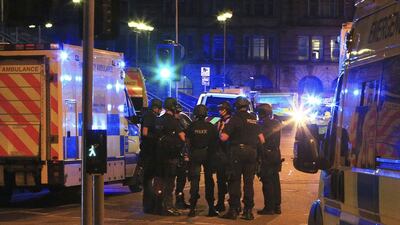
  • Armed police gather at Manchester Arena after the explosion. PA/AP
    Armed police gather at Manchester Arena after the explosion. PA/AP
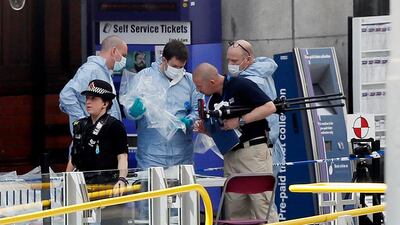
  • Forensic officers investigate the scene near the Manchester Arena. AP
    Forensic officers investigate the scene near the Manchester Arena. AP
  • A woman walks past an electronic advertising board displaying a Union Jack flag and the words 'Pray For Manchester'. AFP
    A woman walks past an electronic advertising board displaying a Union Jack flag and the words 'Pray For Manchester'. AFP
  • Police escort members of the public awawy from the Manchester Arena after the bombing. Getty Images
    Police escort members of the public awawy from the Manchester Arena after the bombing. Getty Images
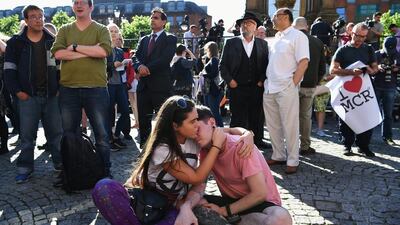
  • A girl cries as she looks at at tributes left in St Anne's Square on the first anniversary of the Manchester Arena bombing. Reuters
    A girl cries as she looks at at tributes left in St Anne's Square on the first anniversary of the Manchester Arena bombing. Reuters
  • A candlelit vigil, to honour the victims in the days after the attack. Getty Images
    A candlelit vigil, to honour the victims in the days after the attack. Getty Images
  • Tributes left in Manchester after the May 22 suicide bomb attack. AFP
    Tributes left in Manchester after the May 22 suicide bomb attack. AFP
  • Suicide bomber Salman Abedi used money from his mother's bank account who continued to claim benefits despite moving to Libya. AFP
    Suicide bomber Salman Abedi used money from his mother's bank account who continued to claim benefits despite moving to Libya. AFP
  • Hashem Abedi had been convicted of 22 counts of murder over the Manchester Arena attack of 2017. EPA
    Hashem Abedi had been convicted of 22 counts of murder over the Manchester Arena attack of 2017. EPA
The rules of the road keeping cyclists safe

Cyclists must wear a helmet, arm and knee pads

Have a white front-light and a back red-light on their bike

They must place a number plate with reflective light to the back of the bike to alert road-users

Avoid carrying weights that could cause the bike to lose balance

They must cycle on designated lanes and areas and ride safe on pavements to avoid bumping into pedestrians

How to avoid crypto fraud
  • Use unique usernames and passwords while enabling multi-factor authentication.
  • Use an offline private key, a physical device that requires manual activation, whenever you access your wallet.
  • Avoid suspicious social media ads promoting fraudulent schemes.
  • Only invest in crypto projects that you fully understand.
  • Critically assess whether a project’s promises or returns seem too good to be true.
  • Only use reputable platforms that have a track record of strong regulatory compliance.
  • Store funds in hardware wallets as opposed to online exchanges.


HER%20FIRST%20PALESTINIAN
%3Cp%3EAuthor%3A%20Saeed%20Teebi%3C%2Fp%3E%0A%3Cp%3EPages%3A%20256%3C%2Fp%3E%0A%3Cp%3EPublisher%3A%C2%A0House%20of%20Anansi%20Press%3C%2Fp%3E%0A
Four tips to secure IoT networks

Mohammed Abukhater, vice president at FireEye in the Middle East, said:

- Keep device software up-to-date. Most come with basic operating system, so users should ensure that they always have the latest version

- Besides a strong password, use two-step authentication. There should be a second log-in step like adding a code sent to your mobile number

- Usually smart devices come with many unnecessary features. Users should lock those features that are not required or used frequently

- Always create a different guest network for visitors

Mercer, the investment consulting arm of US services company Marsh & McLennan, expects its wealth division to at least double its assets under management (AUM) in the Middle East as wealth in the region continues to grow despite economic headwinds, a company official said.

Mercer Wealth, which globally has $160 billion in AUM, plans to boost its AUM in the region to $2-$3bn in the next 2-3 years from the present $1bn, said Yasir AbuShaban, a Dubai-based principal with Mercer Wealth.

Within the next two to three years, we are looking at reaching $2 to $3 billion as a conservative estimate and we do see an opportunity to do so,” said Mr AbuShaban.

Mercer does not directly make investments, but allocates clients’ money they have discretion to, to professional asset managers. They also provide advice to clients.

“We have buying power. We can negotiate on their (client’s) behalf with asset managers to provide them lower fees than they otherwise would have to get on their own,” he added.

Mercer Wealth’s clients include sovereign wealth funds, family offices, and insurance companies among others.

From its office in Dubai, Mercer also looks after Africa, India and Turkey, where they also see opportunity for growth.

Wealth creation in Middle East and Africa (MEA) grew 8.5 per cent to $8.1 trillion last year from $7.5tn in 2015, higher than last year’s global average of 6 per cent and the second-highest growth in a region after Asia-Pacific which grew 9.9 per cent, according to consultancy Boston Consulting Group (BCG). In the region, where wealth grew just 1.9 per cent in 2015 compared with 2014, a pickup in oil prices has helped in wealth generation.

BCG is forecasting MEA wealth will rise to $12tn by 2021, growing at an annual average of 8 per cent.

Drivers of wealth generation in the region will be split evenly between new wealth creation and growth of performance of existing assets, according to BCG.

Another general trend in the region is clients’ looking for a comprehensive approach to investing, according to Mr AbuShaban.

“Institutional investors or some of the families are seeing a slowdown in the available capital they have to invest and in that sense they are looking at optimizing the way they manage their portfolios and making sure they are not investing haphazardly and different parts of their investment are working together,” said Mr AbuShaban.

Some clients also have a higher appetite for risk, given the low interest-rate environment that does not provide enough yield for some institutional investors. These clients are keen to invest in illiquid assets, such as private equity and infrastructure.

“What we have seen is a desire for higher returns in what has been a low-return environment specifically in various fixed income or bonds,” he said.

“In this environment, we have seen a de facto increase in the risk that clients are taking in things like illiquid investments, private equity investments, infrastructure and private debt, those kind of investments were higher illiquidity results in incrementally higher returns.”

The Abu Dhabi Investment Authority, one of the largest sovereign wealth funds, said in its 2016 report that has gradually increased its exposure in direct private equity and private credit transactions, mainly in Asian markets and especially in China and India. The authority’s private equity department focused on structured equities owing to “their defensive characteristics.”

TUESDAY'S ORDER OF PLAY

Centre Court

Starting at 2pm:

Elina Svitolina (UKR) [3] v Jennifer Brady (USA)

Anastasia Pavlyuchenkova (RUS) v Belinda Bencic (SUI [4]

Not before 7pm:

Sofia Kenin (USA) [5] v Elena Rybakina (KAZ)

Maria Sakkari (GRE) v Aryna Sabalenka (BLR) [7]


Court One

Starting at midday:

Karolina Muchova (CZE) v Katerina Siniakova (CZE)

Kristina Mladenovic (FRA) v Aliaksandra Sasnovich (BLR)

Veronika Kudermetova (RUS) v Dayana Yastermska (UKR)

Petra Martic (CRO) [8] v Su-Wei Hsieh (TPE)

Sorana Cirstea (ROU) v Anett Kontaveit (EST)

Results

5pm: Maiden (PA) Dh80,000 (Turf) 1,200m, Winner: ES Rubban, Antonio Fresu (jockey), Ibrahim Aseel (trainer)

5.30pm: Handicap (PA) Dh85,000 (T) 1,200m, Winner: Al Mobher, Sczcepan Mazur, Ibrahim Al Hadhrami

6pm: Handicap (PA) Dh80,000 (T) 2,200m, Winner: Jabalini, Tadhg O’Shea, Ibrahim Al Hadhrami

6.30pm: Wathba Stallions Cup (PA) Dh70,000 (T) 2,200m, Winner: AF Abahe, Tadgh O’Shea, Ernst Oertel

7pm: Handicap (PA) Dh85,000 (T) 1,600m, Winner: AF Makerah, Tadhg O’Shea, Ernst Oertel

7.30pm: Maiden (TB) Dh80,000 (T) 1,600m, Winner: Law Of Peace, Tadhg O’Shea, Satish Seemar

PROFILE

Name: Enhance Fitness 

Year started: 2018 

Based: UAE 

Employees: 200 

Amount raised: $3m 

Investors: Global Ventures and angel investors 

Mia Man’s tips for fermentation

- Start with a simple recipe such as yogurt or sauerkraut

- Keep your hands and kitchen tools clean. Sanitize knives, cutting boards, tongs and storage jars with boiling water before you start.

- Mold is bad: the colour pink is a sign of mold. If yogurt turns pink as it ferments, you need to discard it and start again. For kraut, if you remove the top leaves and see any sign of mold, you should discard the batch.

- Always use clean, closed, airtight lids and containers such as mason jars when fermenting yogurt and kraut. Keep the lid closed to prevent insects and contaminants from getting in.


Name: Peter Dicce

Title: Assistant dean of students and director of athletics

Favourite sport: soccer

Favourite team: Bayern Munich

Favourite player: Franz Beckenbauer

Favourite activity in Abu Dhabi: scuba diving in the Northern Emirates 


The President's Cake

Director: Hasan Hadi

Starring: Baneen Ahmad Nayyef, Waheed Thabet Khreibat, Sajad Mohamad Qasem 

Rating: 4/5

Libya's Gold

UN Panel of Experts found regime secretly sold a fifth of the country's gold reserves. 

The panel’s 2017 report followed a trail to West Africa where large sums of cash and gold were hidden by Abdullah Al Senussi, Qaddafi’s former intelligence chief, in 2011.

Cases filled with cash that was said to amount to $560m in 100 dollar notes, that was kept by a group of Libyans in Ouagadougou, Burkina Faso.

A second stash was said to have been held in Accra, Ghana, inside boxes at the local offices of an international human rights organisation based in France.

Porsche Taycan Turbo specs

Engine: Two permanent-magnet synchronous AC motors

Transmission: two-speed

Power: 671hp

Torque: 1050Nm

Range: 450km

Price: Dh601,800

On sale: now

The specs

Engine: 1.6-litre 4-cyl turbo and dual electric motors

Power: 300hp at 6,000rpm

Torque: 520Nm at 1,500-3,000rpm

Transmission: 8-speed auto

Fuel consumption: 8.0L/100km

Price: from Dh199,900

On sale: now

The specs: 2018 Dodge Durango SRT

Price, base / as tested: Dh259,000

Engine: 6.4-litre V8

Power: 475hp @ 6,000rpm

Torque: 640Nm @ 4,300rpm

Transmission: Eight-speed automatic

Fuel consumption, combined: 7.7L / 100km

Updated: March 02, 2023, 4:30 PM