


Part of a major exhibition celebrating the 200th anniversary of when a French scholar cracked the code of the Egyptian hieroglyphs is to go on tour in the UK in March.
Hieroglyphs: Unlocking Ancient Egypt, on show at the British Museum in London, will come to a close on February 19 after a run of three months, having attracted more than 128,000 visitors.
The main exhibition features 240 objects, including the Rosetta Stone, which was taken off the main floor of the museum for the paid show.
A small sample of objects – but not the Rosetta Stone – will go on a year-long tour to three institutions in Hull, Lisburn and Torquay, said Ilona Regulski, curator of Egyptian written culture at the British Museum.
“The spotlight tour is often done after a big exhibition as a kind of legacy to share the story with other institutions,” she said.
“Because we only have 10 objects, the story is focusing a little bit more on how we understand ancient Egypt now so much more.”
The touring objects will include a small statue featuring a feast list and festivals celebrated at the beginning of the year.
'Hieroglyphs: unlocking ancient Egypt' exhibition - in pictures
-

A British Museum employee poses next to the Rosetta Stone ahead of the 'Hieroglyphs: unlocking ancient Egypt' exhibition that is set to be held at the museum in London. EPA -

The exhibition explores how the Rosetta Stone helped academics to decipher Egyptian hieroglyphics in 1822. EPA -

About 240 artefacts will be on display. EPA -
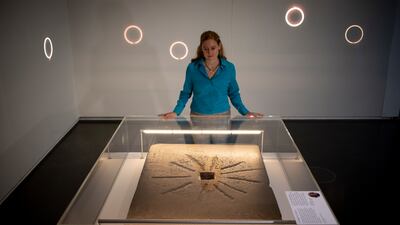
A British Museum employee poses with the Shabaka Stone at the museum. EPA -
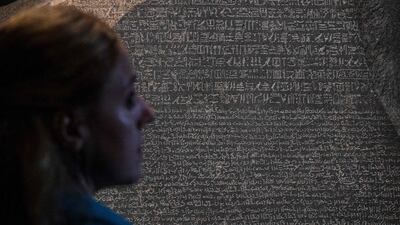
The exhibition runs from Thursday, October 13, 2022, to February 19, 2023. AFP -
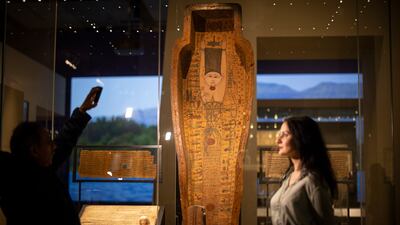
A British Museum employee poses with a wooden coffin lid that dates back to 240 BC. EPA


“We have a papyrus, one of the Book of the Dead, because the afterlife is something visitors can associate with ancient Egypt,” Ms Regulski said.
“We have an ostracon [a piece of pottery used for a note] and a wooden drawing board the scribes used to practise hieroglyphs.
“So we can talk a little bit about education, learning, which I think for their audience is interesting, because their primary audience is families and younger audiences.”
The Rosetta Stone will return to its normal position in the British Museum, where it will again be free for the public to view.
The stone, one of the most famous objects in the British Museum, has a message carved into it in three writing systems — hieroglyphs, the Egyptian demotic script and ancient Greek — which helped scholars to decrypt the hieroglyph pictorial symbols.
The message was copied on to slabs placed in every temple in Egypt.
The Rosetta Stone was found in 1799 near the town of Rosetta, modern day Rashid, in the Nile Delta by soldiers during the French occupation of Egypt.
British Museum Egyptian hieroglyphs exhibition - in pictures
-

An exhibition by the British Museum, scheduled to open to the public on October 13, will mark 200 years since the decipherment of ancient Egyptian hieroglyphs. Photo: The Trustees of the British Museum -

The Rosetta Stone provided the key to decoding hieroglyphs and expanding modern knowledge of Egypt’s history. Photo: The Trustees of the British Museum -

The temple lintel of Amenemhat III, a pharoah from ancient Egypt and the sixth king of the 12th Dynasty of the Middle Kingdom of Egypt. Photo: The Trustees of the British Museum -

The exhibition will feature 'The Enchanted Basin', a large black granite sarcophagus covered with hieroglyphs from about 600 BC. The hieroglyphs were believed to have magical powers, and bathing in the basin was expected to offer relief from the torments of love. Photo: Trustees of the British Museum -

The outer coffin containing the mummified remains of a woman called Baktenhor, who lived between 1070 and 713 BC in Thebes, now called Luxor. Photo: The Trustees of the British Museum -

An image of Dr Thomas Young (1773-1829) on a copper medal. Young was instrumental in the decipherment of Egyptian hieroglyphs, specifically the Rosetta Stone. Photo: The Trustees of the British Museum -
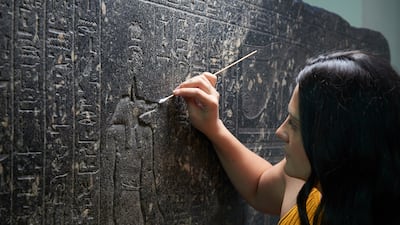
Senior conservator Stephanie Vasiliou cleans ‘The Enchanted Basin’ in preparation for the exhibition. Photo: The Trustees of the British Museum -

The mummy bandage of Aberuait from the Ptolemaic period, which has never been displayed in the UK, will also be on show. Photo: Musee du Louvre -

A 19th century portrait of Jean-François Champollion (1790–1832). Champollion was able to decipher the hieroglyphs through the oval shapes found in the hieroglyphic text, which are known as Kharratis and include the names of kings and queens. Photo: Musee Champollion -

Ms Vasiliou and conservation student Shoun Obana clean ‘The Enchanted Basin’. The reused ritual bath was discovered near a mosque in Cairo. Photo: The Trustees of the British Museum -
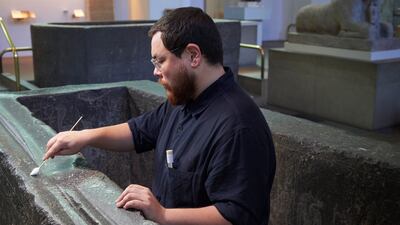
Mr Obana cleans ‘The Enchanted Basin’, which was later identified as the sarcophagus of Hapmen, a nobleman of the 26th Dynasty. Photo: The Trustees of the British Museum -

The limestone statue of a scribe dating back to ancient Egypt's Sixth Dynasty will also be on display. Photo: Musee du Louvre -

Queen Nedjmet's 3,000-year-old 'Book of the Dead' will feature alongside a set of canopic vessels that preserved the organs of the deceased. Photo: The Trustees of the British Museum -
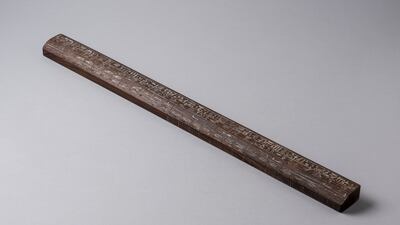
A royal cubit rod belonging to Amenemope, a scribe from ancient Egypt. The exhibition explores the inscriptions and objects that helped academics unlock an 'ancient civilisation' two centuries ago. -
Visitors looking at the Rosetta Stone. Photo: The Trustees of the British Museum -
Installation of an amulet in front of The Book of the Dead. Photo: The Trustees of the British Museum -
A visitor views Egyptian sculptures of cats. Photo: The Trustees of the British Museum


It later became the property of the British under the terms of the Treaty of Alexandria, following Napoleon's defeat in 1801.
It was shipped to England the following year and presented to the British Museum by King George III.
“We, of course, talked a lot about whether we could take it off permanent display [for the exhibition], but we couldn’t tell the story of decipherment without the Rosetta Stone,” Ms Regulski said.
“It was an opportunity for us to elaborate a little bit of the story of the Rosetta Stone.
“So that was certainly the highlight and at the heart of the show. The exhibition is organised in one line, so you can see the Rosetta Stone from anywhere, from any spot.”
She said it was wonderful to see so many visitors engaging with the story of ancient Egypt and decipherment.
“Whenever I go into the exhibition, I see so many visitors reading the labels, looking at the objects and not just looking around but really engaging with the story," she said.
The spotlight tour will visit Hull’s Ferens Art Gallery from March 17 to June 18, before moving to the Irish Linen Centre and Lisburn Museum in Northern Ireland from June 28 to October 12.
The final destination will be Torquay Museum in Devon from October 21 to February 18, 2024.
An Egyptian-led petition to have the stone returned to the country recently attracted more than 100,000 supporters.

