


Water bills in England and Wales are set to rise to an average £448 ($555) a year as households see the largest increase to their water charges in almost 20 years from April.
The 7.5 per cent increase would see customers pay about £1.23 a day on average — an increase of 8p a day or an average £31 more on last year’s charges, figures from industry body Water UK show.
The rise could prove the tipping point for the one in five customers already struggling to pay, consumer groups warn.
But Water UK said water bills remained lower in real terms than they were a decade ago and this year’s increase reflected higher energy costs, with water companies using about 2 per cent of the nation’s electricity.
Companies were set to invest another £70 billion to “eliminate harm” from storm overflows and increase water supplies by building reservoirs and national water transfer schemes, it said.
Water UK said it was “acutely aware of the impact of price rises on lower-income and vulnerable customers” and recently increased the level of support they offered by more than £200 million.
“With an average increase of around 60p a week, most customers will again see a below-inflation increase in their water bill," said Water UK director of policy Stuart Colville.
"However, we know that any increase is unwelcome, particularly at the moment.
“That is why companies are also releasing an extra £200 million to help those that may be struggling.
“Anyone with worries should contact their water company or go to supportontap.org for advice, and it’s worth remembering that water companies will never cut anyone off, or make them use a prepayment meter.
“Next year’s bills will support what is already the highest level of investment on record, with a further £70 billion set to be spent over coming years on building new reservoirs and ending overflows into rivers.”
Inflation around the world - in pictures
-
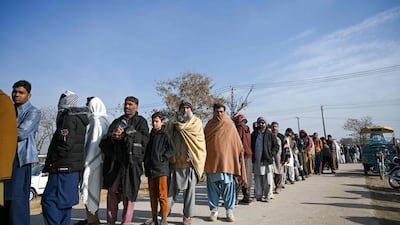
People queue to buy wheat flour at government-controlled prices in Islamabad. Pakistan's economy has been hit hard by a political crisis, as well as devastating floods and the global energy crisis, with the rupee plummeting and inflation at decades-high levels. AFP -
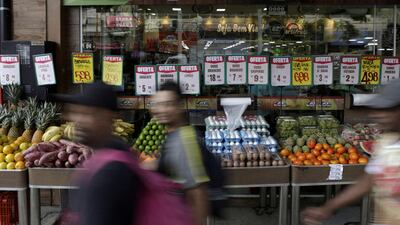
A market in Rio de Janeiro. Brazil's inflation ended 2022 with a sharp slowdown from double-digit peaks seen throughout the year. Reuters -
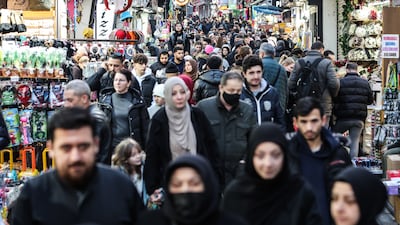
A market in Istanbul. Turkey's inflation at the end of 2022 stood at 64. 27 per cent, the country's Statistical Institute said, while the independent group of inflation researchers ENAG calculated it at 137. 55 per cent. EPA -
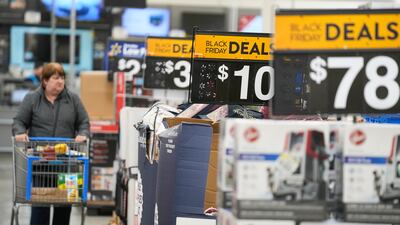
A Walmart in New Jersey. According to a poll, US Republicans and Democrats have distinct views of what’s most important for the government to address amid high inflation. More Republicans name gas and food prices, energy and immigration, while Democrats focus on health care, climate change and poverty. AP -
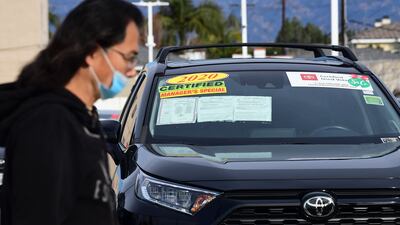
A used car sales lot in California. US Federal Reserve officials have indicated it’s possibly too early to declare victory over inflation. AFP -
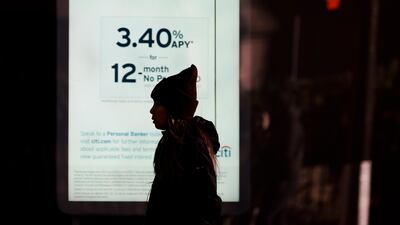
A person walks by a sign showing interest rates at a bank in New York. EPA -
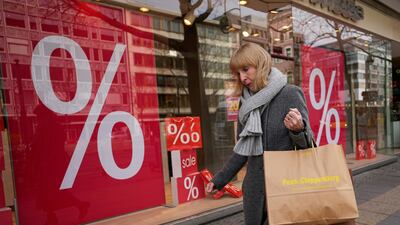
A woman walks with purchases past a store in Berlin. In December, consumer price growth across the Euro zone slowed to 9.2 per cent from 10.1 per cent a month earlier, Eurostat data showed last week. AP -
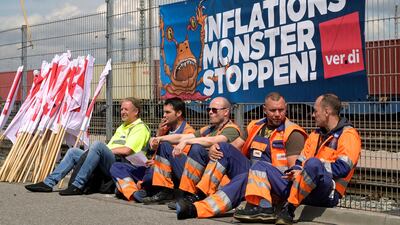
Workers sit in front of a banner reading "Stop the Inflation Monster" at the Burchardkai Container Terminal as they go on strike for higher wages at the harbour in Hamburg, Germany. Reuters -
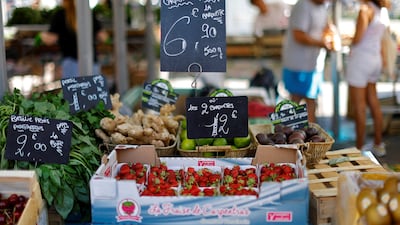
Price tags at a market in Nice, France. Reuters -
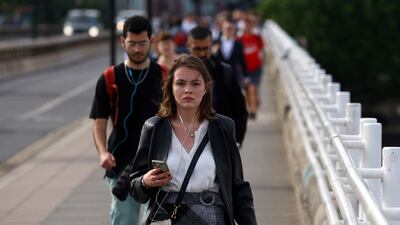
Commuters cross Waterloo Bridge in London. The British Retail Consortium said spending in store chains rose by 6.9 per cent in annual terms in December, but this was a long way off consumer price inflation, which hit 10.7 per cent in November. Reuters -

Jobseekers in Johannesburg. South Africa’s governing party wants the central bank’s mandate broadened to shore up the economy and promote employment in addition to its existing task of tackling inflation. Reuters -

Social grant recipients stand in a queue outside a post office, as joblessness takes its toll in Meadowlands, South Africa. Reuters


The Consumer Council for Water said regional variations and factors such as whether a customer is on a meter and how much water they use meant some households could face rises significantly above — or below — the average.
And it said the postcode lottery of social tariff schemes meant many customers who could not afford their bill “slip through the net”.
“Water is essential for all of us so no one should be worried about being able to afford their bill," said CCW chief executive Emma Clancy.
"These increases will bring more uncertainty to struggling households at a time when they can’t be certain they will get the help they need.
“Low-income households need immediate relief and the long-term security of knowing their water bill will be affordable.
“It’s not fair that struggling households face a postcode lottery when it comes to getting help with their bill.
"That’s why we urgently need a new water affordability scheme that provides consistent support based on people’s needs.”
UK Chancellor says 'best tax cut right now is a cut in inflation' - video
Jess Cook, water poverty lead at National Energy Action, said: “Social tariffs are essential for low-income households
"Discounted water bills for those struggling to pay can stop the most vulnerable from cutting back or running up debt when they can ill afford to do so.
“But the current postcode lottery means where you live affects what you pay and what support you receive, and the Secretary of State [for Environment, Food and Rural Affairs], Therese Coffey, has suggested that fixing this is not one of her top priorities.
“With water bills rising 7.5 per cent on average during this cost-of-living crisis, it’s more vital than ever that access to a social tariff should be made fairer, more consistent, and accessible to everyone who needs it, regardless of where they live.”
What is a recession? - video
Ofwat chief executive David Black said: “We know times are tough and customers who are already struggling will be worried if they see their water bill increase, so companies should be doubling down to support those who need a helping hand.
“Kind words don’t mean anything unless they are backed up by action, which is why we were pleased to see the recent increase in support.”
The announcement of higher water bills comes as the Which? Consumer Insight Tracker reports that about 2.3 million UK households missed an essential payment last month, up from 1.9 million in December.
But the figure for January — when missed payments for mortgage, rent, loans, credit cards and other bills typically peak — is similar to those from the past two years, according to Which?
The monthly poll of about 2,000 people found that six in 10 (59 per cent) made at least one financial adjustment, such as cutting back on essentials, selling items, or dipping into savings in the past month to cover essential spending.
It was a significant increase on the 49 per cent last January, but lower than the peak of 65 per cent who made adjustments in September.
How to prepare for a recession - video
The number of households cutting back on essentials such as utility bills, housing costs, groceries, school supplies and medicine has increased by 11 percentage points from three in 10 (27 per cent) last January to four in 10 (38 per cent) this January.
“With 2.3 million UK households missing payments in January and those on the lowest incomes being hit hardest, consumers will need more support than ever in 2023," said Rocio Concha, Which? director of policy and advocacy.
“As the cost-of-living crisis continues to bite into household finances, we are calling on businesses in essential sectors, like food, energy and broadband providers, to do more to help customers get a good deal and avoid unnecessary or unfair costs and charges.”
The Consumer Insight Tracker is an online poll carried out monthly by Yonder on behalf of Which?, with about 2,000 respondents in each wave.

