


Twenty extremist groups are entrenched in Taliban-controlled Afghanistan with eyes on targets abroad, a security expert has said.
In a chilling warning to the international community, Arian Sharifi suggested the landlocked country has become a breeding ground for terrorists looking to establish or re-establish themselves.
It has been 17 months since the Taliban entered Afghanistan’s capital Kabul and took control of the country. They have since implemented policies reminiscent of their brutal rule in the late 1990s, including banning woman from studying at universities and working for aid groups.
After storming back into power, the Taliban promised the West it would not allow the country to serve as a platform for terrorists amid fears foreign groups could use it as a springboard to launch attacks elsewhere.
But Dr Sharifi, a lecturer and associate research scholar at Princeton University in New Jersey, said the landscape today suggests the rulers have failed to live up to their commitment.
He said the task for international leaders now is to decide if they can accept and deal with a Taliban-run government.
“What is really missing and the policy on the part of the international community towards the Taliban is the clarity of policy over whether the world can actually accept and live with a Taliban-run government in Afghanistan,” he told a panel discussion hosted by the Royal United Services Institute in London.
“Can they really accept the potential consequences both to Afghanistan and the region and beyond from a Taliban-run Afghanistan?”
Dr Sharifi outlined two areas which he said should be causes for concern for countries around the globe.
“I did some research and I pinpointed 20 foreign terrorist and violent extremist groups currently in operation in Afghanistan.
“These groups have objectives beyond Afghanistan, not in Afghanistan. So it's only a matter of time to see potentially some [evidence] of that terrorism in the region and beyond.”
He said the presence of such groups in the county also risks serving as inspiration for like-minded organisations in other parts of the world who may be plotting attacks of their own.
Some extremists may even “pick up the trail that was left by Al Qaeda” to wage vicious campaigns to forward their agendas, the security expert noted.
Islamic State Khorasan Province (ISIS-K) has already claimed responsibility for numerous attacks in Afghanistan since the Taliban seized control.
The Haqqani Network, responsible for some of the most high-profile attacks on western interests during the Afghan war, is also growing in influence.
Pakistan's fight against the Taliban — in pictures
-
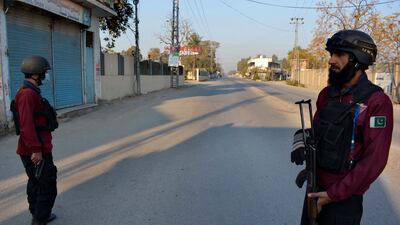
Security officers guard a road leading to a counter-terrorism centre in Bannu, a district in Pakistan's Khyber Pakhtunkhwa province. AP Photo -
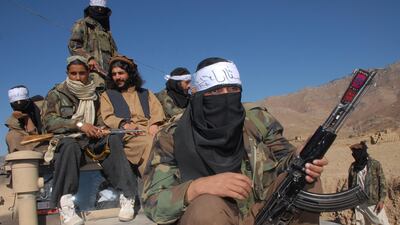
Pakistan's Taliban commander Latif Mehsud, centre, a close aide to the former chief of the Tehreek-e-Taliban Pakistan (TTP), Hakimullah Mehsud, sits on an armed vehicle in Khyber Pakhtunkhwa province. AFP -
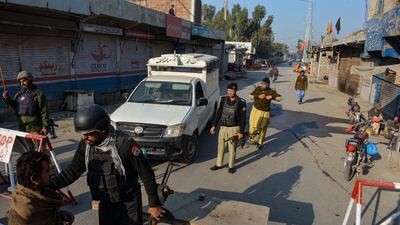
Officers stand guard along a road they blocked after Taliban militants seized a police station in Bannu. AFP -

Soldiers drive towards North Waziristan from Bannu at the start of an offensive against Pakistani Taliban militants in the restive ethnic Pashtun tribal region. Reuters -
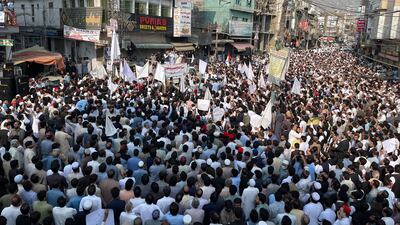
People take part in a protest a day after an attack on a school bus in Mingora, in the Swat District of Khyber Pakhtunkhwa. AFP -

Security officials and relatives attend a funeral ceremony of a slain policeman who was killed in an attack claimed by the TTP in the border town of Chaman. AFP -

Pakistani security officials check identity cards at a roadside check point in Karachi. EPA -

Pakistani security officials in Karachi. EPA -

A Pakistani security official in Karachi. EPA -

Surrendered Taliban militants at a Pakistani military compound in Swat valley on August 20, 2009. AFP -
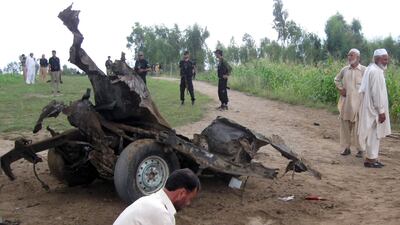
Pakistani security officials at the site of a bomb blast in Jandol town, 100km from the once Taliban-infested Swat Valley on September 16, 2012. AFP -

Armed Pakistani militiamen gather in the former Taliban stronghold area of Puchar in Swat valley on September 14, 2009. AFP -
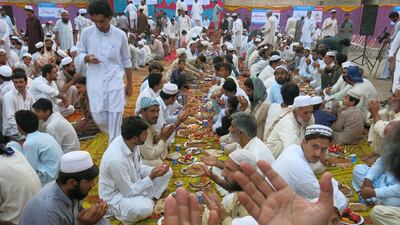
Internally displaced Pakistani civilians pray before breaking their fast during Ramadan in Bannu, northern Pakistan, on July 6, 2014. AFP -
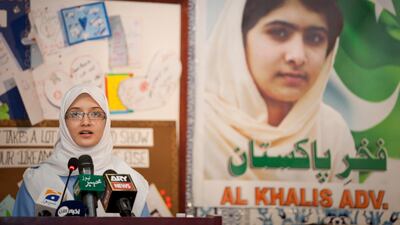
Ayesha Abdul Jalil, 16, speaks at a tribute to Malala Yousufzai, who was shot in the head by the Taliban in the Swat valley, at the Embassy of Pakistan in Abu Dhabi. Razan Alzayani / The National


Secondly, he said world leaders must admit that the main markets for Afghanistan-grown drugs which the Taliban is profiting from are western European nations and North America.
“Can the world really accept that?” he questioned. “Can the world really let the Taliban produce and procure this amount of drugs and send it to their capitals, into their main cities?
The population of 14 million people has been “taken captive” by the Taliban, which is estimated to have about 70,000 members, he said.
“How long can this really continue the way they are dealing with women, the way they're dealing with minorities, the way they're running the country? There is literally no resemblance of a government and what the Taliban are doing.
“So in my view, at the very top strategic level, the world needs to decide what they're going to do with the Taliban.”

